
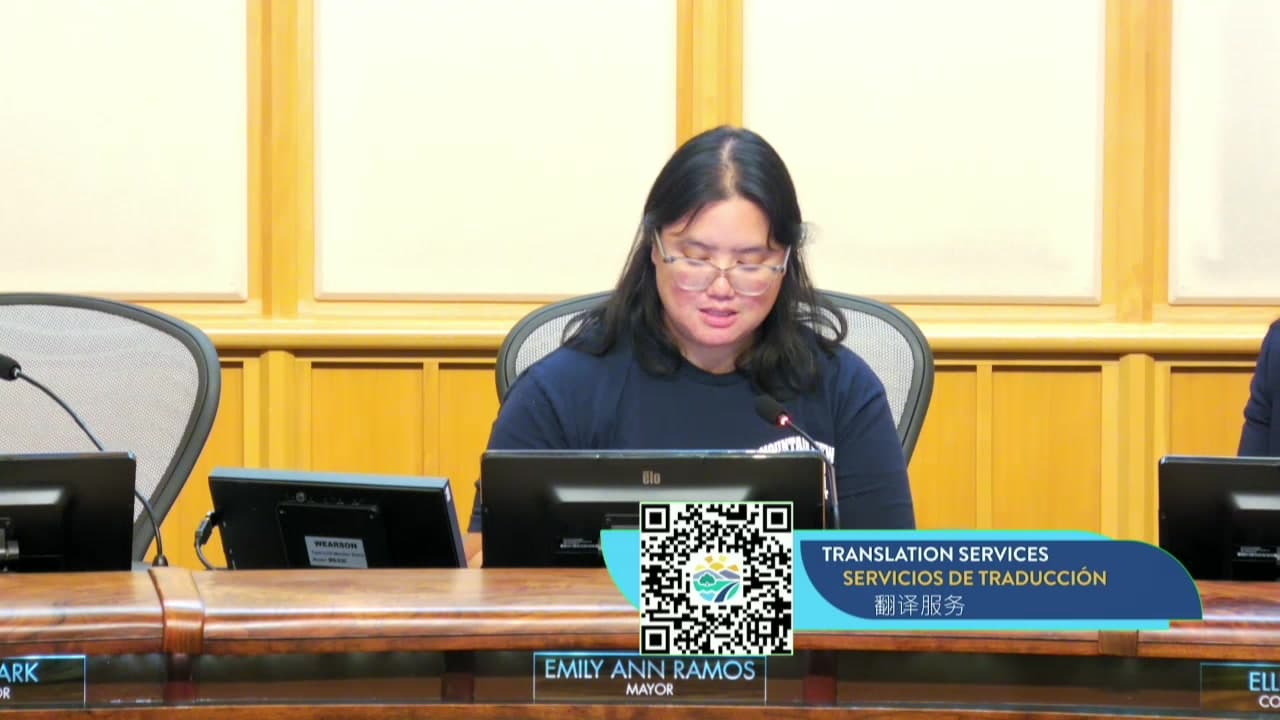
Mountain View Council Unanimously Adopts Public Art Strategy With Pooled Fund
City Council • Mountain ViewOctober 28, 2026
Locunity is an independent informational service and is not an official government page for this commission. All information is sourced from public footage and an analysis of official agendas with the aid of responsible, fact-checked AI. to report an error or omission.
Mountain View is changing how it pays for, places and maintains public art. On Oct. 27, the City Council unanimously adopted a citywide Public Art Strategy that replaces site-bound art spending with a pooled fund and new stewardship rules. Earlier, a routine consent vote on a LinkedIn agreement turned into a pointed exchange over whether parks funding is keeping pace with affordable housing growth.
- Public Art Strategy adopted unanimously, creating a pooled art fund, an updated 5% for art policy and collection maintenance rules
- Council adds mural siting guidelines and wider artist pools to the strategy
- LinkedIn agreement extended five years, with a $1.6M fee going to affordable housing
- Councilmember McAlister presses on parks funding as 1,500 to 1,600 affordable units move through the pipeline
- MidPen says its next bond measure likely comes around 2040; e-bikes stay off most trails
Art Moves From Project Budgets to a Shared Pot
Why it matters: The strategy ends the practice of spending art money only at the capital project that generated it. A new administrator will lead implementation, giving the program dedicated staff for the first time.
The basics: Under a "percent for art" policy, a share of capital project budgets is set aside for art. "Deaccessioning" is the formal process of removing a work from a public collection.
Where things stand: Staff said the strategy grew out of outreach to more than 700 participants. It sets two goals and seven recommendations. These include a dedicated pooled public art fund, an updated 5% for art policy, and a collections management policy that covers maintenance and deaccessioning.
"The city currently owns 52 public artworks, and there are an additional 70 publicly accessible artworks on private property," said Economic Development Strategist Kirstin Hinds.
Community Development Director Christian Murdock presented three corrections to the document, including a step to "remove a duplicate action item on page 49 of the plan." Public Art Administrator Stephanie Troyan also joined the staff presentation.
Public voices push further: Public commenter Jesse Cupp called the strategy a solid base. He urged a mandatory percent for art on private development, with in-lieu fees. He also asked for measurable equity benchmarks, funding that rolls over between years, artist workspace, collection stewardship and free art permits. Public commenter Amy Lee, a cancer survivor and patient advocate, cited research on the health benefits of music, dance and art. She urged intergenerational programs for isolated residents.
Councilmember Alison Hicks asked staff to confirm the comments had been addressed. "I believe they're all accounted for and addressed in one way or another in the proposed public art strategy," Murdock replied.
Hicks praised the centralized fund for fixing the old requirement that art money be spent at the project site. She then proposed several additions:
- Directing staff to "develop guidelines to identify priority locations for murals"
- Widening artist pools
- Defining "youth" to include early-career adults
- Separating public art from urban design
Getting council out of the way: Two councilmembers argued that City Hall should step back. "It's long past the time that the city council ceased to be a gatekeeper in determining what is appropriate public art," said Councilmember Lucas Ramirez. Councilmember John McAlister pointed to volunteer talent and utility box murals. "There's a lot of stuff that can get done for free," he said. Councilmember Ellen Kamei raised maintenance and asked how the city will keep the strategy fresh over time.
Decisions and stakeholder impacts: McAlister moved to adopt the strategy with the additions from Hicks and Ramirez and the staff corrections. Mayor Emily Ann Ramos declared the motion passed unanimously on a voice vote; no roll call tally was taken.
- Artists, especially early-career ones, gain broader eligibility and a clearer path to mural sites.
- Neighborhoods without existing art stand to benefit from the equity focus and flexible funding.
- The city takes on explicit maintenance obligations for its 52 works.
- Private developers face no new mandate for now. Cupp's call for a private-development requirement was not part of the motion.
What's next: Implementation moves to the Public Art Administrator. Watch for the mural location guidelines and the collections policy as the first deliverables.
LinkedIn Deal Sparks a Parks Funding Debate
Why it matters: The city expects 1,500 to 1,600 affordable units in its pipeline. Those projects pay no parkland fees, so the city's main parks funding source is Measure G, its real property transfer tax.
Where things stand: The consent calendar included the second reading of an ordinance amending LinkedIn's development agreement for 700-810 East Middlefield Road and 1100-1200 Maude Avenue (staff report). The amendment extends the agreement five years. A $1.6M public benefit fee goes to the Affordable Housing Fund.
McAlister pulled the item for comment. He noted that the council had steered the fee to housing and posed a pointed question: "How much does an affordable housing project have to pay for open space and parkland?" His own answer was that affordable projects pay nothing toward parkland, so new housing needs matching open space funding.
The other side: Ramirez moved approval and pointed to Measure G as the dedicated parks source. "Up to $12 million generated in revenue, a third is set aside for parks and open space. Beyond $12 million, 50% of revenue is allocated for parks and open space," he said.
"So far year to date, we've collected approximately $11.4 million," said Assistant City Manager Arn Andrews. He added that the city is running about $3M to $3.5M above budget. That puts collections close to the threshold where the parks share rises to half.
Decisions and stakeholder impacts: Ramirez moved the consent calendar and Hicks seconded. Ramos declared it passed unanimously on a voice vote, with no tally announced. Councilmember Showalter was absent at roll call, and Vice Mayor Chris Clark was temporarily absent.
- Affordable housing advocates gain $1.6M for the Affordable Housing Fund.
- LinkedIn secures five more years under its agreement.
- Parks advocates now have a clear marker: whether Measure G revenue crosses $12M this year.
MidPen Eyes 2040 Return to Voters
Where things stand: Kurt Reifel, board treasurer of the Midpeninsula Regional Open Space District, and fellow director Karen Holman briefed the council. They described the district's 73,000 acres and 27 preserves, along with plans for a Highway 17 wildlife undercrossing. MidPen runs Deer Hollow Farm and provides ranger dispatch to Mountain View under contract.
Ramirez asked about Measure AA, the district's 30-year bond approved in 2014. "We're thinking we probably will go back to the public, but probably more in about the 2040 timeframe," Reifel said.
The e-bike question: McAlister asked about e-bike rules. "They are prohibited on our trails," Reifel said. He listed three exceptions: the access route to Deer Hollow Farm, a segment of the Ravenswood Bay Trail, and riders with disability certificates.
Residents Raise RVs, Growth and Starway Zoning
Three residents spoke on items not on the agenda:
- Public commenter Joojin Son, a Gemini Avenue resident, described a confrontation tied to RV parking. He cited RV owners evading tire-marking enforcement, generator noise, trash and the lack of official quiet hours. He urged a different city approach while supporting housing solutions for people living in RVs.
- Public commenter Richard Nguyen described neighbors' push for an R3-to-R2 transition zone for Starway following the Oct. 7 EPC meeting. He said the effort was not meant to step on council's toes and asked to work with councilmembers.
- Public commenter Laura Connors criticized street features on California Avenue and asked when apartment construction will stop.
Ramos noted that the council cannot respond to non-agenda items.
Minor Items
- Up to $50M in tax-exempt bonds through the California Municipal Finance Authority approved on consent for the 334 San Antonio Road multi-family housing project.
- SR 237/Middlefield Road interchange design concept and bidder pre-qualification for the Public Safety Building approved on consent without discussion.
- Wordly pilot launched after anonymous racist callers disrupted virtual comment. "The city has launched a pilot of Wordly, an AI-powered translation caption service," said Ramos, adding that comments violating the code of conduct may be cut off.
- Board and commission recruitment continues until the Appointments Review Committee meets after the election. Council gave informal direction by show of hands.
- Mayor for a Day winners from Landels Elementary School and Graham Middle School were honored, and October was proclaimed Breast Cancer Awareness Month.
Looking ahead: Ramos and Kamei reported on the 50th anniversary of the city's sister city relationship with Iwata, Japan. Kamei said she attended the ICMA conference to support the city manager, "who won an inaugural award on good governance." The council's next meeting is Nov. 10.