
Mountain View Council Bans Vanlording, Pushes Enforcement to July 2027
City Council • Mountain ViewNovember 18, 2026
Locunity is an independent informational service and is not an official government page for this commission. All information is sourced from public footage and an analysis of official agendas with the aid of responsible, fact-checked AI. to report an error or omission.
The Mountain View City Council voted 7-0 Nov. 17 to ban renting out vehicles as lodging on public streets and to bar unhitched trailers. The vote followed more than four hours of testimony and debate, and members delayed enforcement to July 1, 2027, while adding money for services. The special meeting ran to nearly midnight and also extended a detention-facility moratorium, approved the city's largest zoning update in recent history and introduced a new park fee framework.
- Vanlording and unhitched-trailer bans introduced 7-0, with enforcement delayed to July 1, 2027
- $428,000 for homelessness services plus $50,000 for vouchers; Hope's Corner gets $200,000 on a 6-0 vote
- R3/R4 zoning overhaul approved, allowing up to 110 units per acre; three Starway parcels stay R-2
- Detention-facility moratorium extended 7-0 to Oct. 2, 2027, amid concerns about ICE activity
- Park fee ordinance introduced with a larger POPA credit and a child care exemption
Vanlord Ban Passes, but Enforcement Waits
Why it matters: Lived-in vehicles on public streets fell 41% from 2017 to 2023, then reversed course. “Since 2023, there's been a 121% increase in the vehicles used for living in the public right-of-way, from 148 vehicles to 428,” said Assistant City Manager Laurel James. Staff said 92% of those vehicles are oversized and about half are rented.
The basics: "Vanlording" means renting out RVs or trailers parked on public streets as housing. The city has spent about $1 million a year on homelessness services since 2015.
Where things stand: One ordinance bans advertising or renting vehicles for lodging in the public right-of-way. The second bans unhitched trailers, with exceptions for utilities and construction. Financial penalties fall on vanlords, not tenants. “So the people living in that vehicle are essentially immune from the prosecution,” said Police Chief Mike Canfield. Safe parking has about 29 open spaces at 92% utilization. Families make up about 5% of vehicle residents, roughly 20 households.
The other side: “I would prefer not to support these ordinances as drafted,” said Councilmember Lucas Ramirez, drawing on his family's time living in an RV. Former Mayor Lenny Siegel said the staff report showed no outreach to vehicle residents. Amy Kaiser, Chief Program Officer of the Community Services Agency (CSA), warned that restrictions have not typically moved people into housing. Jessica Matthew of Silicon Valley DSA and Edie Keating urged a no vote. Residents near Central Avenue and the Mountain View Research Park, along with CREA Silicon Valley, backed the bans. They cited sanitation, safety and 120 documented incidents.
Decisions and stakeholder impacts: Most of the council framed the vote around exploitation. “The vanlord ban is designed to slow down predatory practices on our most vulnerable residents,” said Councilmember Pat Showalter. “We can't be the North County's homeless agency,” said Councilmember Alison Hicks. Councilmember Ellen Kamei withdrew a narrower motion after Ramirez offered a compromise. His compromise:
- Delays enforcement to July 1, 2027.
- Narrows the ban to rentals "in exchange for money, goods, and/or services."
- Directs state advocacy, data collection and pressure on county safe-parking time limits.
- Adds $50,000 for a CSA voucher program at the City Manager's request.
Staff said the county limit is 120 days, not 60, for households that do not engage with county intake.
The package passed 7-0. Ramirez said “because the council has considered and included the amendments I was seeking, I will be voting yes.” Showalter registered reluctance about the trailer ban. Under the funding package, CSA outreach staffing rises from 0.7 to 2 full-time positions, and direct financial assistance doubles to $300,000. The $200,000 for Hope's Corner food, showers and laundry passed 6-0. Hicks recused herself because her residence is within 1,000 feet of Hope's Corner. Tenants are not targeted by enforcement, but the ordinances include no affirmative protections for them.
What's next: Second readings are set for Dec. 8, 2026.
Zoning Overhaul Clears After Seven Years
Why it matters: The R3/R4 update reshapes medium-density zoning citywide. It also conforms city code to state law on ADUs, SB 9 and SB 79.
Where things stand: “A subset of these areas were identified for the highest density at 110 units per acre, or roughly 7 to 8 stories,” said Planning Manager Eric Anderson. Other areas allow 65 units per acre. The package includes seven precise plan amendments and four repeals. The council certified an environmental impact report that found significant, unavoidable impacts on air quality, greenhouse gases and transportation.
The other side: Chris Carmsey, a Starway resident, accepted upzoning on Miramonte Avenue but asked to keep 41, 43 and 75 Starway at R-2. He noted the street has no sidewalks or storm drains. Katya Kamangar, representing the Del Medio Gardens owners, said the proposed R-3B zoning would allow 78 units where 85 already exist. Amy Shelton opposed R-4 near Castro and Escuela, citing traffic and utilities. David Watson of Mountain View YIMBY pushed for one parking space per unit on small lots. Jeff Gelman of Tan Group backed the change at the Americana Apartments site.
Decisions and stakeholder impacts: “We can actually effectuate the Starway action tonight,” said Community Development Director Christian Murdock. Ramirez's motion made several changes:
- Keeps the three Starway parcels at R-2.
- Sets a 5-foot side setback and one parking space per unit on lots under 70 feet wide.
- Modifies owner-occupancy rules for R-2 urban lot splits.
- Directs a Del Medio follow-up.
Vice Mayor Chris Clark asked for a later review of rules on windows and balconies.
Because of recusals, the council voted in pieces:
- South Whisman Precise Plan: 5-0, with Kamei recused.
- 1297-1299 W. El Camino Real map change: 5-0, with Clark recused.
- Main zoning motion: 6-0.
- General Plan amendments: 5-0, with Clark recused.
Councilmember John McAlister was not called in these roll calls. Earlier, a motion to continue past 10 p.m. passed 5-2, with McAlister and Ramirez opposed.
What's next: Follow-ups on Del Medio and on windows and balconies are expected next year.
Detention Moratorium Extended to 2027
The council voted 7-0 to extend its urgency moratorium on detention or custodial facilities while staff study zoning rules. Interim City Attorney Jannie Quinn recommended extending it “until October 2nd, 2027.” The moratorium adopted Oct. 13 would otherwise have expired Nov. 27. State law allows a 10-month, 15-day extension. The extension required six votes and takes effect immediately.
Two speakers urged unanimous support, citing increased ICE activity. One was Monica Teicher, a participant in the Rapid Response Network in Mountain View. Kamei moved the extension and Showalter seconded. No councilmember asked questions.
Park Fees: Framework Now, Price Tag Later
Why it matters: Builders told the council park fees run 5% to 8% of construction cost. A housing element program promises a 20% reduction.
Where things stand: The ordinance updates the city's Quimby Act park land rules. It adds land-acquisition and improvement fees under the Mitigation Fee Act, based on a standard of 3 acres per 1,000 residents. Speaker Kevin Ma noted the city's current ratio is 2.3 acres per 1,000. Amendments added credits for affordable housing and historic projects, plus a transparency provision.
The other side: Dennis Martin of BIA Bay Area asked the council to delay until nexus studies, the capital plan and fee schedules can be reviewed together. James Kuzmal warned that high upfront fees reduce apartment feasibility.
Decisions and stakeholder impacts: Showalter's motion raised the credit for privately owned, publicly accessible open space (POPA) to the full value of the land. “Anything we can do to incentivize the development of parks is probably a good idea,” she said. Child care centers are now exempt. The mayor announced the motion passed “with one absence.”
What's next: Fee amounts and nexus studies return Dec. 8. Quinn said “your fees would become effective February 6th of 2027.”
- Consent calendar passed 7-0, including settlements over projects at 749 W. El Camino Real and 901-987 N. Rengstorff Ave.
- $4M affordable housing loan shifted to Phase One of 87 East Evelyn.
- $1M for building plan-check consultants, a $641,000 civic center and Performing Arts design contract, and a $300,000 Stevens Creek repair contingency approved.
- Rengstorff grade separation advances after Showalter cited 17 minutes of hourly delay since Caltrain electrification.
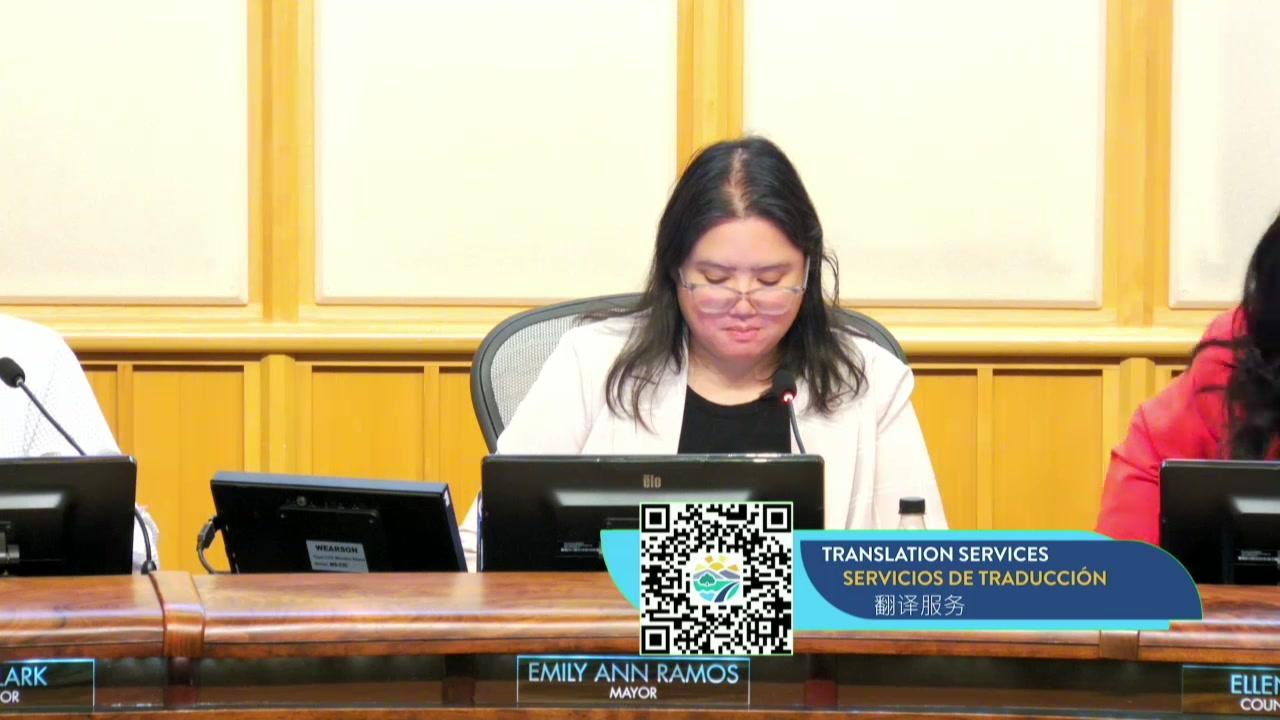
- Mayor Emily Ann Ramos condemned racist disruptions of virtual comment and announced a pilot of Wordly translation in 60+ languages.
Looking ahead: The council returns Dec. 8 for second readings of the vehicle ordinances and the turf irrigation ban, plus park fee amounts. During general public comment, one speaker noted that protections for RV residents under an existing settlement expire in February.