
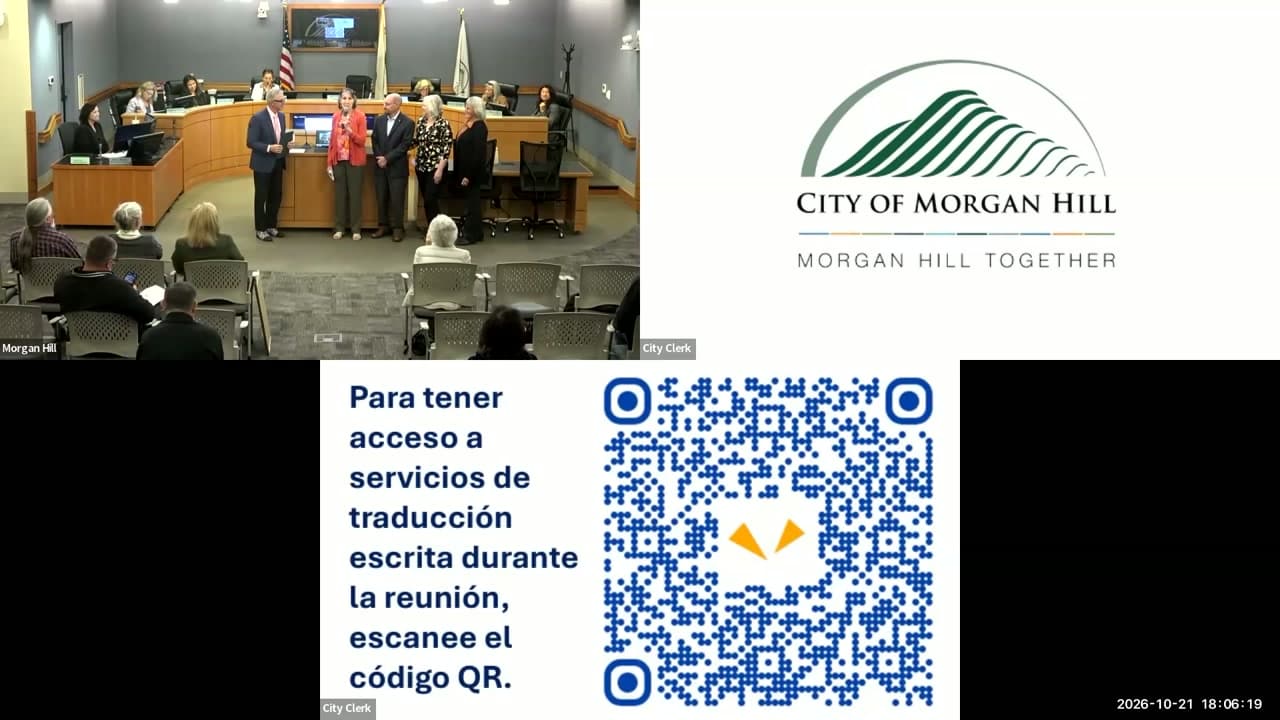
Council Approves 105 Builder's Remedy Homes, Extends Data Center Pause
City Council • Morgan HillOctober 21, 2026
Locunity is an independent informational service and is not an official government page for this commission. All information is sourced from public footage and an analysis of official agendas with the aid of responsible, fact-checked AI. to report an error or omission.
Morgan Hill's City Council approved a 105-home subdivision on Oct. 21, 2026, that state housing law and a settlement left it little power to stop, even with traffic and farmland impacts the city cannot fully offset. In the same session, the council extended its moratorium on data centers and battery storage to Sept. 16, 2028, over building trades opposition. It also shelved a county annexation deal until it sees the costs.
- 105 single-family homes approved 5-0 under builder's remedy; city gains 4.7 acres plus $500,000
- Data center and battery storage moratorium extended to Sept. 16, 2028, 5-0, over union objections
- County annexation agreement continued as council demands fiscal data on about 2,400 proposed units
- Spanish Leadership Academy graduates ask for a Spanish-language citizens police academy
Builder's Remedy Leaves Little Room to Say No
The council approved three resolutions for High Street Residential's DePaul Residence project in one motion. They cover a vesting tentative map dividing 15.8 acres into 114 lots, a design permit for 105 two-story homes and two parks, and an environmental impact report with a statement of overriding considerations. The Planning Commission had recommended approval.
The basics: The builder's remedy, part of the state Housing Accountability Act, limits a city's ability to deny housing projects while its housing element lacks state certification. Morgan Hill conceded that status for this project in a settlement agreement signed in October 2025.
Why it matters: Denial risked litigation, fines and the city's certified housing element. Approval instead delivers a 4.7-acre parcel and $500,000 for future housing.
Where things stand: Staff said the city submitted its housing element in August 2022 and blamed the state's review delays. "The failure was with HCD," said Jennifer Carman, Development Services Director. Councilmembers pressed staff on legal exposure, including fines, SB 1037 and risk to the housing element.
The applicant pitched the land as a voluntary contribution. "The city is actually getting a pretty significant benefit in 4.7 acres of land that we're contributing to the city," said Adam Volker, representing Trammell Crow Company and applicant High Street Residential. Staff said the city will hold the parcel for future housing needs starting in 2031.
Unmitigated impacts: The EIR found three significant, unavoidable impacts. They include converting 10.8 acres of unique farmland and generating vehicle miles traveled (VMT) of 30.47 against a 24.64 threshold. "We're seeing that we're over our threshold and we don't really have anything to address that," said Yvonne Martínez Beltrán, Councilmember, District B.
"Part of having a nonattainment area means that you cannot mitigate to a point of reducing the impacts to a level that meets the thresholds," Carman said. Mitigation is limited to a carpool program, bike share, a travel behavior program and a construction traffic plan. There is no mitigation fee because the former MOGO shuttle no longer exists.
The other side: Public commenter Armando Benavides suggested approving the project but bringing open decisions back for transparency. He cited nearby congestion and asked whether the 4.7 acres could stay commercial. Deborah Africa, a nurse, questioned the transparency of mitigations and possible respiratory effects. She asked for a deeper health study before approval.
Councilmembers voiced regret even as they voted yes. "I don't like the idea of being forced into something, but if you have to be forced, this is a nice project to do so," said Miriam Vega, Councilmember, District A. Martínez Beltrán added: "I am disappointed that we won't be able to have that mixing in your development because I think it's going to be a beautiful development."
Decisions and stakeholder impacts: The vote was unanimous (For: 5, Against: 0). The developer secures 105 market-rate homes. The city banks land and cash for future housing. Neighbors absorb added traffic, and the region loses 10.8 acres of farmland.
What's next: The applicant must decide between paying in-lieu fees or purchasing farmland for agricultural mitigation before building permits issue. Martínez Beltrán asked the applicant to consider donating toward a regional last-mile transit program.
Moratorium Extended as Trades Push Back
The council voted 5-0 by roll call to extend its interim moratorium on freestanding data centers and grid-scale battery energy storage systems (BESS) for 22 months and 15 days. A separate item, 10.1, also passed unanimously by voice vote.
The basics: Interim Ordinance 2377 was adopted Sept. 16, 2026, for 45 days. The extension under Government Code 65858 runs to Sept. 16, 2028, but ends sooner if the council adopts permanent rules. "No further extensions are allowed under the law," Carman said.
Why it matters: Building trades see lost jobs and clean energy work. Supporters want time to write rules on water, power and public input.
Where things stand: The city attorney said Morgan Hill proceeded under subsection B, which allows a single extension of that length, unlike the path Gilroy used. "So as I read the statute, that's the time period we're looking at for an extension," said the City Attorney. Staff pledged to finish sooner. "We could probably do a check-in at the goal setting in February," said the City Manager.
The other side: Union representatives urged a no vote and standards developed with labor:
- Scott Reese, UA Local 393, noted that no applications are pending
- Basil Romero, IBEW Local 332, sought community benefits and skilled-labor requirements
- Jason Hunt, Sheet Metal Workers Local 104, said the pause blocks clean energy progress
- Erica Valentine, speaking for 3,200 workers, presented a timeline she said suggested political timing
- Cherie Cabral, Western Steel Council, called 22 months excessive and cited a legal challenge to urgency moratoria
Supporters included Benavides, who wants 1981-era standards updated, and Daniel, who cited a 98-megawatt facility's power demand. Sally Casas also spoke in support. Africa backed the extension but asked for a public work plan with deadlines and full cost disclosure.
"This is not about a ban on data centers," said Mark Turner, Mayor. Martínez Beltrán cited the city's finances as context: "We have a $4 million structural deficit in Morgan Hill."
Decisions and stakeholder impacts: The roll call vote was For: 5 (Turner, Vega, Librers, Iwanaga, Martínez Beltrán), Against: 0, Absent: 0. Developers and trades wait for staff-written standards. Residents gain time for input.
What's next: Martínez Beltrán requested a workshop with union leaders on skilled labor and apprenticeships. A moratorium check-in is expected at February goal-setting.
County Deal Stalls Over 2,400-Unit Question
The council unanimously voted to continue, with no date set, a proposed memorandum of agreement (MOA) with Santa Clara County.
The basics: Eleven builder's remedy projects outside city limits would rely on septic and wells. "There's roughly 2,400 units being proposed across all the projects," Carman said. Under the MOA, if the county approves a project and the city later annexes it, the regional housing needs allocation (RHNA) credits would stay with the county. RHNA credits count toward a jurisdiction's state-assigned housing targets.
Why it matters: Staff framed the MOA as a way to steer utility planning before construction. Councilmembers worried the city would inherit the costs.
Where things stand: Staff stressed the MOA takes no position on projects and cannot compel annexation, which requires approval from the Local Agency Formation Commission (LAFCO). Turner cautioned members to stick to questions rather than signal support or opposition. He then asked about county incentives, termination, Mello-Roos taxes, fire and police response and PG&E. "Can staff prepare a fiscal impact analysis comparing the cost of serving these homes with the revenue they would bring in before any annexation is approved?" he asked. Staff said many answers would come through each project's EIR.
Chris Kenny, Public Services Director, noted that half of Holiday Lake Estates lacks sewer service. Shane Palsgrove, Police Chief, said city police respond to major injury accidents in county areas. "We're really talking about the impacts that we're absorbing," Martínez Beltrán said.
The other side: Africa asked for a public analysis of water, sewer, traffic, emergency services and finances, and for developers to fund infrastructure. Benavides said the MOA opens the door to 11 builder's remedies and proposed a clean annexation instead.
What's next: Staff will return with fiscal, service-cost and infrastructure data.
Elevate Graduates Ask for Spanish Police Academy
Five participants in the Elevate Morgan Hill Spanish Leadership Academy made a coordinated request during public comment: Jorge Mendoza, Sandra, Luz Carrasco, María Romero and María Elena Dominguez. They asked the city to offer a citizens police academy in Spanish.
Why it matters: Speakers said language barriers keep some families from engaging with police. Carrasco also asked how graduates can keep collaborating with the city.
What's next: Turner asked whether a citizens police academy exists. The city manager said there would be further conversation.
- Tourism report: Business improvement district collections rose 8.2% to $354,328. Turner sought room-night data and an expanded Visit Morgan Hill board; no action was taken.
- Oak tree: Architect Charles Weston asked that a removal permit for an oak at Diane and Butterfield be agendized.
- City updates: Hale Avenue reopens after Upper Llagas Creek flood work, and Butterfield Park and its BMX track are open. Downtown short-term parking begins with courtesy enforcement.
- Housing sessions: Four listening sessions on mobile home rents, inclusionary housing and condo conversions, including Spanish-language sessions, include Oct. 26 and Nov. 4.
- Procedural: The council moved Item 9 ahead of Item 8 and approved the agenda and consent calendar, each 4-0 with one member absent.
Looking ahead: Martínez Beltrán requested a future agenda item to design a regional last-mile transit program. The county MOA returns once staff completes its fiscal analysis.