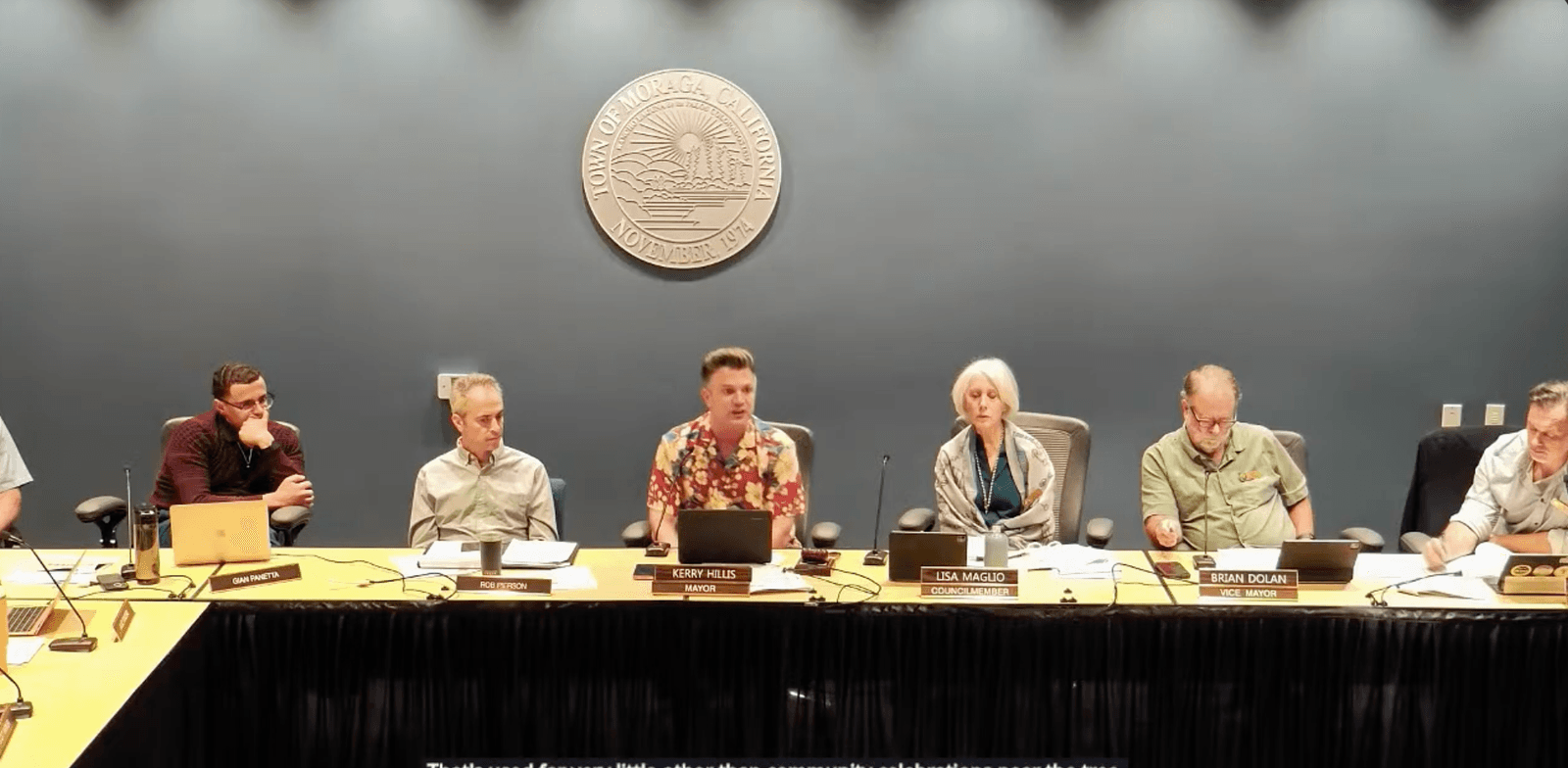
City Council - Sep 10, 2026 - Special Meeting
City Council • MoragaSeptember 10, 2026
Locunity is a independent informational service and is not an official government page for this commission.We use AI-assisted analysis and human editorial review to publish information.
Moraga's First Parks Master Plan in 15 Years Faces Pivotal Test on Costs
Moraga's Town Council and Parks and Recreation Commission convened a joint special session to review a sweeping draft Parks, Recreation and Open Space Master Plan — the town's first comprehensive parks blueprint in roughly 15 years. Consultants presented ambitious proposals spanning a three-prong community center strategy, site-specific park upgrades, new trails, and a controversial sports field, but council members made clear the plan's fate hinges on a still-unwritten implementation chapter with real cost estimates and staffing analysis.
- Three-prong strategy targets Moraga's decades-long indoor recreation gap — partnering with St. Mary's College, expanding the Hacienda de las Flores, and building a new 10,000-to-12,000-square-foot town-owned community center
- Proposed multi-use field in the Moraga Commons "back 40" threatens one of the world's earliest disc golf courses, drawing objections from the disc golf community and multiple council members
- Former mayor and EBRPD director warns proposed Mulholland Ridge trails cross federal conservation easements not referenced in the draft plan
- Council members demand actionable priorities, realistic costs, and timelines before the plan returns Oct. 12 to the commission and Nov. 18 to the council
- Mayor pushes town ownership over partnerships, warning that reliance on institutions like St. Mary's College leaves the town vulnerable if partner priorities change
A 15-Year Blueprint, Seven Goals, One Big Question: Can Moraga Deliver?
The basics: Consultant firm WRT, led by Peter Winch, presented the draft master plan organized around seven goal areas: park and trail improvements, expanded recreational opportunities within existing parks, roughly 8 acres of new parkland to keep pace with growth, open space management, strengthened programming (especially for older adults, teens and tweens), operations and maintenance upgrades, and diversified sustainable funding — including recalibrated development impact fees.
Community engagement over the plan's development reached more than 1,500 residents via surveys, focus groups, pop-up events, workshops, and online tools. Key findings: high satisfaction with existing parks, recognition of limited indoor recreation, strong support for more shade, walking loops, gathering spaces, and a multi-generational recreation center — and a clear preference for improving existing parks over building new ones.
Why it matters: This plan will guide millions of dollars in park investments over the next 10 to 15 years for Moraga's 16,000-plus residents. But the elephant in the room — openly named by nearly every council member — is whether the ambitious scope will translate into built projects or join the prior master plan on the shelf.
The Community Center Puzzle: Three Paths, No Easy Answers
The most politically charged element of the plan is its three-prong approach to finally addressing Moraga's longstanding lack of indoor recreation space.
Where things stand: The first prong would partner with St. Mary's College for public access to its recreation center, including group fitness, a pool and a gymnasium — the fastest path to implementation. The second would improve and expand the Hacienda de las Flores as a joint community and event center through its current partnership with private events operator Wedgwood, potentially splitting usage 60/40 between private events and community use. The third would build a town-owned multi-generational community center of 10,000 to 12,000 square feet for multipurpose programming, community gathering and potentially civic meetings.
WRT evaluated 12 potential sites for the town-owned facility. Three emerged as most promising: the Moraga Library site (town-owned, central, potential library synergy but topography constraints), Ream Boulevard and St. Mary's Road (town-owned, flat, less central), and Moraga Center Area 7 (centrally located near the commons, but privately owned with limited current interest from the property owner). Live polling showed roughly two-thirds support for exploring the three-prong approach.
The other side: Mayor Kerry Hillis pushed firmly for town ownership over reliance on partnerships that could evaporate.
"I especially don't want to say, okay, maybe a college president changes. They no longer want us on the campus and they want to use it for something else. And now we put all our ducks and investment in that — doesn't sound great either. So I really like the concept of ownership," said Mayor Hillis.
He also issued a blunt warning about follow-through: "The concern that I have is I don't want this to be another one that lands on the shelf like the one 20 years ago where we recommend having these things and nothing happens."
Councilmember Graham Thiel took a different tack, suggesting the town explore a privately developed, leased-back model: "I think we should perhaps consider — replace town-owned, town-developed with privately developed and leased back — so we can understand what might be a better reality of how that would practically play out."
Thiel also pointed to nearby Lafayette's Aardvark Center as a low-cost model: "It's on Mount Diablo in a small storefront where they have a space for seniors, teens and tweens to hang out all together. It's been very successful. Surprisingly low cost."
Public commenter David Laurier, who lives adjacent to the Hacienda de las Flores, raised neighborhood compatibility concerns, arguing that expanding private events would impose a burden on nearby homeowners and calling for an independent acoustic study before any expansion proceeds.
What's next: The consultants will incorporate council feedback into the community center analysis before returning with the implementation chapter.
Back-40 Battle: Historic Disc Golf Course vs. Sports Field
Why it matters: Moraga has no dedicated community sports field despite years of parent advocacy. But the draft plan's proposed small multi-use field in the "back 40" area of Moraga Commons would collide with one of the earliest disc golf courses in the world — established in 1981 by Steady Ed Hendricks, the founder of disc golf.
Where things stand: Public commenter Brad Hoover, a member of the Moraga Disc Golf Club who spearheaded $15,000 in improvements and more than 400 volunteer hours of renovation, warned the field would eliminate holes 6 and 7, including the course's signature hole. "We've put 10 new cement tee pads in. We spent over $15,000 in contributions and over 400 hours of volunteer work," Hoover told the council.
Parks and Recreation Director Mackenzie Brady said she had anticipated the conflict. During the recent course renovation, she specifically blocked installation of a basket in the back 40: "The disc golf group asked if they could put a basket in the middle of the back 40, and I specifically said no because there was a potential future use of the back 40." She said no recommendation has been made to remove existing holes or baskets and envisioned potential shared use with signage or time-based restrictions.
The other side: Mayor Hillis argued the back 40 is "a big empty plot of land" and that the town needs a sports field, pointing to alternatives like the Los Perales lower field. Vice Mayor Brian Dolan expressed skepticism about adding a field to the Commons given topographic challenges, suggesting better alternatives exist elsewhere. Councilmember Lisa Maglio supported preserving the disc golf course, noting its 40-year history and the potential for significant community pushback, and also raised concerns about electromagnetic field exposure from high-voltage towers near the proposed field location.
What's next: The disc golf conflict will be revisited as consultants refine the implementation chapter. The level of community mobilization around the course suggests this will remain a flashpoint.
Trails and Open Space: Ambition Meets Environmental Reality
The plan proposes new multi-use paths along Moraga Way (already grant-funded), Moraga Road (part of the Livable Moraga Road study), and Donald Drive to Moraga Ridge, along with potential new soft-surface hiking trails on Mulholland Ridge.
The other side: Linda DeChambeau, a 36-year Moraga resident, former mayor, and current East Bay Regional Park District Ward 2 Director, delivered some of the meeting's most substantive feedback. She warned that three proposed hiking trails on Mulholland Ridge go through federal conservation easements and that an 18-month Mulholland Ridge Habitat Conservation Plan process — including its CEQA findings — was not referenced in the draft. She also urged consultation with EBRPD on the Lafayette-Moraga Regional Trail alignment and noted that U.S. EPA has declared Moraga's waters to be of nationally significant importance. DeChambeau recommended adding a water feature map showing that a creek runs under the Ream shopping center and incorporating riparian setback considerations along the Lafayette-Moraga corridor.
Mayor Hillis directed staff to consult with the East Bay Regional Park District before the next meeting. Councilmember Thiel requested clear delineation of trail use types — hiking, equestrian, biking — and asked about ADA accessibility on proposed routes.
Park-by-Park: What Changes Are Coming
Consultant Madison Merrill presented site-specific recommendations for each major park:
Moraga Commons: A small multi-use field in the back 40, shade structure over the all-access playground, splash pad replacement, conversion of partial basketball courts to a full court, team gathering area, walking loop improvements, creek restoration, amphitheater upgrades, potential parking lot expansion, and shade tree planting.
Rancho Laguna Park: The loudest community feedback called for preserving the park's natural, peaceful character. Recommendations include restroom and playground replacement, accessible walking loop improvements, creek restoration, and maintaining the central lawn for off-leash hours during set times — explicitly no large sports facilities. Parks and Recreation Director Mackenzie Brady made a pointed clarification: "It is not a dog park. It is a park with off-leash hours. And fencing in the entire space would allow that problem to continue."
West Commons: Central lawn area with shade and seating, small rentable pavilion, stronger entrance with parking, play elements, and creek restoration — roughly half the site is creek and woodland.
Hacienda de las Flores: The plan recommends an updated site and facility master plan given the complex facility and access challenges, including considerations for new or improved buildings, ADA modernization, and clearer public/private space delineation.
Linear Park (St. Mary's Road): Replacing fitness stations, considering a dog park or pump track, additional seating, shade, and art.
Mulholland Ridge Open Space: Trailhead amenities, trail repair, habitat enhancement, defensible space for wildfire, and potential new trails pending CEQA review.
Creek restoration across multiple parks will involve complex regulatory coordination with the California Department of Fish and Wildlife, East Bay MUD, the Moraga-Orinda Fire District, and other agencies.
The Make-or-Break Chapter: Implementation
Why it matters: Nearly every council member and commissioner signaled that the implementation chapter — due next month — will determine whether this plan becomes reality.
Vice Mayor Dolan was the most direct: "Not in our wildest dreams can we afford or provide enough staff to do all these things. We really got to narrow it down into something actionable because it would take a staff five times just the operational things that are in there."
Councilmember Maglio read absent Councilmember Steve Woehleke's written comments into the record, calling for the town to "identify and commit to a limited set of prioritized and actionable recommendations to detail and implement each year with current staff." Maglio added her own emphasis on protecting existing assets and addressing safety, wildfire resilience, and deferred maintenance first: "I would prioritize existing assets and items of safety, wildfire resilience, and I would look to indoor space that's dependable through enforceable partnerships."
Councilmember Thiel pressed for timeline estimates alongside cost in the phasing framework, noting that high priority does not necessarily mean near-term achievability: "My brain says, oh, phase one, that's the stuff we do first. But if that is something that takes a longer time, then it's not something we could achieve doing first."
Consultant Peter Winch previewed the prioritization criteria — community priority, amenity deficiency, critical infrastructure, sustainability impact, operating cost reduction, and funding availability — and identified the highest-priority projects in the initial evaluation: park walking loops, joint use with St. Mary's, a new neighborhood park at the Los Perales site, the Hacienda site master plan, the multi-generational community center, a shade structure at the Moraga Commons playground, and trail connections.
Vice Mayor Dolan also questioned the feasibility of adding 8 acres of parkland, given limited town-owned land: "We don't really have a lot of city-owned land to convert. And so the way you would get the 8 acres is through development. Yet the vast majority of our development is higher-density stuff in the center of town, which aren't necessarily the unserved neighborhoods."
What's next: The plan returns to the Parks and Recreation Commission on Oct. 12 and to the Town Council on Nov. 18 with the completed implementation chapter, including cost estimates, phasing, and staffing capacity analysis.
Minor Items
- Roll call: All five council members and all commissioners were present, with Councilmember Steve Woehleke absent but submitting written comments that were read into the record by Councilmember Maglio.
- Public comment was consolidated into the main agenda item rather than taken as a separate period.
- Mayor Hillis recounted the political history behind funding the master plan, describing how he navigated council reluctance by initially proposing a staff-only effort before later securing consultant funding.