
Town's Permitting Error Forces Variance for Half-Built Texas Road Home
Board of Adjustment • MontreatOctober 22, 2026
Locunity is an independent informational service and is not an official government page for this commission. All information is sourced from public footage and an analysis of official agendas with the aid of responsible, fact-checked AI. to report an error or omission.
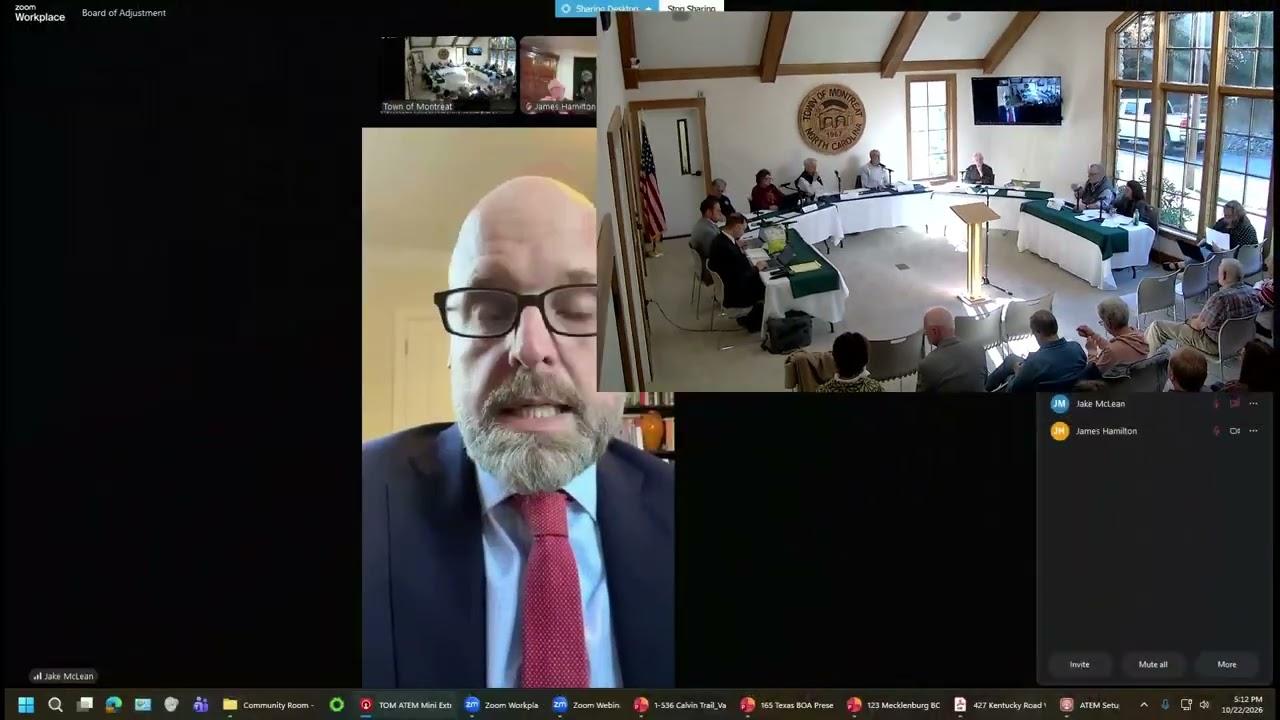
Montreat's Board of Adjustment spent its longest stretch on Oct. 22, 2026, cleaning up after the town's own mistake: a building permit that approved 10-foot side setbacks where 15 feet were required, leaving a family with a partly built house in a flood zone. The board granted the variance by voice vote. In a night with a full seven-member board, a second variance on Mecklenburg Circle passed only after one member changed her vote.
- Texas Road Extension variance granted after staff said the town permitted the home in error
- Mecklenburg Circle setbacks approved 6-1, but only after a member reversed a mistaken no vote
- Burns rehearing on Foreman Siding Road continued to Jan. 28, 2027, unanimously
- Calvin Trail variance extended six months, one day before it would have expired
Town Error, Neighbor Worries on Texas Road
The basics: A variance lets a property owner depart from a zoning rule, such as a setback, when strict enforcement would cause unnecessary hardship. The board must grant only the minimum relief needed.
Why it matters: Staff said the town approved a plan with 10-foot side setbacks on the 0.14-acre lot at 165 Texas Road Extension, which sits partly in the 100-year floodplain. The code required 15 feet. The building permit was issued Aug. 12, and a neighbor's complaint surfaced the problem after construction began.
"It was an error on the town's part, and what needed to be approved was 15-foot setbacks," said Interim Zoning Administrator Jacob Compher.
Where things stand: The request sought a 5-foot reduction on both side setbacks. The debate centered on whether 5 feet was truly the minimum, because roof overhangs of up to 4 feet are excluded from setback measurements. The board's attorney first read the code to require only 1 foot of relief.
"I would like language that we approve that meets the actual overhang needs, and not an inch more," said Board Member Matt Horn. The attorney agreed: "I agree with Mr. Horn that what should be granted is the smallest variance," said Brendan, Board Attorney.
The applicant team pushed back. Ross Smith, the builder with Assembly Build, and architect Leslie Holman of Assembly Architecture and Build testified that the foundation piers sit at the 10-foot line and that the roof overhangs measure 12 to 24 inches. "I do believe, especially on the plan right side, we need that 5-foot allowance," said Holman. Smith described the project as modest: "It's a darling little house. It's 1,200 square feet."
The other side: Neighbors were sympathetic but wary. Sarah Stancil, a resident, confirmed the lot is tiny and flooded after Hurricane Helene and wished the owners well. She also questioned the practice of requiring board members to explain negative votes. "We have setbacks for a reason," said Stancil.
Jay Haney spoke for his sister-in-law, who owns the adjacent 163 Texas Road Extension. He asked for erosion controls and "a request to have a professional arborist come out to the site," with any tree damage paid for by the owners or the builder.
Haney's testimony prompted a procedural detour. The attorney said the board cannot consider outside written statements and that representing another person is normally an attorney's role. "So I think it is appropriate to disregard testimony about what someone else said," said Brendan. Members agreed to hear Haney without setting a standing policy. The attorney said erosion and tree concerns fall under other permits and ordinances, not the setback request.
Decisions and stakeholder impacts: Members found no objection to the setback itself, and the variance passed by voice vote. No tally was stated. "This was no fault of the applicant," said Board Chair Ed Kramer. The owners and builder avoid a costly redesign of a half-built home. Neighbors' erosion and tree concerns now rest with other town permitting processes.
What's next: The board approved the written order granting the variance later in the meeting, making it the operative legal record.
One Changed Vote Decides Mecklenburg Circle
Why it matters: Variances need 80% approval, or six of seven votes. "To pass a variance, you need 80%," said Kramer. On Oct. 22, 2026, a single misunderstanding nearly sank a new home.
Where things stand: Applicant William Sharman sought to cut the side setback from 15 to 10.88 feet and the rear from 35 to 30.72 feet. The 0.33-acre lot is vacant, zoned R-1 and crossed by a perennial stream. Compher said the house would meet the 30-foot stream setback, while a deck would encroach about 4 feet.
Sharman said the buildable area is about 2,000 square feet and that he wants to avoid building over an ephemeral stream, meaning one that flows only after rain. He conceded a smaller home is possible. "You can put a much smaller structure on there, but it'll be better for Montreat if I get the setback," said Sharman.
One board member suggested rounding the request to 10 and 30 feet. The attorney warned that the board must grant the minimum variance. Next-door neighbor John Hinkle of 121 Mecklenburg Circle said the homes would sit about 25 feet apart. "My wife and I do not object to the variance that has been requested," said Hinkle.
The other side: Kramer questioned whether buying a lot known to be difficult counts as a hardship. "I don't believe the beauty of the flowers of this is a hardship," he said in explaining his no vote. The attorney reminded members that an applicant does not have to show the property would have no use without a variance.
Decisions and stakeholder impacts: The chair first announced 6-1, then corrected it to 5-2, which would have failed. A board member said she had voted no believing the house would cross an ephemeral stream. "If I'm incorrect about that, I would change my vote," she said. After clarification she switched, and the variance passed. For: 6, Against: 1, Absent: 0. Individual votes beyond the chair's were not clearly recorded.
The outcome lets a single-family home rise on a constrained stream lot. It also shows how thin the margin is under the six-vote rule: one mistaken vote nearly killed a request the neighbors did not oppose.
What's next: The board approved the written order granting the variance at the end of the meeting.
Burns Rehearing Pushed to January
Why it matters: The long-running dispute over 779 Foreman Siding Road (VA-2022-01), remanded from Superior Court, will wait at least three more months.
Where things stand: TC Morphis, attorney for applicants Wade and Susie Burns, said the 2021 stream determination expired after five years and could not be renewed before the meeting. "Our stream determination expired earlier this year," said Morphis. He said his clients would seriously study an alternative from neighbor James Hamilton: piping part of the stormwater system and removing driveway paving.
Will Hamilton, the neighbor's son, had canceled his flight to attend. He agreed to January if the experts are available. "We are happy to continue the matter till January," said Hamilton. Morphis also urged the board to consider a site visit. Kramer noted that this is a request, not an obligation.
Decisions and stakeholder impacts: The board attorney said a continuance had to go to a date certain. The motion to continue passed unanimously on a show of hands.
What's next: The rehearing returns Jan. 28, 2027.
Calvin Trail Variance Survives by a Day
Where things stand: Compher said the owner of 536 Calvin Trail "essentially has not made any progress on this variance request," which reduces a side setback. The ordinance allows one six-month extension in that case, and the variance would have expired the next day.
The attorney said state law may allow two years and that the state extended deadlines to 2029 after Helene. He called the extension an abundance of caution. Owner Richard Deibert said the family removed half the deck and that plans are finalized. He attributed the delay to "architect changes and design, further design work, and then rentals for the summer." Kramer pressed him on why no work had been done.
Decisions and stakeholder impacts: The extension passed by voice vote. No tally was stated. The owner keeps the setback relief without reapplying.
Minor Items
- Full board seated: Matt Horn moved up from alternate, and Tiffany Neville took the extraterritorial jurisdiction (ETJ) seat, filling all seven positions.
- 427 Kentucky Road: The board approved a written order denying zoning and stormwater variances, finding no unnecessary hardship.
- Written orders: The board approved orders for Mecklenburg Circle and Texas Road Extension together by voice vote.
- Agenda and minutes: The board adopted the agenda and the Aug. 27, 2026, minutes by voice vote.
Looking Ahead
Staff previewed a possible Nov. 19 meeting on a special use permit for an accessory dwelling unit, to be presented by the new zoning administrator. "Town of Montreat requires a special use permit to put any accessory dwelling on the property," said Compher. The chair's closing remark that nothing was scheduled in November left that date unsettled, so residents should confirm with the town. The Burns rehearing is set for Jan. 28, 2027.