
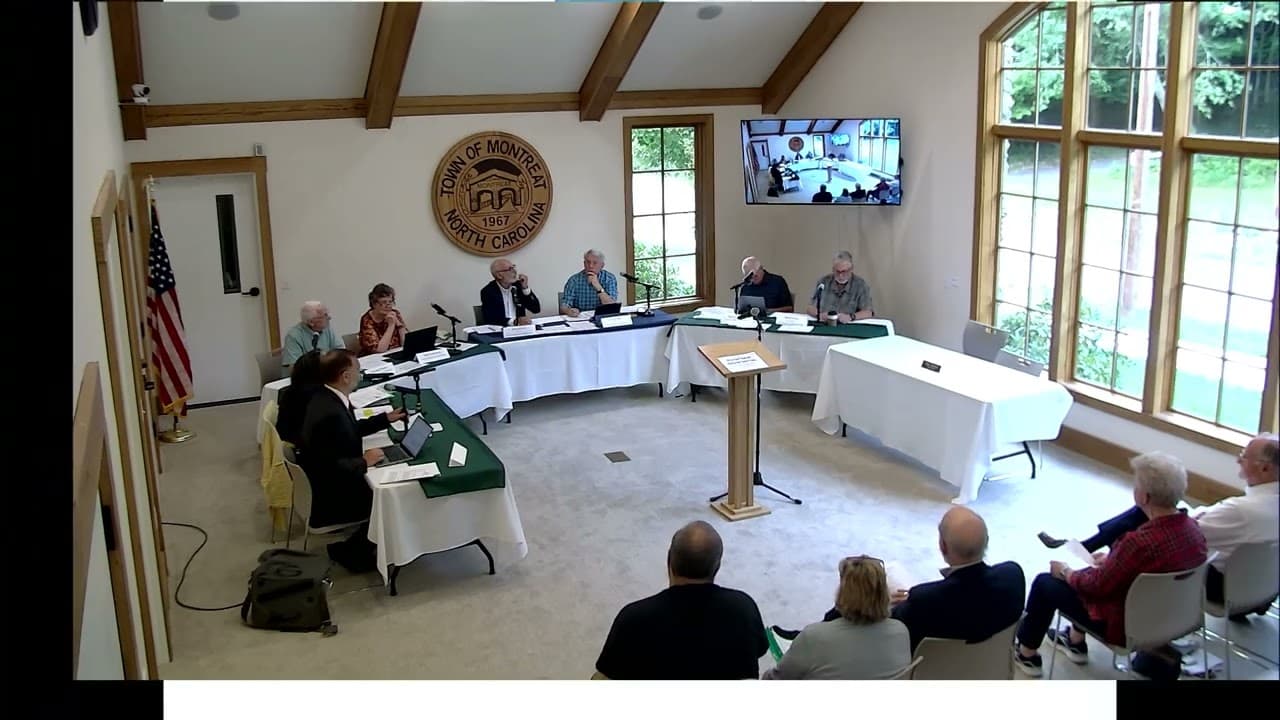
Montreat Board Denies Both Variances for 427 Kentucky Road Home
Board of Adjustment • MontreatAugust 27, 2026
Locunity is an independent informational service and is not an official government page for this commission. All information is sourced from public footage and an analysis of official agendas with the aid of responsible, fact-checked AI. to report an error or omission.
A smaller-than-expected lot was not enough to loosen Montreat's rules. On Aug. 27, 2026, the Board of Adjustment voted 5-1 to deny setback relief and 6-0 to deny a stream buffer reduction for a proposed one-story home at 427 Kentucky Road, a purchase the buyers said depends on the variances. The message to future applicants: bring evidence that your lot differs from its neighbors, because a survey surprise alone won't do it.
- Setback variance denied 5-1 after the board found no unnecessary hardship at 427 Kentucky Road
- 30-foot stream buffer upheld 6-0 despite the applicants' offers to fund a pipe extension or retaining wall
- Neighbors raise privacy and precedent concerns, and explain the old land trade that narrowed the lot
- Board Member Matt Horn recused midhearing after a witness turned out to be his children's pediatrician
Survey Surprise Isn't Hardship, Board Rules
1 big thing: The Board of Adjustment rejected contract purchasers Philip and Linda Jung's request to shrink setbacks so they could replace a circa-1919 two-story house with a one-story home, garage and workshop.
The basics: A variance lets a property owner depart from zoning rules when strict enforcement creates an unnecessary hardship. The board sits in a quasi-judicial role, meaning it must decide on evidence. "A quasi-judicial decision is not a popularity contest," said Board Chair Ed Kramer.
Where things stand: The lot is zoned R-1, which requires a 30-foot front setback and 15-foot side setbacks. Applying on behalf of owners Julian and Nancy Lake, the Jungs sought a 10-foot front setback and 5-foot side setbacks for a roughly 2,500-square-foot, three-bedroom home.
Their case rested on a June 17 survey. It showed 45.46 feet of Kentucky Road frontage, not the 70 feet in town and county records, and 0.204 acres. About 25 feet had been deeded to the neighboring Walker property long ago. Philip Jung said the lot is about 18% smaller than typical 0.25-acre lots nearby and that strict setbacks would leave a 15-foot-wide house front.
"We have this property under contract and are ready to close contingent on the results of the variance meeting," said Philip Jung, applicant.
The other side: Members pressed for proof that the lot is unusual. Board Member Dan Sharp noted the GIS plat showed similar neighboring lots, and the applicants acknowledged they lacked comparative data. "The hardship question says that there has to be something specific or peculiar about the property different from neighboring properties," Sharp said.
Board Member Mari Gramling established that the Jungs did not yet own the property and learned its true size before closing. "We knew it was a small lot, but it's smaller than we thought," Philip Jung said. Gramling argued that no hardship existed because the sale had not closed. The town attorney advised against that reasoning: "I would encourage the board to look at the hardship issue without regard to the ownership or the ability to sort of back out of buying the property," said the Town Attorney.
Kramer questioned whether a hardship exists when an applicant plans to demolish a house and design a new one to fit. "Now, if their surveyor gave them the wrong information, I don't think that's the board's responsibility to make up for a mistake that was from a survey that they have hired," Kramer said.
Members also questioned the rear placement and a workshop near the road in the Montreat Historic District. "I'm thinking other neighbors have lived with that, but you don't want to," said Board Member Bill, whose surname was not given. Interim Zoning Administrator Alexis Baker clarified that the surveyor had mislabeled a 30-foot rear line. Only 10 feet is required there because the lot abuts the Woodland district.
Decisions and stakeholder impacts: Sharp moved to deny for failure to meet the hardship requirement, and Gramling seconded. The motion passed (For: 5, Against: 1, Recused: 1, Matt Horn). The dissenting member was not identified. Without relief, the Jungs' contingent purchase and one-story design may not proceed. Neighbors keep the existing spacing. Future applicants now know the board expects neighborhood-comparison evidence.
Neighbors: Sympathy, but Not at Our Windows
Why it matters: The adjacent Walker family both backed the applicants' account of the lot and argued against the variance.
Where things stand: Carlisle Willard, partner, Walker Wigwam LLC, which owns the neighboring Walker home, acknowledged the lot is small but objected to the rear placement. "If the house is moved back to where it is, our neighbor on that side can look through our bedroom and bathroom windows," Willard said.
He warned of crowding: "before very long, it will look like a row of townhouses, with not much room between the houses." Citing Section 310.42(B), Willard said hardships arising from personal circumstances cannot justify a variance. He recommended denial unless a compromise could be reached.
Ann Walker, daughter of original builder Boo Walker, explained why the lot is narrow. Her father traded frontage with neighbors, a swap later formalized in deeds around 1995. "How about if I trade 5 of front for 15 of back and I'll pave your driveways? And that was actually done," she recounted. She affirmed that the Jungs' survey is accurate and said she worried construction would require clear-cutting the lot.
The other side: Philip Jung listed nearby structures close to roads or streams, some not grandfathered, to argue that precedents already exist. Alternate Board Member Arrington Cox rejected the precedent framing from both directions: "There is no real precedent set because each property is separate, so its hardships should be considered separately from any other house in town being built."
Stream Buffer Stays at 30 Feet
Why it matters: The unanimous vote shows the board won't trade stream protection for applicant-funded engineering fixes without a proven hardship.
The basics: Montreat General Ordinances Chapter K, Article 3 requires a 30-foot buffer from the top of bank of intermittent streams. These are channels that flow for part of the year.
Where things stand: A geoscientist from Equinox Environmental classified the drainage channel in front of the lot, which flows from South Carolina Terrace under Kentucky Road, as an intermittent stream. The finding cited base flow, benthic macroinvertebrates and aquatic mollusks. The Jungs sought a 10-foot buffer so the workshop could sit near the road. Philip Jung said moving it west would block access to the garage.
Sharp pointed out that the Equinox letter concluded buffer rules did not apply. Asked about it, Philip Jung replied, "I think that's incorrect, yes." He relayed the geoscientist's view: "he said it barely makes the classification as an intermittent stream, but it is an intermittent stream." He added that the lot sits about 72 inches above the streambed and that construction would be the main period of risk.
The Jungs offered to build a reinforced concrete or stone retaining wall, or to pay the town to extend the 24-inch corrugated metal pipe along the property. "I've seen it dry many times," said Linda Jung, applicant.
The other side: Sharp argued that building 10 feet from the streambed risks its health. "It's a pretty important thing to have a stream buffer for those reasons, for those ecological reasons," he said.
Decisions and stakeholder impacts: Cox asked whether denying the setbacks made the buffer request moot. The town attorney advised a separate ruling: "I think there are 2 variance applications before the board, so I would rule on them both." Sharp moved to deny, citing findings of fact not adequately met. The motion passed (For: 6, Against: 0, Recused: 1, Matt Horn). The full buffer remains in place.
Recusal Midhearing Reshapes the Dais
Where things stand: After Ann Walker testified, Horn asked to step aside. "Ann Walker was the beloved pediatrician to my children, so if I can be recused from this decision, if I'm not needed for quorum purposes, I should step back," said Board Member Matt Horn.
The town attorney said the close relationship "could be the basis for recusal." Kramer said he would rather Horn stay but would not force him. Gramling moved to recuse, and Cox seconded. The motion passed by voice vote, with at least one "no" heard. The attorney confirmed the board "still stays at 7 for the purpose of majority, supermajority calculations."
Why it matters: Steps like this protect a quasi-judicial decision from later challenge. Earlier, the attorney confirmed that Sharp, whose term has expired, may keep serving until he is replaced. Cox arrived late and was seated without objection after questions about any ex parte contacts, meaning outside communications about the case.
- Agenda adopted by voice vote after the chair certified a quorum of 6 of 7 members.
- May 28, 2026, minutes approved without objection on a motion by Sharp, seconded by Gramling.
- Written order continued to Sept. 24, 2026, at the town attorney's request. Bill proposed a special meeting, and Sharp saw no urgency.
Looking ahead: The denials become formal when the board adopts the written order at its Sept. 24, 2026, meeting. That adoption sets the timeline for any next steps by the applicants.