
Montclair Planners Adopt 10-Year Master Plan Review on Deadline Night
Planning Board • MontclairNovember 17, 2026
Locunity is an independent informational service and is not an official government page for this commission. All information is sourced from public footage and an analysis of official agendas with the aid of responsible, fact-checked AI. to report an error or omission.
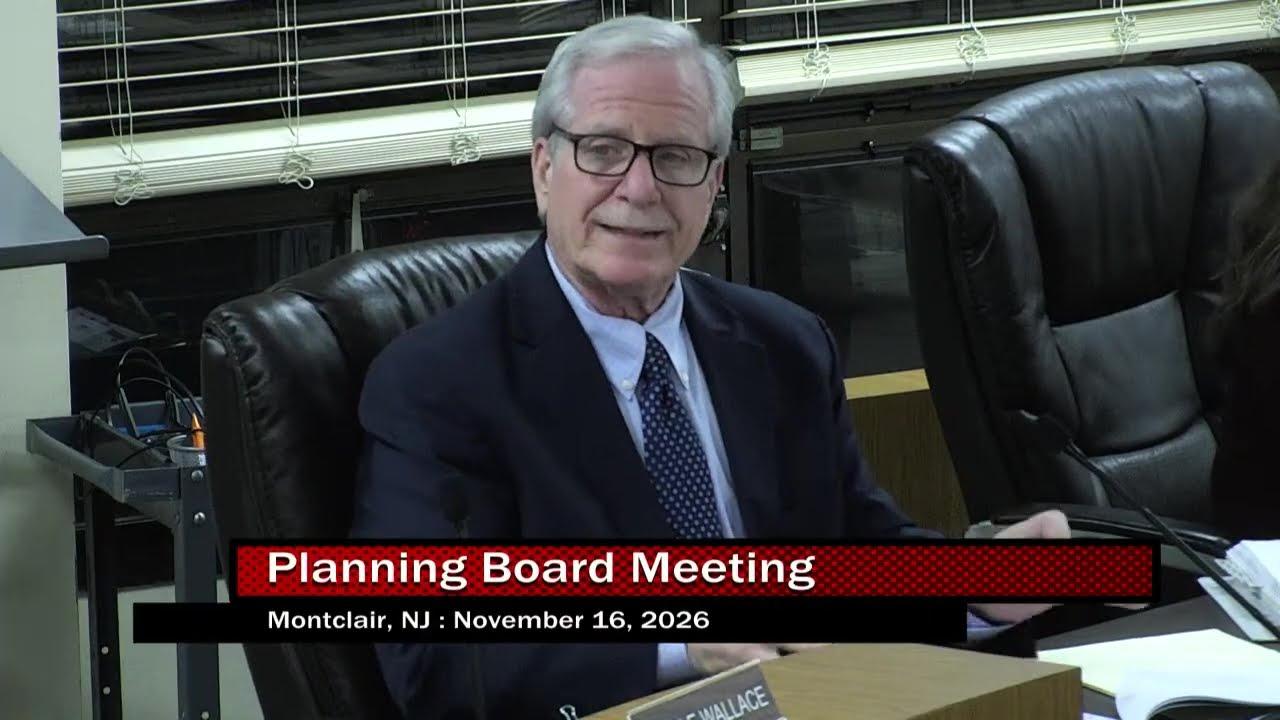
With no meeting left before a state-mandated 10-year clock ran out, Montclair's Planning Board on Nov. 16, 2026, adopted its Master Plan Reexamination Report, a decade-long to-do list for housing, parking and zoning. The voice vote came after two hours of public comment and line edits that showed where the board splits: whether to open single-family neighborhoods to more housing, and whether Upper Montclair should get a parking deck.
- Master Plan Reexamination Report adopted by voice vote on deadline night, with edits made on the spot
- RO and ROA zones flagged for possible affordable and supportive housing at Mayor Renee Baskerville's request
- "Revenge zoning": Councilmember Erik D'Amato pushes back on broad upzoning as six residents split on housing
- Parking compromise keeps an Upper Montclair parking deck on the 10-year agenda without committing the town
A Deadline Vote on Montclair's Planning Roadmap
The basics: New Jersey requires towns to reexamine their master plan and development regulations, now every 10 years. Montclair's last report was adopted Nov. 21, 2016.
"A Master Plan Reexamination Report is not the Master Plan," said Director of Planning and Community Development Janice Talley, framing the document as a review of progress and a list of recommendations for study, not a set of commitments.
Why it matters: Staff and counsel said failing to adopt would leave the town's land use rules open to challenge. "Hades is not coming down on the town if we don't do this tonight. But it does put our ordinances in some jeopardy," said Board Attorney Arthur Neiss. Because no meeting was scheduled before the window closed, Board Chair Keith Brodock concluded: "We don't want that, so we have to pass this tonight."
Where things stand: Talley reviewed what Montclair has done since 2016. That includes a new housing plan adopted in 2025, rent control, an accessory dwelling unit (ADU) ordinance, a C-3 zone on Bloomfield Avenue, impervious coverage limits and Complete Streets work. Unfinished work includes a utilities element and a parks and open space element; Talley said funding and a consultant are in place for the parks and open space element.
The data paints a changing town. Talley reported a Black population decline of more than 26% from 2010 to 2024, 542 new dwelling units since 2016 and large affordable housing waitlists. Homelessness has risen sharply since the pandemic. "We had 41 individuals experiencing homelessness in 2022," Talley said, noting the count reached 115 in 2025.
How input became policy: Mayor Baskerville asked how items made it into the report. Talley said comments were compiled and discussed at the previous meeting. Appendix A summarizes what the board heard, and the recommendations run from about page 28 to page 37. The chair and staff stressed that nothing had been voted on until that night.
Public commenter Jennifer Andre said her comments had been left out of Appendix A. A board member confirmed her written comments had been distributed, and Talley agreed to make sure the record reflects that. Public commenter Jane Hanson praised the report and asked how and where recommendations such as striping changes would be reviewed. Talley said there is no answer yet and that she would work with the manager and council.
Final edits: Councilmember D'Amato flagged two recommendations that could get ahead of work still in progress:
- A dormer-related increase to maximum principal dwelling height, which conflicts with the zoning subcommittee's anti-mansionization work.
- A shade tree committee proposal that is not in the tree ordinance under consideration.
The board softened that language to "consider." The chair also asked to consider raising the native species requirement from 70% to 100%. He requested two other edits: changing "planning board" to "township" in the first general recommendation and restructuring the Unified Land Use and Circulation Element listing.
Decisions and stakeholder impacts: Brodock moved "approval of this draft reexamination report with the edits we've discussed and agreed to this evening." It passed by voice vote. No tally was announced, and no opposition was audible. The report now sets the agenda that developers, housing advocates and neighborhood groups will cite for the next decade. Because its recommendations are items to study, the fights over them will move to future ordinances.
Missing Middle Divides Residents and the Dais
Why it matters: The report's housing recommendations will guide future zoning changes. Speakers disagreed sharply on whether upzoning reflects what residents want.
Where things stand: Six residents commented, and most of them focused on housing.
Kate Albright urged zoning that permits townhouses through fourplexes and transit-oriented development across wards. She also asked for a definition of "neighborhood character" to promote integrated, mixed-income neighborhoods. Carl Negge backed missing middle zoning and more market-rate supply, and asked the board to cut parking requirements and procedural hurdles to speed construction. William Scott, a member of the Montclair Housing Commission and former chair of the Rent Control Board, said the First and Second Wards use the most acreage with the least housing. He urged attention to affordability and rezoning.
Mayor Baskerville asked to add a recommendation to consider rezoning residential areas such as the RO zone for affordable and supportive housing. Talley said the housing element already contains a similar recommendation and proposed language naming the RO and ROA zones specifically.
The other side: Andre argued that converting single-family homes to multi-unit housing shifts the tax burden to existing owners, does not serve families and is not affordable. Councilmember D'Amato called a blanket upzoning recommendation unpopular. "For me, it smacks a little bit of what I like to call revenge zoning," he said. He did accept rewritten multifamily language for "transitional areas" after a board member explained it grew out of the 260 Park Street application.
Decisions and stakeholder impacts: The RO/ROA language and the transitional-areas wording made the final report. Affordable and supportive housing advocates gained a named target for future study. Single-family homeowners worried about conversions saw blanket upzoning language kept out. Neither side won a binding change; any rezoning would still need its own ordinance.
Upper Montclair Parking Deck Stays on the Table
Why it matters: Parking is a recurring issue in business-district applications. The compromise keeps a possible deck in play for the next decade.
Where things stand: Public commenter Dr. P.B. Markovic urged adding an Upper Montclair parking deck, which he said has been discussed since 1980. He also called for more frequent planning hearings outside vacation months and urged caution about data on a declining child population.
Mayor Baskerville asked for specific language: "Consider adding a parking deck to the Upper Montclair business district where appropriate."
The other side: Councilmember D'Amato and the vice chair preferred a statement covering every business district. Brodock supported studying the idea but drew a line on public money. "I think we should not make it a subsidy of the town," he said. Another board member asked for a traffic study and broader options: "I would love if we could just condition it with parking deck or other forward-looking solutions."
Decisions and stakeholder impacts: Talley offered compromise wording: "Evaluate forward-looking parking alternatives, which may include a parking deck in all business districts, with a particular focus in the Upper Montclair business district." Baskerville said she could live with it, and the chair noted general head nods. Upper Montclair merchants get a stated focus, while other districts stay in the frame. Brodock's warning signals that any future deck financing will face scrutiny.
- Grafton Inns LLC: The resolution for a minor site plan and parking variance at Egan's and Sons Restaurant was revised. Spaces 2 through 4 are now compact-only, and space 1 is for an employee. A new landscape-compliant plan is required before permits. The vote outcome was not clearly declared.
- 260 Bellevue Ave.: The resolution was approved by voice vote with the chair's edits; no opposition was audible.
- BG Valley LLC: The resolution was carried to a future meeting at the applicant attorney's request.
- Minutes: The Nov. 2, 2026, minutes were approved, amended to add all land use boards to the joint-meeting liaison note.
Looking ahead: The zoning subcommittee expects to bring recommendations to the first December meeting. Staff anticipate a busy 2027 with two major subdivision applications and a possible Lackawanna Plaza site plan filing.