
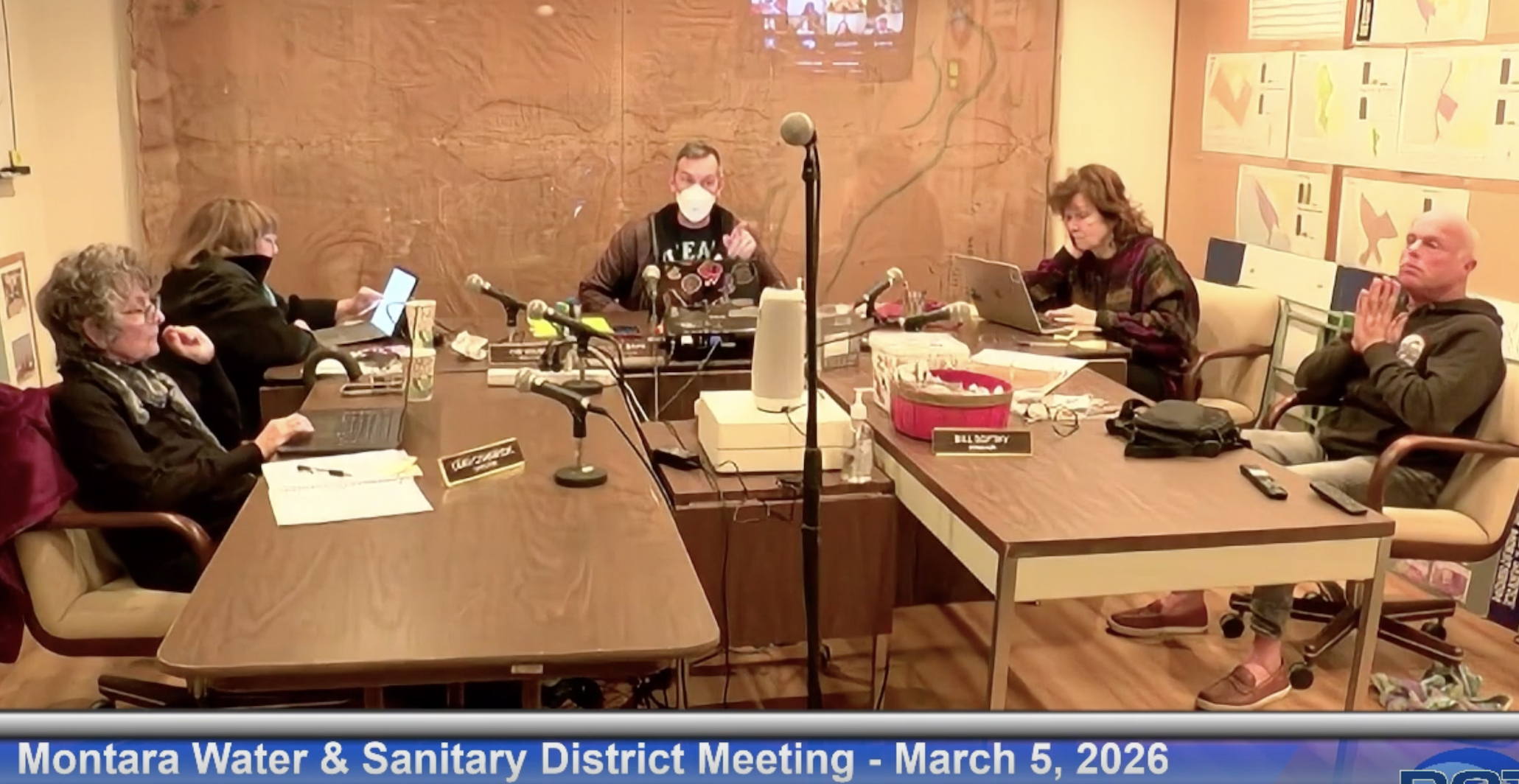
Board of Directors - Mar 05, 2026 - Meeting
Board of Directors • Montara Water and Sanitary DistrictMarch 5, 2026
Locunity is a independent informational service and is not an official government page for this commission.We use AI-assisted analysis and human editorial review to publish information.
Montara Marks End of Nine-Year Lawsuit, Locks In Federal Disaster Grants
The Montara Water and Sanitary District board opened its March 5 meeting with a declaration of victory: Half Moon Bay has declined to appeal a court ruling that dismissed all claims in a lawsuit that dragged on for nearly a decade. With that legal cloud lifted, the board moved to secure the district's future by unanimously approving participation in a federal hazard mitigation plan worth up to $3 million in pre-disaster grants — and staked out a firm position against any administrative merger of local water agencies.
Nine-year Half Moon Bay lawsuit officially over after the city declines to appeal a ruling dismissing all claims against Montara and Granada
Board votes 5-0 to join the 2026 FEMA hazard plan, preserving eligibility for pre-disaster grants of $500,000 to $3 million
Directors push back on consolidation, arguing the existing Sewer Authority Mid-coastside already captures efficiencies without sacrificing local control
Resident alleges Brown Act violation over broken website links; district counsel says the district is in compliance
Wildfire breakthrough: Caltrans funds a mitigation project on the Montara right-of-way after a year of community advocacy
The Lawsuit Is Over
Board President Scott Boyd opened the meeting with news that had been nine years in the making: Half Moon Bay has chosen not to appeal a court ruling that dismissed every claim the city brought against the Montara and Granada sanitary districts.
Why it matters: Ratepayers in both districts bore the financial burden of defending the lawsuit for nearly a decade. The ruling clears the path for renewed cooperation between agencies that share critical sewer infrastructure through the Sewer Authority Mid-coastside, known as SAM.
Where things stand: Boyd described the court opinion as thorough and well-written, and did not mince words about the toll the fight took, calling the lawsuit a "wasteful and costly burden" to their ratepayers.
Former board member Jim Harvey congratulated the district, board, staff, and counsel during public comment.
What's next: The concluded lawsuit was on the closed session agenda alongside 12 potential cases of anticipated litigation in Seal Cove. District Counsel Christine Fitzgerald announced that Board Member Carlysle Ann (Cid) Young would recuse herself from the Seal Cove closed session item because, as she lives within the affected area, she had a financial conflict under government code section 87100.
The lawsuit's conclusion also set the stage for two broader discussions later in the meeting — whether the board should pursue a strategic plan update and how to approach inter-agency cooperation going forward.
Board Locks In FEMA Grant Eligibility With Hazard Plan Vote
The board voted 5-0 to authorize Montara Water and Sanitary District's (MWSD) continued participation in the 2026 San Mateo County Local Hazard Mitigation Plan (LHMP), a federally required multi-jurisdictional document that opens the door to significant pre-disaster grant funding.
The basics: The LHMP is updated every five years and coordinated by San Mateo County. MWSD first joined in 2021 through a special district annex, which also allowed SAM to be covered as a sub-applicant. Under the Robert T. Stafford Act, participation is mandatory to receive any FEMA funding — both post-disaster reimbursement and competitive pre-disaster mitigation grants.
Why it matters: Without LHMP participation, the district loses access to FEMA pre-disaster grants ranging from $500,000 to $3 million. SAM already secured $500,000 through this program last year to relocate electrical equipment at its treatment plant that was vulnerable to flooding. For a small special district, the program has been transformative.
Where things stand: Tanya Yurovsky, Engineer with SRT Consultants, walked the board through the update process, explaining that the plan will include asset replacement values, risk assessments, and proposed mitigation projects drawn from the district's Capital Improvement Program. She noted that the program has leveled the playing field for small districts that were previously outmatched competing against larger jurisdictions.
Board Member Bill Softky pressed on three practical questions: how much money the district might receive, what obligations come with grants, and where the board has input on project selection. Yurovsky explained that proposed projects come from the board-approved CIP, and that grant recipients must complete funded work or face repayment.
Board Member Carlysle Ann (Cid) Young asked whether Seal Cove infrastructure would be covered. General Manager Clemens Heldmaier confirmed all district areas would be included.
Greg Diego submitted written public comment endorsing the district's LHMP leadership and urging a broader role in mid-coast public works infrastructure, noting that even if federal funding shifts, state climate bond funding and Measure K dollars may be available.
Decisions: The motion to authorize participation passed 5-0 (For: Boyd, Champion, Young, Slater-Carter, Softky; Against: none; Absent: none).
What's next: A follow-up universal resolution required by FEMA to formally accept grant funding will come before the board at a future meeting.
Board Draws a Line Against Agency Consolidation
Fire Is Global, Water Is Local
The SAM report triggered an extended philosophical discussion about whether mid-coast water and sewer agencies should consolidate — and the board was united: no.
Why it matters: With the Half Moon Bay lawsuit now concluded, the question of whether to merge local water and sewer agencies into a single entity could resurface. The board used this moment to preemptively define its position: the existing SAM joint powers authority already delivers the benefits of consolidation without eliminating local governance.
Where things stand: President Scott Boyd argued that anyone serious about consolidation should first demonstrate support for SAM, which already operates a consolidated administrative, operations, and field services team across three agencies.
"Anyone who wants to talk about consolidation, they really are sincere about trying to get the benefits of the consolidation — the best way to make that point would be to encourage productive cooperation in the current consolidated joint powers authority," said Boyd.
Vice Chair Kathryn Slater-Carter was direct about what merging would actually cost.
"What we would be losing in consolidation of governance is local representation," she said, adding that further consolidation would not reduce staffing needs.
Board Member Bill Softky framed the argument around the nature of the infrastructure itself, contending that while fire response benefits from cross-boundary coordination, water and sewer systems are inherently local.
"Administrative consolidation is, in general, a really dumb idea when you're dealing with in-the-ground infrastructure," said Softky.
Board Member Carlysle Ann (Cid) Young raised a financial concern: Montara's bond will be paid off in 2028, and merging with districts that haven't invested in their own water infrastructure could shift that burden.
The other side: Boyd reported that at a recent SAM meeting, Slater-Carter proposed a strategic planning session for SAM, but other member agencies were hesitant, still processing the end of the lawsuit. In a positive sign, Half Moon Bay had offered to help bring SAM under its umbrella for LHMP purposes — a gesture Boyd characterized as signaling a "new era."
What's next: Young raised a related governance request: the district's strategic plan is 11 years out of date, and she asked that the Strategic Planning Committee — on which she and Softky serve — be authorized to meet.
"Since we did solve the lawsuit now, and our strategic plan is 11 years out of date — can we now have a committee meeting for that?" said Young.
The request was noted for a future agenda.
Website Fight: Broken Links Spark Brown Act Accusation
Resident Presses; Counsel Pushes Back
Public commenter Michelle Dragony told the board that the district's recent website redesign broke links to agenda attachments going back six years, with 404 errors appearing when users click on past staff reports and minutes. She alleged the broken access constituted a Brown Act violation and said she had emailed multiple board members and staff without receiving a response.
Where things stand: President Scott Boyd pushed back firmly on the Brown Act claim, clarifying the legal standard.
"What's required under the Brown Act is that the current meeting agenda and materials have to be available and accessible. And that requirement under the Brown Act is satisfied and is consistently satisfied. Past records are a different matter and they don't fall under any kind of aegis of the Brown Act," said Boyd.
General Manager Clemens Heldmaier disputed broader characterizations of the website as dysfunctional, noting that specific items previously raised by Board Member Carlysle Ann (Cid) Young — electoral divisions and board member information — were in fact available. He acknowledged that form 806 committee assignments needed updating.
Board Member Bill Softky offered a pragmatic observation: link rot is an inherent challenge of maintaining digital records over time.
Boyd offered to meet with Dragony over coffee to troubleshoot specific broken links and encouraged anyone finding issues to report them.
The other side: Separately, public commenter Andrew raised months-old unresolved Public Records Act requests regarding documentation on Seal Cove infrastructure classification, asking the board to direct staff or counsel to provide responsive documents or a clear timeline.
Wildfire Win on the Montara Right-of-Way
General Manager Clemens Heldmaier shared a breakthrough in wildfire mitigation during public comment, reading from an email by Greg Diego of the local advocacy group RAMP. After just over a year of campaigning, a CEQA-documented, funded Caltrans project has been identified to address the overgrown right-of-way behind Montara — a persistent fire risk. Exemptions in the project documentation suggest the entire right-of-way may be covered, though a project map is still pending.
Separately, Heldmaier noted the San Mateo County Resources Control District's annual Chipper program is scheduled for May 26 and is seeking increased community participation to strengthen wildfire resilience. The district will post flyers and website notices.
Minor Items
Slater-Carter proposed removing the Mid-coast Council report from the board's regular agenda, citing dysfunction and irrelevance. Softky supported bringing the proposal as a formal agenda item at a future meeting.
Consent agenda approved 5-0 with no items pulled for separate discussion; specific contents were not detailed in the meeting.
Fitzgerald announced Young's recusal from the Seal Cove closed session item due to a financial conflict of interest under Government Code Section 87100.
Board entered closed session on two items: the concluded Half Moon Bay lawsuit and 12 potential cases of anticipated litigation in Seal Cove.