
Board of Directors - Apr 02, 2026 - Meeting

Board of Directors - Apr 02, 2026 - Meeting

Board of DirectorsMontara Water and Sanitary DistrictApril 2, 2026

Sources:

Locunity is a independent informational service and is not an official government page for this commission.We use AI-assisted analysis and human editorial review to publish information.

Montara Board Locks In $12.4M in Sewer Spending as Consolidation Debate Simmers

The Montara Water and Sanitary District board unanimously approved two Sewer Authority Mid-Coastside budgets totaling $12.4 million for fiscal year 2026-27 — a combined increase of roughly 16% driven by a new union contract and a looming sewer force main deadline. A resident's pointed call to merge the coastside's three sewer districts drew no formal response but clearly animated the evening's discussion, as board members used every budget line to argue the multi-district model still delivers value.

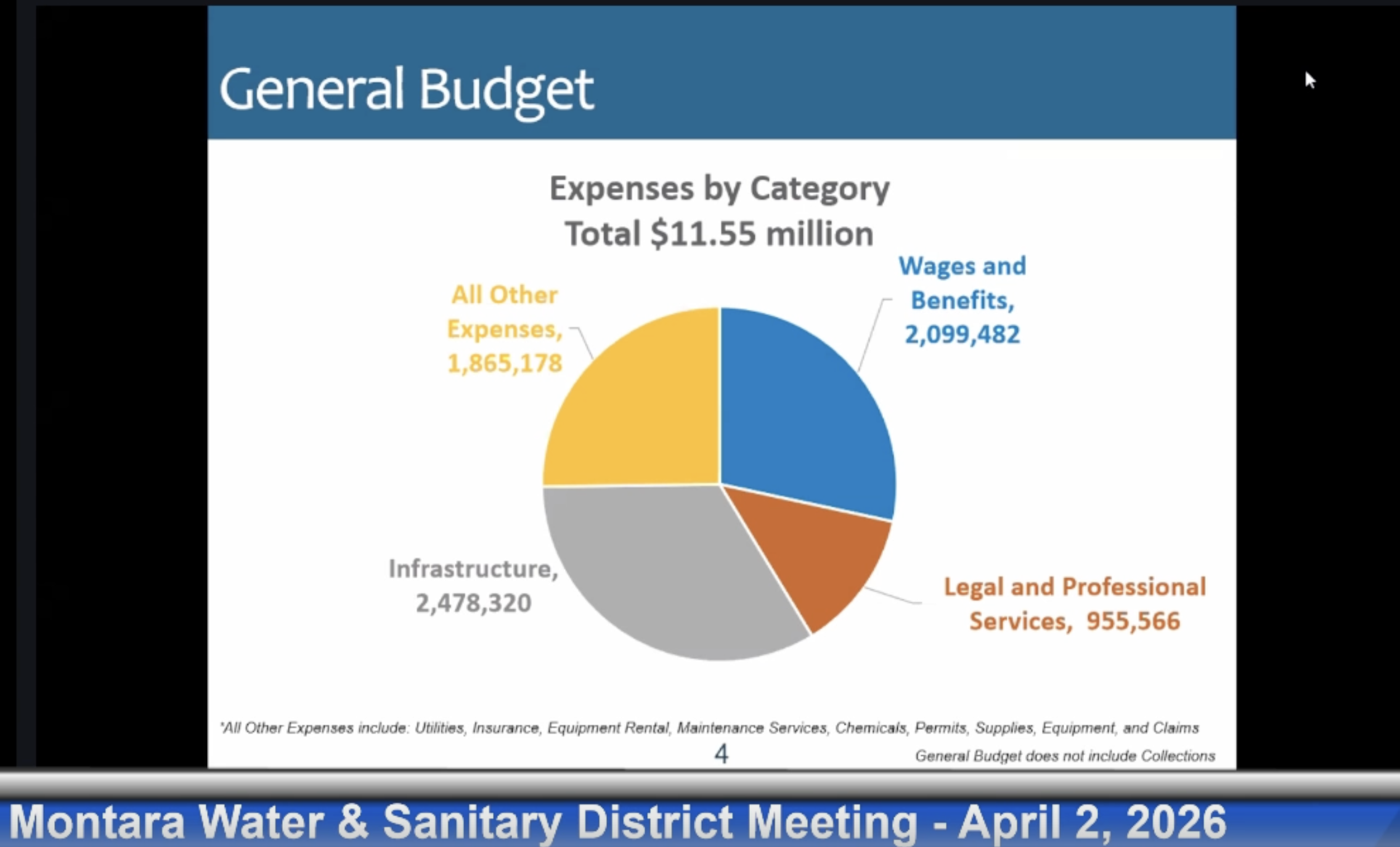
  • Board approves $11.5M SAM general budget, up 15%, with Montara's share at $2.35M

  • Separate $912K collections budget passes with 20% increase, reflecting union contract costs

  • Resident challenges the existence of three sewer districts, citing $2.9M in litigation spending

  • Board nominates Director Slater-Carter for LAFCO seat to advocate for special district independence

  • Another $131K in FEMA disaster funds received, pushing cumulative total past $1.7M

  • District counsel pushes back on Public Records Act allegations, calling them "unfair" to staff


Two SAM Budgets, One Message: Infrastructure Costs Are Climbing

The board consented to a pair of SAM budgets for FY 2026-27 that together represent the largest line items on Montara's books — and both are growing faster than inflation.

The basics: The Sewer Authority Mid-Coastside (SAM) operates the shared treatment plant and collection system serving Montara, Granada, and Half Moon Bay. Each member district approves SAM's budget annually. The general budget covers plant operations and capital projects; the collections budget covers pipe cleaning, pump station maintenance, and emergency response.

Why it matters: Montara ratepayers will absorb a $275,000 increase in their SAM general assessment, now $2.35 million (20.61% of flow). The collections tab adds another $355,000. Together, these obligations shape what's left for the district's own water and sewer operations.

Where things stand: SAM General Manager Kishen Prathivadi walked the board through the $11.5 million general budget — a $1.5 million (15%) jump over the current year. The biggest cost drivers: wages and benefits rising 9% under a Local 39 union contract signed in 2025 that provides 100% employer-paid health coverage; infrastructure spending climbing $605,000 (17%) to complete the Montara sewer force main by June 2027; a new $404,000 equipment line; and a roughly $401,000 increase in CalPERS unfunded pension liability.

Board President Scott Boyd framed the spending as unavoidable.

"There is one true thing about maintenance and repair for infrastructure, and that is it will never be cheaper than it is today," he said, noting that trenching costs have risen from $100–$150 per foot to $300 per foot.

Director Kathryn Slater-Carter commended SAM's zero-accident safety record, which keeps workers' compensation costs low.

"We've had no accidents there, so our workers' comp rates are very low and we don't have ongoing medical expenses for people who have been injured," she said. "That is a tribute to how well the plant is run."

Director Cid Young asked Prathivadi about cost-saving measures — a question she framed as a direct response to a public commenter's criticism of multi-district overhead. Prathivadi pointed to the Bay Area Chemical Consortium for bulk purchasing savings and ongoing FEMA grant applications to offset capital costs.

The resolution passed 5-0 (For: Boyd, Champion, Young, Slater-Carter, Softky; Against: none; Absent: none).

Collections: Why Montara Pays a Third

The separate $912,000 collections budget — up $149,000, or 20% — sparked the evening's most revealing exchange about why Montara's costs look disproportionate.

General Manager Clemens Heldmaier laid out the geography plainly:

"Half Moon Bay is gravity drain. Our system is mainly pumped. So that means we have 13 major pump stations and Half Moon Bay has one — and that's the cost."

Montara's 37% share of the collections budget reflects that infrastructure reality. The share actually dropped 1 percentage point because 35 Seal Cove grinder pump homes are no longer serviced by SAM — though SAM still maintains the lift stations in the area. Young confirmed the reduction applies only to those specific homes.

Boyd described the arrangement as straightforward fee-for-service:

"Whether it's a third, a half, or 100% — what we're paying for is what we need."

He noted that sharing the flusher truck and four-person maintenance crew already captures consolidation efficiencies.

Slater-Carter took the argument further, half-jokingly floating a counterproposal:

"Instead of trying to consolidate everything, I believe Montara should offer to run Half Moon Bay's public sewer district. I think we could do it for less money."

Prathivadi added that SAM was once the lowest bidder when a member agency explored outsourcing collections, and described how staff strategically park trucks at midpoints along the coastside to ensure one-hour emergency response times.

The budget passed 5-0.


Consolidation Question Hangs Over Every Line Item

Chad Hooker, a longtime Half Moon Bay community volunteer, used public comment to directly challenge the three-district model. He cited grand jury and Local Agency Formation Commission (LAFCo) reports recommending consolidation, pointed to $2.9 million spent on litigation between districts, and argued the coastside has too many boards, offices, and staffs for its population. He noted that the California Coastal Commission oversees 800 miles of coast with 12 board members, while the local water and sewer districts alone have 12 board members between just Montara and Half Moon Bay.

Hooker urged all three boards to either outline a transition framework or publicly justify the status quo. He also suggested the districts drop efforts to recover legal costs and redirect that energy toward cooperation.

Board members did not respond during public comment — citing pending litigation — but President Scott Boyd offered to meet privately. Throughout the meeting, however, directors indirectly made their case. Director Bill Softky argued the engineering reality undermines paper consolidation:

"It sounds good on paper, but certain kinds of large-scale things like fires require coordinated global responses. Sewage, though, flows downhill. And most of our problems now are from trying to transport sewage across three watersheds."

The tension between consolidation advocates and the board's defense of its model is unlikely to dissipate — especially with LAFCO's municipal service review on the horizon.


Slater-Carter Nominated for LAFCO to Champion Special Districts

The board adopted a resolution nominating Director Kathryn Slater-Carter for the open regular special district member seat on the San Mateo County Local Agency Formation Commission, the state body that oversees district boundaries, consolidation studies, and service reviews.

Why it matters: LAFCo decisions directly affect whether districts like Montara continue to exist as independent entities. Slater-Carter, who currently serves as LAFCO alternate, brings experience on cemetery boards, CSDA, and the Harbor District.

Director Bill Softky offered an emphatic endorsement:

"As competent and well versed in local government and well connected to people in it as anyone I could imagine. We could not ever do better."

Slater-Carter explained her motivation in terms that connected directly to the evening's consolidation debate:

"I would like to be there as a representative for water and sewer and special districts to say that special districts are generally fiscally sound, balanced budgets, and we stick to what our missions are. We don't keep trying to expand our missions and then need to talk about increasing taxes."

She referenced a letter from Supervisor Ray Mueller in which he said he couldn't control the Harbor District — a point she used to illustrate what she sees as the discipline gap between special districts and other agencies.

Decisions: The resolution passed 4-0 (For: Boyd, Champion, Slater-Carter, Softky; Against: none; Absent: Young). The election among special districts is expected in May for a four-year term through 2030.


FEMA Reimbursements Top $1.7M, With Montara as Sole Applicant

The board received an update that another $131,000 in FEMA/Cal OES disaster reimbursement funds arrived in early March, bringing the cumulative total to $1.719 million — all passed through Montara to SAM.

Why it matters: Montara was the only special district willing to serve as the FEMA applicant; Half Moon Bay declined the same opportunity. Engineering firm SRT administers the paperwork for both the district and SAM.

"We're really glad to be in a position to help SAM get this money," said Board President Scott Boyd. "Being able to apply for it had certain technical requirements and Montara was in a position to step up, team up with SAM, and help get this."

Director Cid Young credited SRT's essential role. Director Kathryn Slater-Carter drew a contrast with Half Moon Bay's decision not to participate, reinforcing the board's broader argument about institutional initiative.

The item was informational; the board directed staff to remit payment to SAM.


District Counsel Fires Back on Records Act Allegations

District Counsel Christine Fitzgerald responded to repeated allegations by residents that the district has not complied with Public Records Act requests related to Seal Cove. She stated the district has timely responded to over a dozen separate requests, identified responsive records, and produced documents on a rolling basis — a standard practice under PRA law when records span four decades across multiple departments.

"The repeated assertions at our meetings, on social media, at other agency meetings, that the district is not complying with the law absolutely and unfairly reflects on the diligent work of the district staff who've been processing these requests for almost a year," she said.

Director Bill Softky suggested posting all PRA responses on the district website for transparency. Director Cid Young noted that the same resident had raised PRA concerns at a LAFCO meeting to try to accelerate the municipal service review — linking the records dispute to the broader consolidation and governance questions facing the district.


Minor Items

  • Draft MWSD budget: Staff presented a preliminary skeleton of Montara's own FY 2026-27 water and sewer budget — earlier than in any previous year. The capital improvement program is not yet included. Next steps: review with the Treasurer, then the Finance Committee, then full board approval before July 1. Slater-Carter commended SAM's GASB-standard formatting for long-term transparency.

  • Caltrans Highway 1 corridor: Heldmaier cautioned the board to remain vigilant about Caltrans' Moss Beach corridor project and its intersection with Cypress Point sewer infrastructure. "We were ensured that this project will not result in cost to this agency, and I think we have to be very vigilant in ensuring that this is the case," he said.

  • Cell phone ban observation: Softky shared during board comments that he attended a San Mateo Unified High School District meeting where the board voted to implement a bell-to-bell cell phone ban — praising the public comment process and evidence-based policymaking.

  • Closed session: The board recessed to discuss property negotiations for 771 Rivera Road with Coast Wholesale Florist / Miller Havis Branch. No reportable action.

Montara Board Locks In $12.4M in Sewer Spending as Consolidation Debate Simmers | Board of Directors | Locunity