
Tennis Club Says Smaller Clubhouse Isn't an Expansion; Neighbors Push Back
Zoning Board of Adjustment • MillburnSeptember 28, 2026
Locunity is an independent informational service and is not an official government page for this commission. All information is sourced from public footage and an analysis of official agendas with the aid of responsible, fact-checked AI. to report an error or omission.
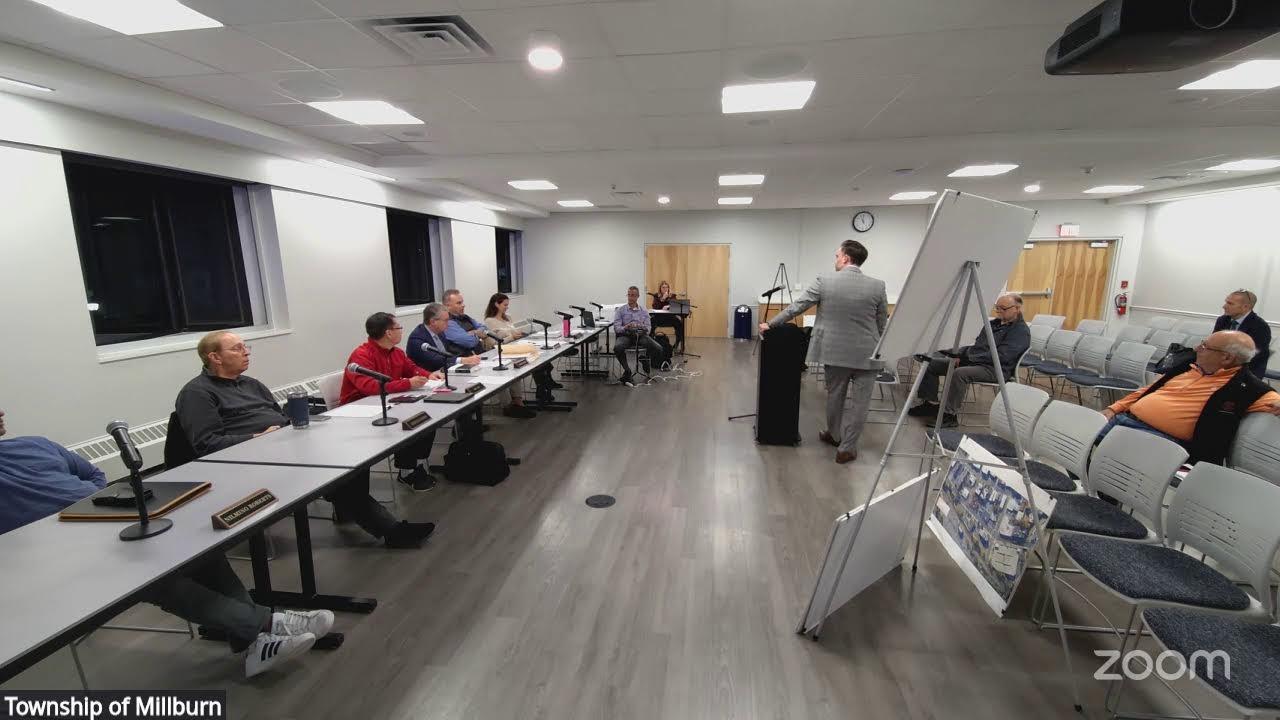
The Millburn Zoning Board of Adjustment spent more than two hours Sept. 28 on a century-old tennis club's argument that rebuilding its clubhouse shrinks the operation rather than expands it. Neighbors pressed on noise, parking and event counts. The board took no votes and continued both applications it heard, including a four-apartment project above Sakura restaurant on Essex Street.
- Tennis club argues its clubhouse rehab is a reduction, with the building shrinking from about 1,900 to just over 1,500 square feet.
- Club offers conditions: events end by 11 p.m., and only members can sponsor them.
- Written objections won't count without live testimony, the board attorney warned, ahead of the Oct. 5 hearing.
- Four apartments proposed above Sakura at 44 Essex Street with zero on-site restaurant parking.
- Board chair questions relying on the township's parking deck to fix a site shortfall. The project returns Oct. 19.
Smaller Building, Bigger Question
The basics: A nonconforming use is one that predates current zoning and would not be allowed under today's rules. The tennis club operates in the R-5 residential zone. Its fallback request is a D-2 variance, which counsel described this way: "we have supplemented our application and requested a D-2 use variance, which is an expansion of the nonconforming use," said the attorney for the tennis club.
Why it matters: The outcome decides whether the club can add a second-club partner without a full variance. Neighbors want limits on evening events and street parking.
Where things stand: Counsel laid out three arguments:
- The zoning officer's denial was issued late and lacked specificity.
- Shrinking the building means the project is not an expansion.
- If the first two fail, the board should grant a D-2 variance.
The club's planner said the project adds no courts, does not enlarge the footprint and adds no parking. The planner argued the project meets the legal tests for a variance: it advances planning goals and does not harm the neighborhood.
Proposed conditions would let court play begin at dawn or 7 a.m., whichever is later. Events would be sponsored by members, who must attend, and would end by 11 p.m.
A longtime member testified from 17 membership books. He said the club historically averaged about 29.7 member families per court, compared with about 31.7 today, with 190 memberships across six courts. He also presented party flyers from 1998 to 2005. He could not give firm counts of private rentals, estimating three or four in some months and none in others.
The other side: Public commenter Eric Humphreys asked how many private events the club would hold each year. Public commenter Judith Christian asked whether the club had financial or IRS records on clubhouse rental income.
Public commenter Teresa Morton, a longtime club member, questioned whether the flyers reflected events that actually happened. She noted they come from a different traffic era. She also said the 11 p.m. cutoff conflicts with the state's 10 p.m. noise standard.
The board attorney said the board cannot grant relief from the state noise code. "One of the exceptions to the state noise code is the human voice," said the board attorney.
Other residents raised drop-off congestion at a neighboring church school, blocked driveways and fire truck access on Wyoming Avenue and Upper Linden Street. The planner said larger events would likely use the larger Maplewood facility and called enforcement a police matter. The board chair said parking enforcement belongs to the township.
The board attorney also posed a hypothetical about a larger camp acquiring a smaller one. He flagged a possible procedural hurdle: "a site plan application would need to be submitted simultaneous with that request for a D-2 variance."
Decisions and stakeholder impacts: No vote was taken. Club members gain a partner if the board approves. Wyoming Avenue and Linden Street neighbors want firm caps on event hours and intensity.
What's next: The hearing resumes Oct. 5 at 7 p.m. at the library, with no further notice. It is likely the final session on the application, and public comment will be heard then.
Four Units, Zero Restaurant Spaces
The basics: Triple One Holdings LLC needs several kinds of relief:
- A D-5 variance for density.
- C-1 and C-2 bulk variances, based on hardship and planning benefits.
- Relief for parking and loading.
The site is a 0.14-acre lot at 44 Essex Street in the B-4 Central Business District.
Why it matters: The project is a scaled-down successor to a 10-unit proposal the board denied in 2022-2023. It would remove all 10 existing restaurant parking spaces, which tests how far the board will lean on public parking for downtown infill.
Where things stand: Zoning allows 25 units per acre, or about 3.5 units on this lot. "We are proposing 4 apartments instead of 3.55," said the attorney for Triple One Holdings. He argued res judicata, the legal bar on relitigating a decided case, does not apply to the smaller plan.
The engineer described a three-story building with 97.85% building coverage, above the 90% allowed. Parking stalls would measure 9 by 18 feet, smaller than the ordinance requires.
The plan provides seven residential spaces, including an ADA stall and an EV stall, against 8.2 required. "There are no on-site parking spaces for the restaurant," the engineer said. About 16 restaurant spaces would have to be found on the street or in the municipal garage.
The planner cited the site's location about 125 feet from the train station, the master plan and the 2021 Downtown Vision Plan. The planner also pointed to about 30 curbside spaces on Essex Street and a deck with more than 339 spaces after 6 p.m.
The other side: The board chair said the uses may be allowable but intensity is the issue. "We're putting a lot of burden now onto the township with this parking deck to solve, to cure the issues of this site," the chair said.
Decisions and stakeholder impacts: No vote was taken. The applicant made several commitments:
- Any employee who drives to work will buy a business parking permit.
- The applicant will follow comments in the police and fire reports.
- Pedestrian beacons will warn of cars leaving the garage.
Downtown commuters and garage users would absorb the restaurant's parking demand. The four apartments would add housing steps from the station.
What's next: With five board members present, the board carried the application to Oct. 19 with no further notice. It could move again to Dec. 7 if another matter proceeds.
Minor Items
- Notice dispute: Public commenter James Peter Kokalis, a Parkview Drive resident, said his household never received notice of the Triple One hearing. The board attorney found notice proper.
- Show up or be left out: Letters and expert reports, including an engineering report by Michael Petrie, will be excluded unless their authors testify and face cross-examination.
Looking Ahead
The tennis club hearing resumes Oct. 5 at 7 p.m. at the library, with public comment expected. Triple One returns Oct. 19. Residents who want their written objections considered should plan to testify in person.