
BP Tennis Wins Boyle Park Contract as Council Declares Storm Emergency
City Council • Mill ValleyNovember 2, 2026
Locunity is an independent informational service and is not an official government page for this commission. All information is sourced from public footage and an analysis of official agendas with the aid of responsible, fact-checked AI. to report an error or omission.
The Mill Valley City Council spent much of its Nov. 2, 2026, meeting on a fight over who will run the Boyle Park tennis courts. After roughly 90 minutes of testimony from supporters of two competing operators, the council approved a contract with BP Tennis LLC by voice vote. Earlier in the evening, members declared a local emergency ahead of El Niño storms and adopted a ranked bike and pedestrian project list designed to compete for grants.
- BP Tennis LLC chosen to run Boyle Park courts over HRT Tennis Academy's offer of $120,000 a year.
- Local emergency declared for king tides and El Niño storms, with an expected $400,000 budget hit.
- City manager expects the city to lose about $250,000 even after reimbursement.
- Bike and pedestrian priority list adopted, with reviews every 12 to 24 months.
Packed Hearing Ends With Council Backing BP Tennis
Why it matters: Boyle Park has had a tennis concessionaire since 1979. The vote keeps free drop-in play and a locally rooted operator in place, but it passes over a competing bid with a larger guaranteed payment to the city.
Where things stand: The longtime concessionaire, Chris Reef, retired. The city then issued a request for qualifications (RFQ), which drew three responses. A four-member committee recommended BP Tennis, and the Parks and Recreation Commission approved fees and endorsed the pick. Deputy Director of Arts and Recreation Jay Ingram said the agreement "maintains access to free drop-in play, and continues offering reasonably priced tennis programming." On rates, Ingram said "those fees are similar to what Chris Reef was charging, a little bit more." Only the revised USTA fees will return to the commission.
Councilmember Katherine Jones pressed staff on fee oversight: "It's my understanding that every time fees are adjusted, that this — the Parks and Rec Commission has to approve them." She also asked for comparison data.
The other side: HRT Tennis Academy General Manager and Tennis Director Hugo Calpart offered the city $120,000 a year, or $600,000 over five years. The bid also included free senior tennis, adaptive programs and scholarships. Calpart said more than 600 Mill Valley players already travel to HRT. HRT parents Libby Smiley and Bojana Berger asked the council to give the academy a chance, and Smiley sought an interview or in-person presentation.
Most speakers backed BP Tennis. They cited community, affordability and drop-in access, along with worry about concentrating public facilities under one operator. "I urge you to consider the consequences of placing another public facility under the same operator," said public commenter Andrew Shapiro. Public commenter Nancy Bailey pointed to HRT's existing contracts with Ross and Strawberry Recreation. Dan Baker described a tension between the public good and an elite pipeline. BP supporter Penny Gladstone asked for transparency on rates, clinics and CPI-tied increases, noting that comparable rates had not gone to the commission.
BP Tennis's Frank called both operators good but different: "My brand is, let's have fun, let's hit some balls."
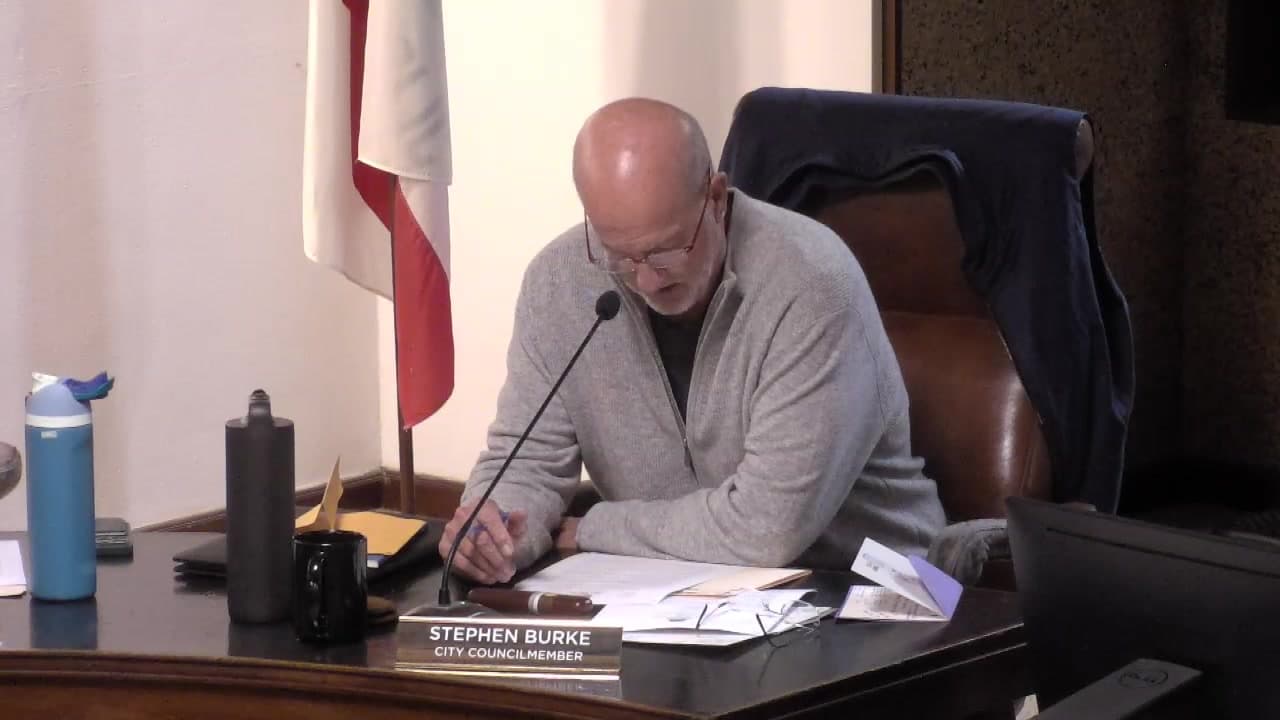
Decisions and stakeholder impacts: City Manager Todd Cusimano said the staff report never anticipated an appeal-style hearing and that "this council is set up in a horrible position." Councilmember Stephen Burke framed the council's role narrowly: "It's simply public comment. But it's not an appeal." Mayor Max Perrey put the test as "do we agree that the process went through its correct steps."
Members found nothing to overturn, and the resolution passed by voice vote with no tally recorded. Recreational players and drop-in users keep their current model. HRT's competitive families lose a local base, and the city forgoes HRT's guaranteed $120,000 a year.
What's next: Staff said the agreement takes effect Jan. 1, 2027. Revised USTA fees go back to the Parks and Recreation Commission.
City Enters Emergency Mode Before Winter Storms
Why it matters: The emergency proclamation gives the city manager expedited spending authority. Cusimano said it will cost money the city may not recover.
Where things stand: Cusimano said high tides alone closed Miller Avenue five times in 10 days. Staff have shifted planning from 7- to 7.5-foot king tides up to 8.5 feet. The proclamation relies on Government Code sections 8558 and 8630.
Staff will report at every council meeting and return within 60 days on whether to continue the emergency.
The cost breakdown Cusimano gave:
- About $100,000 in overtime
- Up to $200,000 in contract support
- About $100,000 in pre-planning
"That puts us at $400,000," he said, adding that reserves would not be tapped. Reimbursement is uncertain. He said recovering 25% would be a win: "I think we're going to lose 250,000." He also explained the city's risk-pool coverage.
The other side: No one opposed the measure, and there was no public comment. Burke asked whether staff who live outside Mill Valley might be housed locally during storm events. Jones asked about temporary barriers on Miller Avenue and at the Manzanita and Seminary exits. Cusimano answered both questions.
Storm worries also surfaced earlier, during public open time. Patrick Seidler, managing partner of WTB Partners LLC at 475 Miller Avenue, urged the city to clear the creek behind his property before winter. He cited the 1982 flood and said he had been told no permits are available after Oct. 15.
Cusimano said Flood Zone 3 and more than 30 private owners are involved along the creek, but he was firm on timing: "We will not let permits get in the way of keeping us safe during this storm season."
A separate emailed comment from resident Sam Houghton, read by City Clerk Hannah Politzer, said parked vehicles near 29 Rennes Road delayed an ambulance on Sept. 20, 2026. Cusimano said the road is eroding and no parking should be allowed there.
Decisions and stakeholder impacts: The resolution passed by voice vote with no tally. Residents near Miller Avenue and flood-prone creekside properties are the most directly affected. The general fund absorbs most of the cost.
What's next: Staff will give storm updates at each council meeting. A decision on continuing the emergency is due within 60 days.
Bike and Pedestrian Plan Becomes a Living List
Why it matters: A formally adopted ranked list positions Mill Valley for grants. It also lets staff pair bike and pedestrian upgrades with road work.
The basics: Appendix G updates the city's 2017 Bicycle and Pedestrian Plan. Projects are scored on safety, efficacy and grant potential.
Where things stand: Traffic and Mobility Advisory Committee Chair Bill Hoppen described "a ranked priority list that's going to get reviewed every 12 to 24 months."
Staff answered seven written questions from Jones:
- SB 1216 does not affect the proposed routes.
- A speed-limit study is a few years out.
- Staff opposed annual review.
- No timeline is set for a Class 4 (separated) bikeway on Miller Avenue.
Public Works Director Andrew Poster cautioned that listed projects "still need to go through the planning outreach development process."
Vice Mayor Caroline Joachim questioned the scoring: "Why do intersections use a 12-point maximum while bikeways and walkways use 15?" She also suggested adding proximity to senior living facilities as a criterion in the next iteration. Perrey floated Measure L as a backstop: "We look at Measure L as a funding source from the city."
Decisions and stakeholder impacts: Councilmember Urban Carmel called the plan a living document and recommended approval. Jones moved the resolution with Joachim's change, which labels the list the "city's current prioritized list." It passed by voice vote, and there was no public comment. Cyclists, pedestrians and advocates now get a regular window to reshape priorities.
What's next: The list will be reviewed again in 12 to 24 months.
Minor Items
- Sewer design: Council approved on consent a contract with Schaaf & Wheeler, up to $440,029, for 2027 sewer rehabilitation design. An $80,000 RHAA City Hall frontage design adjustment also passed.
- Holiday parking: Meter and kiosk payments will be suspended from Nov. 27 through Dec. 31, 2026.
- Transportation funding: Jones reported the Transportation Authority of Marin allocated $450,000 for Miller-Montford intersection planning.
- Police: Cusimano introduced incoming police chief Hamid Khalili. Third-quarter police data showed no outliers.
- Volunteer honor: The council named John Cutler a Volunteer All-Star for six decades of service to schools, the arts and senior groups.
Looking Ahead
Minutes from the Oct. 19 joint school district and council meeting were pushed to Nov. 16. The council recessed to a closed session on labor negotiations for unrepresented employees, and no outcome was reported.