
Midcoast Community Council - Jun 10, 2026 - Meeting
Midcoast Community Council • San Mateo CountyJune 10, 2026
Locunity is a independent informational service and is not an official government page for this commission.We use AI-assisted analysis and human editorial review to publish information.
DPW Unveils 14-Mile Paving Blitz as Residents Sound Alarm on Drainage, Governance
The Midcoast Community Council got its first comprehensive look at San Mateo County's 2026 public works pipeline — and immediately pushed back on the order of operations, arguing the county is repaving roads before fixing the flooding that damaged them. Meanwhile, two governance threats quietly moved onto the council's radar: a possible county push to raise the Midcoast's 40-unit annual building cap, and an accelerated state review that could consolidate local agencies.
County Department of Public Works (DPW) rolls out 14 miles of paving, $850K Marauder Road grant, and new bike infrastructure across Montara, Miramar, and Moss Beach — with school safety improvements near Farallone View
Residents challenge drainage priorities, arguing stormwater fixes should come before repaving and that the MCC's own stormwater report has been ignored
County LCP amendment and accelerated LAFCO review flagged as top threats to Midcoast self-governance and the 40-unit building cap
Half Moon Bay city council to consider funding a healthcare district study as coast-side medical access gaps persist
Evacuation safety concerns raised over proposed Main Street traffic calming after December 2024 tsunami warning exposed bottlenecks
The Big Briefing: DPW's 2026 Capital Plan
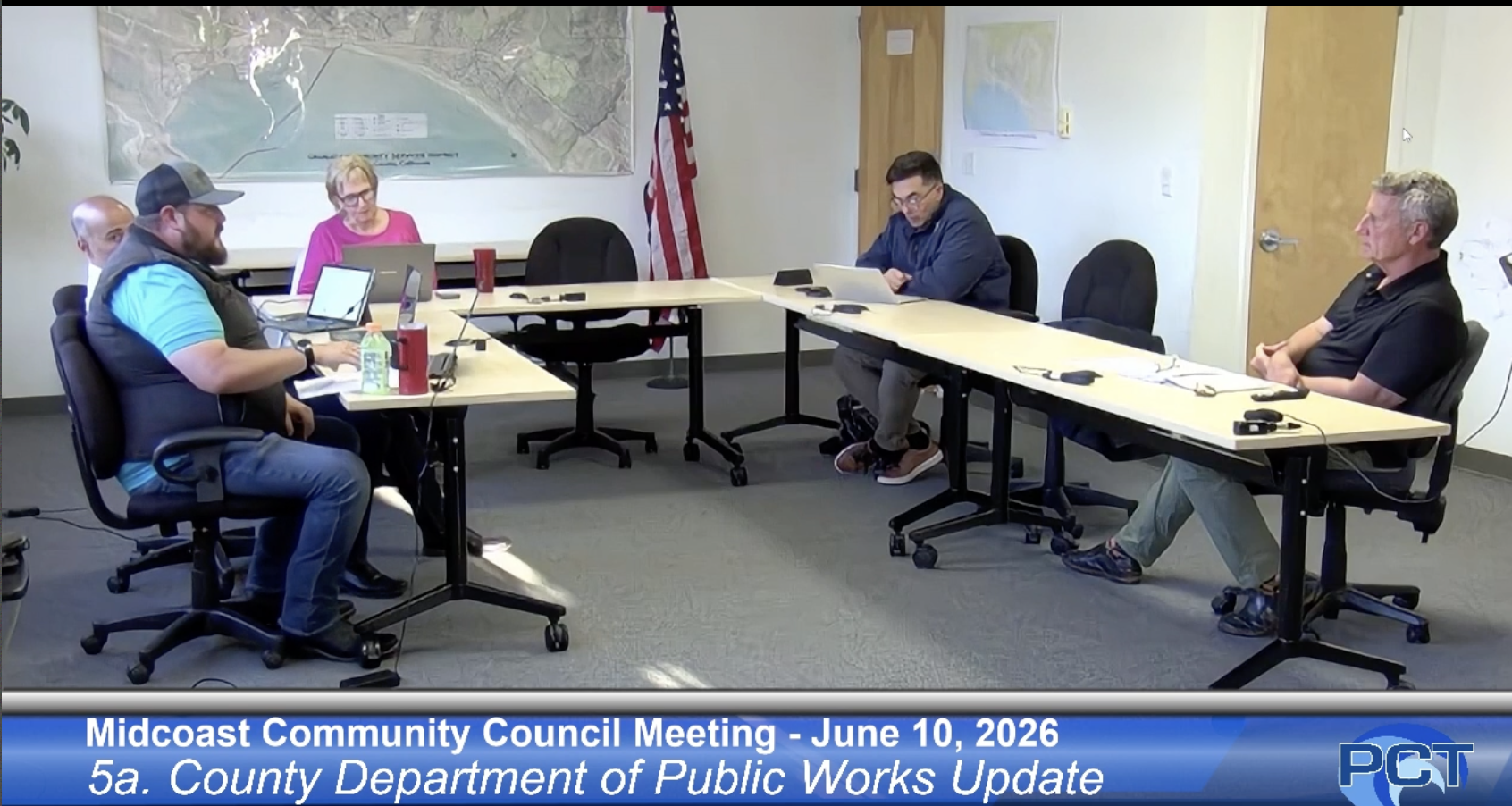
Krzysztof Lisaj, assistant director and county engineer at San Mateo County's Department of Public Works, delivered the most detailed infrastructure presentation the MCC has received in years — and proposed making it a regular occurrence, with structured spring and fall updates at council meetings.
Why it matters: The Midcoast has long complained of being an afterthought in county capital planning. DPW's commitment to attend at least twice a year — and actively seek community input during project development — represents a new framework for engagement.
"We value your guys' local knowledge, experience and perspective. And so we are seeking feedback on how and when the council would like to provide input during the project development," said Lisaj.
Where things stand: The pavement preservation project covers approximately 14 miles of roads in Montara and Miramar. Bids opened this week, the Board of Supervisors is scheduled to award the contract June 23, and construction is targeted for July. Work includes pavement repairs, micro surfacing, and improved striping and crosswalks consistent with the county's active transportation plan.
A separate coast-side resurfacing project — covering Alhambra, Obispo, and Capistrano in Moss Beach, roughly 1.5 miles — involves a full grind-and-pave treatment at about 60% design. That project adds concrete curb ramps, sharrows, enhanced pedestrian crosswalks, and potential Class 2 and 3 bike lanes.
Council Member Claire Toutant pressed on a longstanding community priority: safety near Farallone View elementary school.
"We have long been advocating for some safety measures for Farallone View school students and there's been a lot of difficulty getting anyone to actually take action about putting in school safety features like crosswalks," she said. Lisaj confirmed the project will address the school intersection: "We've specifically looked at the intersection right in front of the school and we are going to be looking how we improve crossings there — adding high visibility crosswalks, thinking about sight distances."
The other side: Public commenter Dan Haggerty raised the issue of colored concrete standards in El Granada, noting that ADA ramp work in the 1990s used specially colored concrete and that new improvements should match. "It was about the early '90s, there was a lot of concrete work done in El Granada, all of Avenue Alhambra down to the point where it branches to Obispo and it was specially colored," Haggerty said. Lisaj acknowledged finding the original source document and committed to returning to the council on the specific color requirements.
Fix the Flooding First: Drainage Fight Erupts Over DPW Priorities
The sharpest exchange of the evening came when multiple speakers challenged DPW's sequencing — arguing the county is spending millions to repave roads without first fixing the stormwater problems that destroyed them.
Why it matters: The MCC submitted a stormwater report to Supervisor Mueller in early 2024 identifying priority drainage projects. Residents say nothing has come of it, and that repaving without drainage fixes wastes public money.
Burnett Silvera asked pointedly whether DPW has incorporated the MCC's findings into its planning. "Is your department continuing to only rely on road crews' input to identify and prioritize stormwater projects, or has it incorporated the findings of that stormwater report into your planning process?" Silvera asked. She noted that higher-priority problems like Coral Quarry Park runoff remain unaddressed while lower-priority items have moved forward.
Gregg Dieguez framed the issue as one of basic logic: "One of the reasons the roads need to be resurfaced is because of the erosion and flooding. Were I to design this, I would do the flooding fixes first and then spend the money to repave the roads." He also proposed impact fees to fund dedicated stormwater work.
Lisaj acknowledged the gap, but was candid about the constraint: "I think historically the challenge we've always had with drainage is we don't have dedicated funding for drainage. And so we're really working to figure out how do we find that funding source to be able to support these types of initiatives."
What's next: DPW has issued an RFP for a Seal Cove surface drainage study, funded by the supervisor's office, to understand how surface water connects to the landslide. Proposals are due June 19, with a community meeting to follow once findings are available. Separately, the county secured an $850,000 grant for preliminary design and alternatives analysis on the Marauder Road long-term repair. That road was converted to one-way northbound with concrete barriers after severe erosion during the 2023 winter storms.
Evacuation vs. Traffic Calming: A Clash of Priorities
Degas also turned his fire on the proposed Montara Main Street traffic calming project, a $750,000 TDA Article 3 grant application that would improve connectivity between 7th and 10th Avenues with Class 3 bike routes, sidewalk gap closures, ADA ramp updates, bus stop improvements, and microsurfacing.
"We had a tsunami warning December 6, 2024 — a police officer was almost killed. We proved we can't get out. So the idea that we're going to put bump-outs on the curbs on Main Street is just going to make evacuation worse, and that should be the priority," said Degas.
Lisaj responded that the traffic calming measures align with the Board of Supervisors-approved active transportation plan. "That's something that's been reviewed, vetted and approved by the Board of Supervisors. And so we do look for opportunities to narrow lanes and provide multimodal access," he said, adding that the improvements also support congestion management requirements tied to building permits.
The tension between livability improvements and emergency egress is likely to intensify as the separate Moss Beach State Route 1 Congestion and Safety Improvement Project — which could include roundabouts, signals, turn lanes, and pedestrian crossings between Cypress Avenue and 16th Avenue — advances through design and environmental review. Construction on that project isn't targeted until 2032, but design decisions are being locked in now. A public meeting will be scheduled after Caltrans approves environmental documents.
County LCP Amendment and LAFCO Review Emerge as Top Governance Threats
Gregg Dieguez used both his public comment time and the retreat action items discussion to flag what he called the two most important issues facing the MCC: the county's proposed Local Coastal Program amendment and LAFCO's accelerated Municipal Service Review.
The basics: The LCP governs land use on the Midcoast, including a 40-unit annual building cap. LAFCO — the Local Agency Formation Commission — conducts periodic reviews of special districts that can lead to agency consolidation or reorganization.
Why it matters: Modifying the LCP building cap could allow significantly more development on the Midcoast. LAFCO consolidation could eliminate or merge the local agencies that currently give unincorporated communities a governance voice.
Degas laid out historical context to argue the county has not earned the community's trust on land-use planning: "With that backdrop on the county's previous land-use planning, they're ignoring the well-documented infrastructure and planning failures. They want to stick even more victims into this bottleneck evacuation death trap and bypass the democratic process by ignoring Midcoast representation." He cited planning failures at Seal Cove, where homes are sliding into the sea, Moonridge flooding, and Cypress Point's projected flood impacts.
Council Member Claire Toutant confirmed that Chair Kimberly Williams is awaiting word from Steve Monowitz at county planning on the LCP matter. Public commenter Dan Hagerty asked about the status of the 40-unit cap change, and Toutant confirmed there is a continued conversation.
Decisions: The council agreed to add both the LCP amendment and LAFCO Municipal Service Review to their retreat action plan at the next meeting.
Highway 1 Bike Lanes: Where Will People Park?
During public comment, Dan Hagerty raised an unresolved question dating back to when the Planning Commission approved Caltrans' coastal development permit for Highway 1 bike lanes. At that time, Planning Commissioner Lisa Ketchum asked whether vehicles could still park off the bike lane on gravel shoulders where adequate space exists.
"The specific question was, can they make it work when there's room — there's actual gravel and room for a car to park off of the bike lane on the side of the road," Hagerty said. That question remains unanswered. Hagerty noted rumors that all side-of-highway parking will be eliminated after bike lane installation and urged that limited parking be preserved wherever it is safe and physically possible.
Why it matters: Beach access parking along Highway 1 is already scarce. Eliminating all roadside parking would significantly reduce coastal access for visitors and residents — a flash point in a community where the coast is the main public amenity.
Half Moon Bay Weighs Healthcare District Study
Council Member Claire Toutant reported that the Half Moon Bay city council will vote at its next meeting on whether to fund a study examining the creation of a healthcare district. "The city council of Half Moon Bay is going to bring up at their next meeting whether or not to try to fund a study looking at a healthcare district. And depending on how that goes, we might be looking at one," Toutant said.
Why it matters: Coast-side communities lack adequate healthcare infrastructure. A formal healthcare district could bring dedicated taxing authority and services to an area that currently depends on distant facilities. New participants with authority recently attended the age-friendly working group meetings, including county health department staff who committed to following up with additional options.
What's next: The Medical Reserve Corps will present at the next MCC meeting regarding emergency medical resource needs on the coast.
Minor Items
Resilience center opens. Dave Cosgrove, staff to the Board of Supervisors, reported the San Mateo Event Center has completed a roughly $17–$18 million remodel of one of its halls, now equipped with a commercial kitchen, showers, and feeding facilities to serve as a mass sheltering site alongside Cal Palace.
Beach safety push. The county convened Cal Fire, the harbor district, state lifeguards, and county and state parks to improve summer safety messaging, with a focus on reaching people not currently engaged by existing outreach.
Highway 1 congestion. Cosgrove reported monitoring significant traffic backups caused by Caltrans work moving into Half Moon Bay, particularly at the North Main/92 and Kelly/1 intersections, where timed signals and lane reductions create extended delays.
Changeable message signs. Hagerty raised concerns about temporary electronic signs proliferating along the coast despite previous unanimous opposition from the MCC and Half Moon Bay to permanent signs.
Parking lot near Sam's. Hagerty warned that the Coastal Commission has approved a Harbor District parking lot north of Sam's restaurant on the west side of Highway 1, calling it a publicly funded gift to a private business that threatens El Granada views and blue heron habitat.
AT&T fiber in El Granada. Council Member Connie Santilli reported AT&T contractors are laying fiber optic lines in northern El Granada extending toward Almeria park, with splicing expected to take about two months. Council telecom liaison Nicholas Calderon is meeting with carriers this week.
Minutes deferred. The council voted unanimously (For: 6, Against: 0, Absent: 1 — Chair Kimberly Williams) to defer approval of April 30 and May 27 minutes to the next meeting.
MCC recruitment. The council tentatively reserved a 4th of July parade booth and plans tabling at all three area post offices before the July 13–Aug. 7 candidate registration window. Vice Chair Scott Bollinger appeared on Coastal Windage radio to promote the MCC and secured a quarterly return invitation.
Wildfire preparedness. Burnett Silvera proposed future agenda items on wildfire Zone 0 compliance, home hardening education, and real estate disclosure requirements, noting homeowners and contractors lack clarity on current standards.