
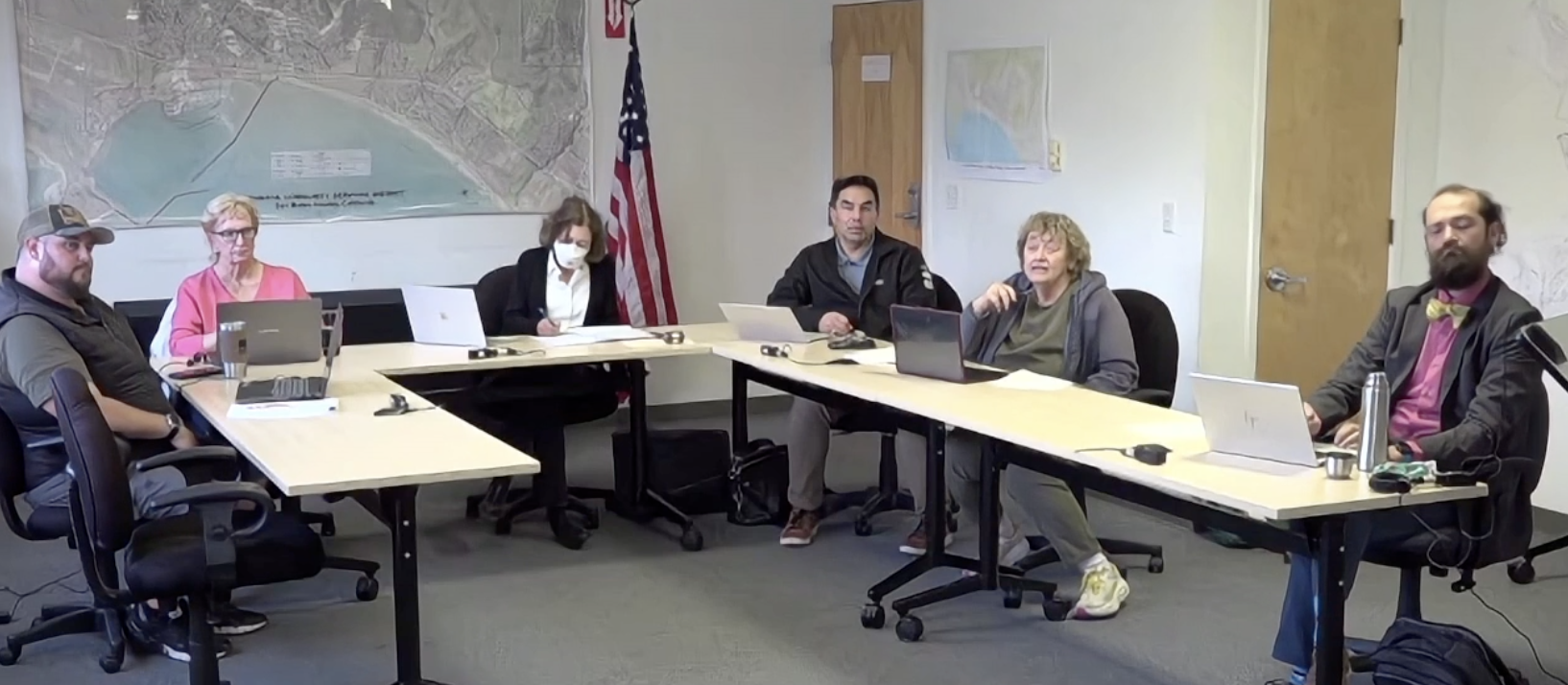
Midcoast Community Council - May 13, 2026 - Meeting
Midcoast Community Council • San Mateo CountyMay 13, 2026
Locunity is a independent informational service and is not an official government page for this commission.We use AI-assisted analysis and human editorial review to publish information.
Caltrans Launches Study to Save Highway 1 at Surfers Beach
The Midcoast Community Council's May 13 meeting was dominated by the coast's most consequential infrastructure challenge — protecting Highway 1 from the sea — alongside county wildfire mitigation plans hitting the ground this summer and a hazard mitigation plan that has already unlocked $111 million in federal funding.
Caltrans unveils nature-based options for Highway 1 at Surfers Beach, including artificial dunes, reefs, and beach nourishment, with a feasibility study targeting a fundable solution by summer 2027
County Parks deploys goat grazing and fuel breaks starting late June, removing 30-40 eucalyptus trees behind El Granada Boulevard homes and piloting goat crews near Montara
County hazard mitigation plan opens for public comment May 15, with a 30-day window that directly shapes which projects qualify for FEMA grants
Gas water heater replacement ban passes 10-8 at the Bay Area Air Quality District, forcing electric conversions after 2027 and raising cost alarms for older coastside homes
MCC faces July 1 election deadline with at least three seats up and one member term-limited; debate over who pays for candidate statements deferred to next meeting
Saving Surfers Beach: Caltrans' First Concrete Step
Caltrans District 4 Climate Adaptation Planning Branch Chief Cody Hedges delivered the meeting's marquee presentation — a concept plan and feasibility study for the eroding stretch of Highway 1 at Surfers Beach that has threatened the roadway for years.
The basics: The concept plan, prepared to comply with emergency coastal development permits, examines three Coastal Commission strategy frameworks: retreat (inland realignment including a viaduct), accommodate (elevated structure within the current right-of-way), and protect (nature-based solutions within the existing footprint). Hedges emphasized these are high-level explorations, not proposals.
Why it matters: Without the existing riprap, cliff erosion models show the bluff edge reaching the parking area by 2050. The feasibility study — funded by Caltrans headquarters in April — is the agency's first concrete step toward a fundable protection project.
Where things stand: The study aims to identify a near-term "programmable" solution by summer 2027, meaning one that fits within the state budget. "Programmable means that is it something that we can actually fit within our state budget given all of the other projects that are going across the state," said Hedges.
Nature-based options under consideration include artificial dunes (constrained by limited space), artificial reefs (with concerns about disrupting surfable waves at a beach named for them), and beach replenishment building on the harbor district's October sand project. Hedges noted his team will incorporate the harbor district's beach monitoring data.
Hedges stressed urgency: "We probably should have had these conversations earlier. And it's only progressively getting worse." He also noted the project carries political weight within the agency: "When District 4 says we need money for this, usually we tend to get it because our coastline is 40% of the coast of the entire state."
The other side: Public commenter Dan Haggerty praised the presentation but pushed for immediate action, encouraging sand replenishment within the existing riprap as a near-term maintenance strategy rather than waiting for the full study. Carlysle Ann (Cid) Young, Montara Water and Sanitary District Board Member, asked about the retreat concept's impact on the fire station's location. Councilmember Claire Toutant praised the collaborative approach, saying the presentation "perfectly sums up what the MCC has been working on along some of these issues for some time now is to try to get buy in from everybody."
What's next: A public open house is planned for June or July. The feasibility study would then feed into a formal project initiation document process.
Goats, Chainsaws, and Fuel Breaks: County Parks' Wildfire Push
Evan Cole, Natural Resources Manager for San Mateo County Parks, outlined an aggressive summer wildfire mitigation slate that puts crews — and livestock — directly behind midcoast neighborhoods.
Why it matters: The Quarry Park fuel break and goat grazing near Montara represent the county's expanding wildfire defense for residential areas on the midcoast, with work starting in weeks.
Where things stand: Completed projects this fiscal year include 10 acres of shaded fuel break at Junipero Serra Park (FEMA-funded), 5.6 acres at San Bruno Mountain, and 60 acres of understory thinning at Pescadero Creek Park under a Cal Fire forest health grant.
The headline summer project: removing 30-40 eucalyptus trees across roughly an acre at Quarry Park along El Granada Boulevard, starting in mid to late June. "There's a huge thicket of eucalyptus just underlying some houses off of El Granada Boulevard," Cole said. "We've met with contractors and we're in the selection process now."
Cole also described pilot goat grazing programs at Edgewood and near Montara East as a maintenance tool for previously completed fuel reduction sites, calling it "a pilot to see how goats can work to provide that maintenance benefit with the hopes that we can expand them as a more active tool."
Environmental safeguards include nesting bird surveys, rare plant flagging, and worker environmental awareness training for contractors. Cole said his team would go out the following week to flag sensitive plants in the field.
The other side: Dan Haggerty expressed enthusiasm for the goat program, noting he had suggested it six years prior. Melinda McNaughton flagged potential monarch butterfly roost sites near Montara East eucalyptus groves and offered to connect Xerces Society data; Cole confirmed awareness of the monarch's candidacy for Endangered Species Act listing. Cid raised concerns about severe stormwater runoff from Quarry Park that floods neighboring streets; Cole acknowledged the issue but said his team handles vegetation, not infrastructure.
$111 Million and Counting: Hazard Plan Opens for Public Comment
Councilmember Connie Santilli, who serves on the Local Hazard Mitigation Plan steering committee, and Ryan Reynolds, Assistant Director of San Mateo County Emergency Management, presented the 2026 LHMP update — a federally required five-year plan that covers earthquake, drought, landslide, severe weather, wildfire, tsunami, sea level rise, dam failure, and flooding.
Why it matters: The LHMP maintains eligibility for the FEMA Hazard Mitigation Grant Program. Reynolds put the stakes bluntly: "Because of this plan we have been able to bring in $111 million for these types of projects across the entire county."
Where things stand: The 2021 plan included 700 mitigation actions across 36 local government agencies. Coastside participants include Half Moon Bay, Coastside Water District, MWSD, Mid-Peninsula Regional Open Space, and the Harbor District. Reynolds acknowledged the federal funding picture is uncertain: "There is the hazard mitigation grant program, which does have significant funding that's available. It's a bit mixed right now, I'll be honest."
Sid offered a concrete example of the plan's value, sharing that MWSD's prior LHMP participation enabled FEMA reimbursement of a couple hundred thousand dollars after a 2023 near-overflow event — while Granada gave up on the paperwork and Half Moon Bay did not apply at all. Santilli urged the council to track participating agencies' mitigation project status over time.
What's next: The draft plan will be posted May 15 with a 30-day public comment period through June 15, followed by Cal OES review and FEMA submission.
Gas Water Heater Ban Hits Home for Older Coastside Housing
David Cosgrave, a staffer in Supervisor Mueller's office, reported that the Bay Area Air Quality District voted 10-8 to pass Regulation 9.6, banning replacement of gas water heaters with gas appliances after 2027. Supervisor Mueller voted against it.
Why it matters: Coastside homes from the 1960s often have small utility panels and knob-and-tube wiring, meaning an electric water heater conversion could require extensive and costly electrical upgrades — including PG&E permits for panel replacement.
"If a water heater goes out, that's a gas appliance. After 2027, it will not be able to be replaced with gas, and the homeowner will have to convert to electric," Cotsgrave said. Low-income and financial burden exemptions exist, but Cotsgrave noted the process for obtaining them remains unclear.
Election Deadline Looms With Multiple Open Seats
Chair Kimberly Williams outlined a July 1 deadline for submitting election materials to the county elections office, including jurisdictional boundaries, number of open seats, and candidate statement details. Three current members — Williams, Vice Chair Scott Bollinger, and Councilmember Gus Mattammal — are up for potential reelection, while Councilmember Claire Toutant has reached her term limit.
Why it matters: Historically low candidate interest threatens council vacancies. Whether the MCC subsidizes candidate statements could influence who runs.
Where things stand: The council confirmed it will continue with at-large elections. Discussion focused on whether the MCC should cover candidate statement costs, estimated between $50 and $1,400 depending on various factors. Dan Haggerty argued strongly for the council paying, contending that $700-800 fees discourage volunteer candidates. Sid mentioned MWSD's $200 cost. Councilmember Connie Santilli volunteered to call the elections division for exact pricing and to check whether volunteer positions qualify for fee waivers.
Decisions: The formal vote on a resolution was deferred to the next meeting. The council also discussed outreach through newspapers, Nextdoor, post offices, and farmers' markets.
Coastside Healthcare: Mueller Explores District Model
Cotsgrave also reported that Supervisor Mueller is exploring a healthcare district model similar to the Peninsula Healthcare District to give the coastside oversight of local healthcare. Mueller is scheduling meetings with Seton operators to get an official timeline for emergency service standby room reopening. He is also exploring whether the COI clinic at 225 Cabrillo could accept private insurance and perform lab specimen collections, and engaging Kaiser given its estimated 60-70% market share of coastside residents.
Councilmember Claire Toutant noted that the Age Friendly Healthcare Advocacy Committee, on which she and Santilli serve as MCC representatives, appears to be working in parallel without coordination from the supervisor's office and asked for better alignment. Cotsgrave committed to following up.
Minor Items
April 22 meeting minutes approved 5-0 via roll call (For: 5, Against: 0, Absent: 0). April 30 retreat minutes postponed to next meeting.
Seal Cove road conditions: Public commenter Alan Moss read a detailed letter to county staff documenting sinkholes, unrepaired water main damage, and county inaction on San Lucas Avenue — including the county's refusal to issue MWSD a permit for water main repairs — ahead of a forecast severe El Niño winter.
Planning Commission design review: Chair Williams reported the commission advanced bird-safe glass requirements championed by Green Foothills and a 2200K lighting standard for new construction (not retroactive) to the Board of Supervisors. Williams said the standards don't go far enough and the MCC may pursue a separate lighting ordinance.
MWSD board seat open: Cid announced the Montara Water and Sanitary District needs a candidate from the Moss Beach Heights area for the November election.
Retreat follow-up deferred again; task assignments not yet complete.