
Midcoast Community Council - Mar 25, 2026 - Meeting

Midcoast Community Council - Mar 25, 2026 - Meeting

Midcoast Community CouncilSan Mateo CountyMarch 25, 2026

Sources:

Locunity is a independent informational service and is not an official government page for this commission.We use AI-assisted analysis and human editorial review to publish information.

Council Backs Strongest Dark-Sky Lighting Standard as Moss Beach Highway 1 Overhaul Takes Shape

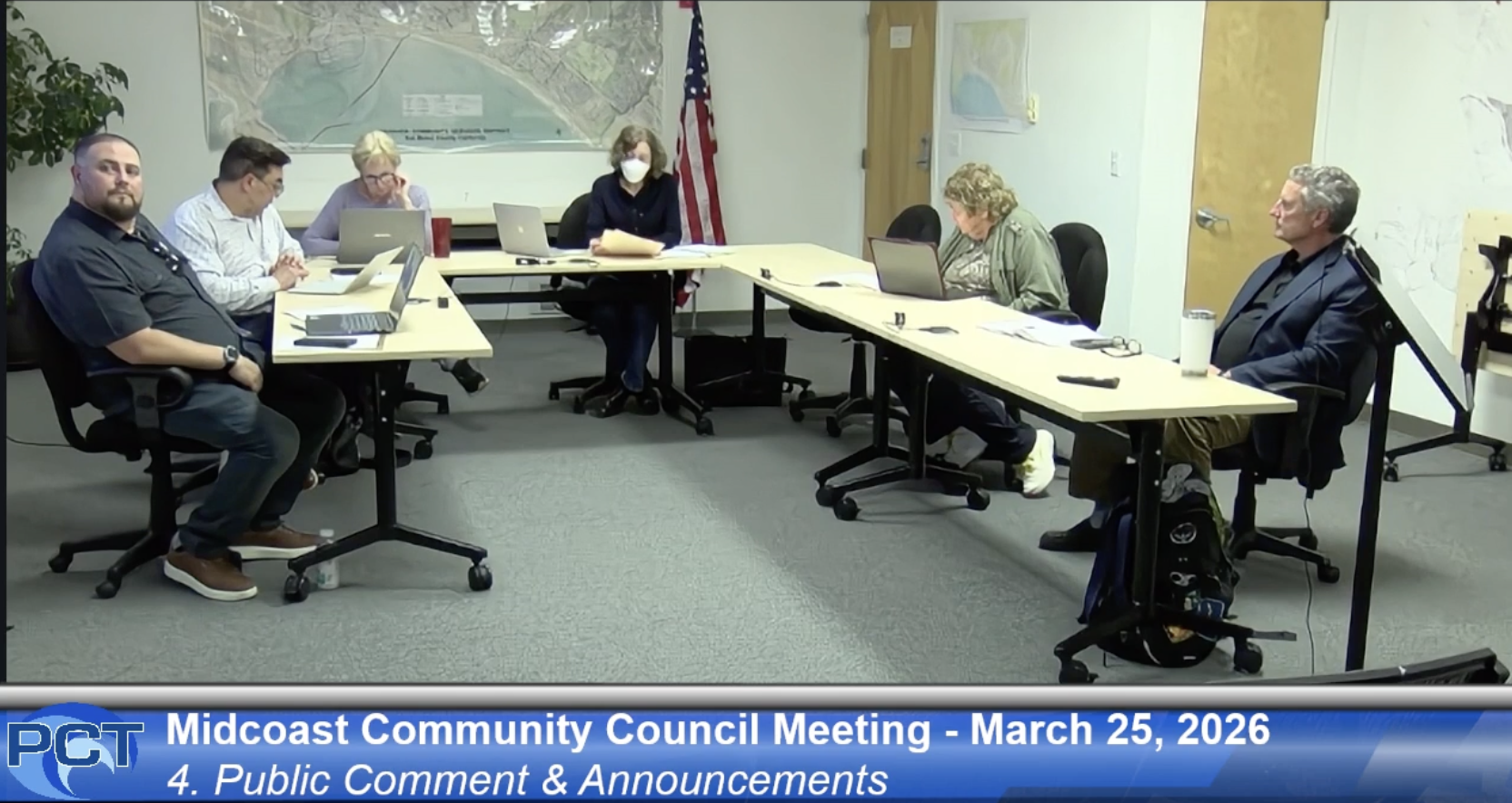
The Midcoast Community Council swore in two new members, then dove into the policy debates that define life on San Mateo County's unincorporated coast: how bright the lights should be, how dangerous Highway 1 intersections should be fixed, and whether cell towers will keep working when the power goes out. The March 25 meeting produced one formal policy action — a unanimous letter demanding the Board of Supervisors reject a weakened exterior lighting standard — and set the stage for a pivotal spring of infrastructure decisions.

  • Council unanimously approves letter demanding 2200K dark-sky lighting limit, rejecting the planning commission's last-minute 3000K standard ahead of an April 8 Board of Supervisors hearing

  • Two build alternatives for Moss Beach Highway 1 — roundabouts vs. signals — head toward a draft environmental document expected May 2026

  • County pushes T-Mobile, AT&T, and Comcast for 72-hour battery backup on coastal cell towers through a new CPUC (California Public Utilities Commission) rulemaking process

  • Residents blast Caltrans for making Highway 1 intersection changes and proposing bike lanes without public input

  • Antonio Conte and David Santoro sworn in, giving the council a full seven-member roster for the first time

  • Fast-track grant application for Montara Main Street sidewalk and bus stop improvements due April 16


Dark Sky Fight Heads to the Board of Supervisors

The most consequential action of the evening was the council's unanimous approval of a detailed comment letter urging the San Mateo County Board of Supervisors to adopt a 2200 Kelvin color correlated temperature limit for all exterior lighting under the updated Coastside Design Review Standards — a significantly stronger standard than the 3000K limit the county planning commission adopted at its last hearing.

Why it matters: The difference between 2200K and 3000K is the difference between the warm amber glow already installed at El Granada Elementary School and along coastside streets, and the cooler, bluer light associated with commercial strip lighting. The 2200K standard would make the midcoast one of the Bay Area's most protective dark-sky communities, affecting wildlife habitat, scenic Highway 1 viewsheds, and residential quality of life.

Where things stand: Chair Kimberly Williams spent weeks researching the issue, consulting directly with Dark Sky International. She reported that the planning commission's 3000K figure — championed by a design review committee member — represents a bare minimum, not a recommendation.

"I even called Dark Sky internationally because planning and building seems to have this idea that dark skies recommending 3,000 color correlated color temperature. And that's actually not the case. 3000 is the cutoff. It's the least thing that you can do. And then 2700 and 2200 are the actual recommended levels," said Chair Kimberly Williams.

The letter also proposes a 3-to-5-year phase-in period for existing noncompliant lighting — far more generous than the county's proposed one-year timeline — and includes model complaint language drawn from Dark Sky International and the Coastal Commission. The council voted to include provisions removing subjective language about "convenience, happiness and comfort" from the standards and adding a formal complaint procedure.

The other side: Member Connie Santilli raised concerns about retroactive requirements but accepted the phase-in provision as a workable compromise. Public commenters were enthusiastic. Steve Terry noted that a District 3 planning commissioner had searched Amazon and found pages of 2200K bulbs readily available. "So that turned out not to be a real issue," he said. Dan Haggerty praised the El Granada School lighting as a model and raised broader concerns about box-style homes eroding community character.

Decisions: Approved 6-0 (For: Williams, Toutant, Santilli, Bollinger, Santoro, Conti; Absent: Mattammal). The letter is addressed to the Board of Supervisors, the planning commission, and the planning and building department.

What's next: The Board of Supervisors is scheduled to consider the design review standards update on April 8 — making this letter a direct input to an imminent decision.


Roundabouts or Signals? Moss Beach Highway 1 Project Nears Its Biggest Milestone

County of San Mateo Senior Transportation Planner Chanda Singh presented the most detailed public update yet on the Moss Beach State Route 1 Congestion and Safety Improvements Project, which covers Highway 1 from Marine Boulevard to 14th Street. Funded by the San Mateo County Transportation Authority through Measure W, the project is in its Project Approval and Environmental Studies phase — and the draft environmental document comparing two build alternatives is expected in May or June 2026.

The basics: Alternative 1 features roundabouts at Cypress Avenue and California Avenue with a traffic signal at 16th Street. Alternative 2 puts traffic signals at all three intersections. A roundabout at 16th Street was ruled infeasible due to grade differentials. Both alternatives include bicycle, pedestrian, and transit improvements, including a Class 1 parallel trail where feasible.

"The primary difference between the two options is looking at roundabouts at the intersection of Cypress Avenue and California Avenue and a signal at 16th Street and realigning Carlos to meet 16th, or traffic signals at those same three locations," said Senior Transportation Planner Chanda Singh.

Where things stand: The environmental review covers biological resources, cultural resources, transportation modeling, noise, and air quality. Singh noted that Class 4 separated bike lanes were considered but rejected because of emergency shoulder access concerns. "One of the reasons we did not pursue that was because of the concern around not having a shoulder space and not being able to use that space in the case of an emergency," she said.

Vice Chair Scott Bollinger raised cyclist safety in roundabouts. Singh explained cyclists can either take the lane through the roundabout or use the parallel trail. Antonio Conti, in his first meeting as a council member, asked about emergency evacuation analysis — Singh confirmed it is a factor in the study.

Public comment was robust. Cid Young urged a strong preference for the Cypress Avenue roundabout, citing growing traffic from the Big Wave development, Seal Cove, and Pillar Ridge neighborhoods. "I really hope they don't try to cheap out and give us a damn stoplight there because it's horrible trying to get out on a weekend there," he said. He also recommended the county use the LADRAS AI evacuation software and coordinate with Montara Water and Sanitary District on sewer construction at 16th and Carlos streets.

Steve Terry pressed on whether Highway 1 bike lanes are mandatory or a community choice, arguing the parallel trail should be promoted over bike lanes in a high-speed zone. Singh acknowledged community input matters but noted constraints: "The community can weigh in on lots of things, but not everything is going to be a decision point that can be made by the community." Caltrans complete streets policy and previously adopted plans make bike lane inclusion likely.

Dan Haggerty pushed for acknowledgment that any intersection controls will increase congestion, and raised concerns about parking loss from bike lanes that he said were not communicated during the Connect the Coastside planning process.

What's next: A public meeting is planned at Farallon View Elementary School to coincide with the draft environmental document release in May or June 2026. Singh also announced a follow-on TDA Article 3 grant application for Montara Main Street improvements.


County Negotiates 72-Hour Battery Backup for Coastal Cell Towers

Deputy County Executive Nicholas Calderon, who has served as the midcoast's county liaison for 15 years, reported that negotiations with T-Mobile, AT&T, and Comcast over closing the coastside fiber loop and securing emergency battery backup for cell towers are producing tangible progress — and a new regulatory opening could give the effort real teeth.

Why it matters: Winter storms and Public Safety Power Shutoff events routinely leave midcoast residents without cell or internet service. The lack of redundancy is not just an inconvenience — it is a public safety threat during emergencies.

Where things stand: Calderon reported that the CPUC is preparing to open a rulemaking process that could create a fire-threat category requiring 72-hour battery backup on cell towers. "The CPUC is going to be opening up a rulemaking process shortly that may provide an opportunity to create a category in their fire threat program that would allow us to designate the midcoast and the south coast," he said.

The approach would be strategic rather than blanket. "We don't need to have a battery added to each site. What we need to be able to do is work with the individual telecommunication companies to look at where all of their facilities are and strategically add batteries or generators, recognizing that when one tower goes down, the surrounding towers can actually increase the output of power to close that gap," Calderon explained.

Member Connie Santilli pressed on a different dimension of the problem — residents in back-of-Montara areas who have no connectivity at all, not just unreliable service. "People don't have connectivity at all. So it's not just a matter of redundancy or for emergency, it's really expanding service further back in some of those areas where there isn't any connectivity today," she said, referencing the CRISP report's recommendation for community-owned towers at Alta Vista and Buena Vista. Calderon confirmed awareness and said the county is working to have carriers voluntarily extend coverage.

A separate complication: the CPUC's fire threat maps, which determine where the 72-hour standard would apply, haven't been updated since 2019 and currently don't cover the midcoast. Santilli reported that she and Supervisor Mueller's office are pushing the CPUC to update the maps, but the agency's policy is to update only every 10 years.


Residents Blast Caltrans Over Highway 1 Changes

Caltrans was originally scheduled to appear before the council but canceled, leaving a vacuum that three public commenters filled with pointed criticism of the agency's Highway 1 modifications and communication failures.

Harvey Gaylin described a dangerous double left-turn lane extension at Capistrano Road and Highway 1 that he said nearly caused collisions, noting Caltrans had already blacktopped over the changes. He expressed deep concern about proposed bike lanes in a 50 mph zone that would eliminate parking for Surfer's Beach.

Steve Hawk asked whether Caltrans would hold a community meeting for public input and reiterated widespread concern about parking removal and the absence of a public forum.

Dan Haggerty provided detailed comments about oversized concrete foundations, the loss of decorative cobblestone at the Capistrano intersection, and what he characterized as a complete lack of communication from Caltrans about the scope and purpose of its work.

What's next: Chair Williams said she is working to get Caltrans on the April agenda.


Two New Members Give Council a Full Roster

County Counsel Tim Fox traveled to the meeting in person to administer the oath of office to Antonio Conte and David Santoro, filling two vacancies on the seven-member council. Both chose to swear rather than affirm. Member Gus Mattammal was absent. The full roster allows the council to take on more committee assignments and advance coastal priorities heading into a planned retreat.


Montara Main Street Grant on a Tight Clock

Senior Transportation Planner Chanda Singh described a TDA Article 3 grant opportunity for Montara's Main Street — resurfacing between 7th and 9th streets, filling sidewalk gaps, and upgrading a basic bus stop near the post office. The grant application is due April 16, requiring a fast-tracked MCC support letter.

Chair Williams flagged an important design consideration: Montara historically chose not to have sidewalks and uses amber lighting to conform with dark-sky principles. "Montara is kind of special because they actually as a community chose not to have sidewalks. That could be why there's a gap. So that's something to be aware of," she said.

Members Claire Toutant and David Santoro volunteered to draft the letter. Member Connie Santilli raised concerns about the community not having time to review the letter before the vote, but the council agreed public comment would be taken at the April 8 meeting when the letter comes up for a vote.


Minor Items

  • March 11 meeting minutes approved 6-0.

  • Council retreat tentatively set for April 24, 2–6 p.m., with April 9 as a fallback.

  • Gmail storage crisis: Facing an April 3 deadline that would lock the council out of its primary email account, the council authorized up to $50/year for additional Google storage (approved 6-0). Chris Lynn, a community member with Google expertise, offered to help identify space-consuming files. David Santoro suggested establishing a formal records retention policy; Chair Williams noted a two-year state minimum and seven-year advisory under the Brown Act and Public Records Act.

  • Half Moon Bay Vice Mayor Deborah Penrose reported the city is in early discussions about annexing the Bay City Flowers property along Highway 1, and that Captain Eamon Allen of Moss Beach was selected as the new coastside sheriff's captain.

  • Vice Chair Scott Bollinger reported on a meeting with Supervisor Mueller covering generator enforcement, e-bike ordinance expansion, and RV enforcement — noting San Mateo County lacks a specific RV ordinance unlike Pacifica and Half Moon Bay.

  • Member Connie Santilli reported on age-friendly initiatives including exploring a health district, a $500,000 funding gap for an urgent care clinic, and the local hazard mitigation plan, which needs community input through May for FEMA grant eligibility.

  • Chair Williams described community input at a harbor district parking lot design meeting, where residents raised concerns about landscaping, stormwater, RV storage impacts on trail views, and what she called the misleading characterization of the lot as "safe surfers beach parking."