
Midcoast Community Council - Jun 24, 2026 - Meeting

Midcoast Community Council - Jun 24, 2026 - Meeting

Midcoast Community CouncilSan Mateo CountyJune 24, 2026

Sources:

Locunity is a independent informational service and is not an official government page for this commission.We use AI-assisted analysis and human editorial review to publish information.

Midcoast Council Mobilizes Against County Plan to Nearly Double Housing Permit Cap

The Midcoast Community Council united against a San Mateo County proposal to raise the annual housing permit cap from 40 to 75 units, calling a rare special meeting to draft a formal response before the county's June 30 public meeting — a meeting the council says was scheduled without consulting them. Six public commenters reinforced the opposition, pointing to wildfire evacuation risks, crumbling stormwater infrastructure, and unmet requirements baked into the very coastal plan the county now wants to amend.

  • Council opposes proposed Local Coastal Program (LCP) amendment to raise the mid-coast annual housing permit cap from 40 to 75 units, citing unmet infrastructure preconditions

  • Special meeting called for Monday, June 29 at 7 p.m. to approve a formal statement before the county's June 30 public meeting

  • Council members blast county planning department for scheduling the public meeting without coordinating with the MCC as promised

  • Medical Reserve Corps reports fivefold growth from 10 to 50 coastside volunteers under a Measure K grant expiring June 2027

  • Board of Supervisors approves midcoast design standard overhaul, raising the CDRC exemption threshold from 150 to 500 square feet


The Fight Over 75 Permits: A Policy Cap With Teeth

The Midcoast Community Council's June 24 meeting was dominated by a single question: Should the county be allowed to raise the annual housing building permit cap on the mid-coast from 40 to 75 units? Every council member and every public commenter who addressed the issue said no.

The basics: San Mateo County's Local Coastal Program, or LCP, currently limits the mid-coast to 40 new housing permits per year under Policy 2.53. That cap was not arbitrary — it was explicitly conditioned on two preconditions that have never been met: completion of a comprehensive transportation management plan and construction of stormwater infrastructure sufficient to prevent sewage overflows. The county planning department is now proposing to amend the LCP to raise that cap to 75.

Why it matters: The mid-coast has only three evacuation routes — Highway 1 north, Highway 1 south, and Route 92. A recent Half Moon Bay Review article identified the Coastside as among the Bay Area's most difficult areas to evacuate during a wildfire. Meanwhile, the 71-unit Cypress Point affordable housing project already consumed nearly two years of the 40-unit allocation, and its infrastructure impacts have not yet been felt on the ground.

Where things stand: Chair Kimberly Williams, attending remotely under AB 2449, set the tone early. "I'm concerned because what we were told was that this meeting would include the MCC, as you referenced in your response, in terms of the planning and in offering alternatives to the original proposal," she said, calling out the planning department for scheduling the June 30 public meeting without advance coordination.

Councilmember Claire Toutant sharpened the critique, noting a pattern. "I've been really upset with the fact that both of these announcements from planning came out on a Thursday afternoon as Kimberly was trying to put — Kimberly and Scott were trying to put together the agenda, which is coming out on Friday. The planning department is closed on Friday," she said. Toutant also reported that Planning Commissioner Matt Burrows offered to share his alternative proposal with the council, though the planning department said they did not understand it.

Vice Chair Scott Bollinger flagged the immediate pressure: "I did notice that there are probably 40 — more than 40 lots for sale right now in the mid-coast. So there are 40 lots that could be sold that are empty and would need a permit. So there could be a flood of permits."

Councilmember Gus Mattammal drove the argument home by reading directly from the LCP's unmet preconditions. "It says that we're limited to 40 units each calendar year until a comprehensive transportation management plan as described in Policy 2.53 is incorporated into the LCP," he said, then continued with the stormwater requirement: "Facilities to adequately contain stormwater infiltration and inflow that exceed the existing pipeline system capacity during storm events and deep flows have been constructed and sufficient evidence has been presented that capacity is adequate to avoid sewage overflows." Neither condition has been satisfied.

Mattammal captured the broader frustration: "What I see in this proposal is our government saying, oh, this rule here is really inconvenient for us, so we're just going to rewrite the rules so that we can do what we want."

Williams urged the council to participate in the June 30 meeting regardless of preparation. "I think it's going to be really important to provide input at this meeting whether we're prepared or not, because they're going to take that input as formal," she said. But she cautioned that individual attendance was safer than speaking for the council without a collectively approved position: "I think it's safest to comment as an individual not representing the MCC because we haven't fleshed out actually what we want to say as a council."

The other side: No one present spoke in favor of raising the cap. Public commenters delivered pointed opposition from multiple angles:

Anne, a public commenter, cited the Half Moon Bay Review's wildfire evacuation reporting and argued more Cypress Point–scale developments every year would be dangerous on roads that are already unsafe.

Dan, a public commenter, argued the density push benefits Wall Street investors and institutional developers, not local builders. He questioned the Regional Housing Needs Allocation numbers, noting a state finance department audit of housing growth projections had failed.

Sid Young, a public commenter and MWSD board member, said the county fears being sued for "takings" if it restricts building, but noted historically only about 30 permits per year were actually issued. He urged the council not to overreact to the 40-plus lots currently for sale.

Carl, a public commenter, argued that any percentage growth rate is exponential and unsustainable in a finite coastal zone, adding that bare land without permits does not constitute a "taking" since no economic value was removed.

Greg Dieguez, a public commenter affiliated with the Midcoast Community Plan, cited sewer spills, stormwater problems, and a December 2024 evacuation as evidence the coastside has passed a tipping point. He offered to help the council marshal evidence for presentations to both the Planning Commission and the Coastal Commission.

Michelle, a public commenter, theorized the proposal is driven by housing element compliance requirements rather than genuine demand, suggesting the permit increase is a workaround for state-mandated housing numbers.

Decisions: The council formed a three-member working group — Chair Kimberly Williams, Councilmember Gus Mattammal, and Councilmember Claire Toutant — to draft a formal statement grounded in the unmet Policy 2.53 preconditions.

What's next: The council scheduled a special meeting for Monday, June 29 at 7 p.m. to review and approve the statement before the county's June 30 public meeting. Council members agreed they would attend the June 30 meeting as individuals unless the special meeting produces an approved collective position.


Medical Reserve Corps Grows Fivefold, Seeks Coastside Recruits

Why it matters: The Coastside's geographic isolation — three roads out, limited hospital access — makes local emergency medical capacity critical. A volunteer corps that barely existed 18 months ago is now a functioning organization, but its funding clock is ticking.

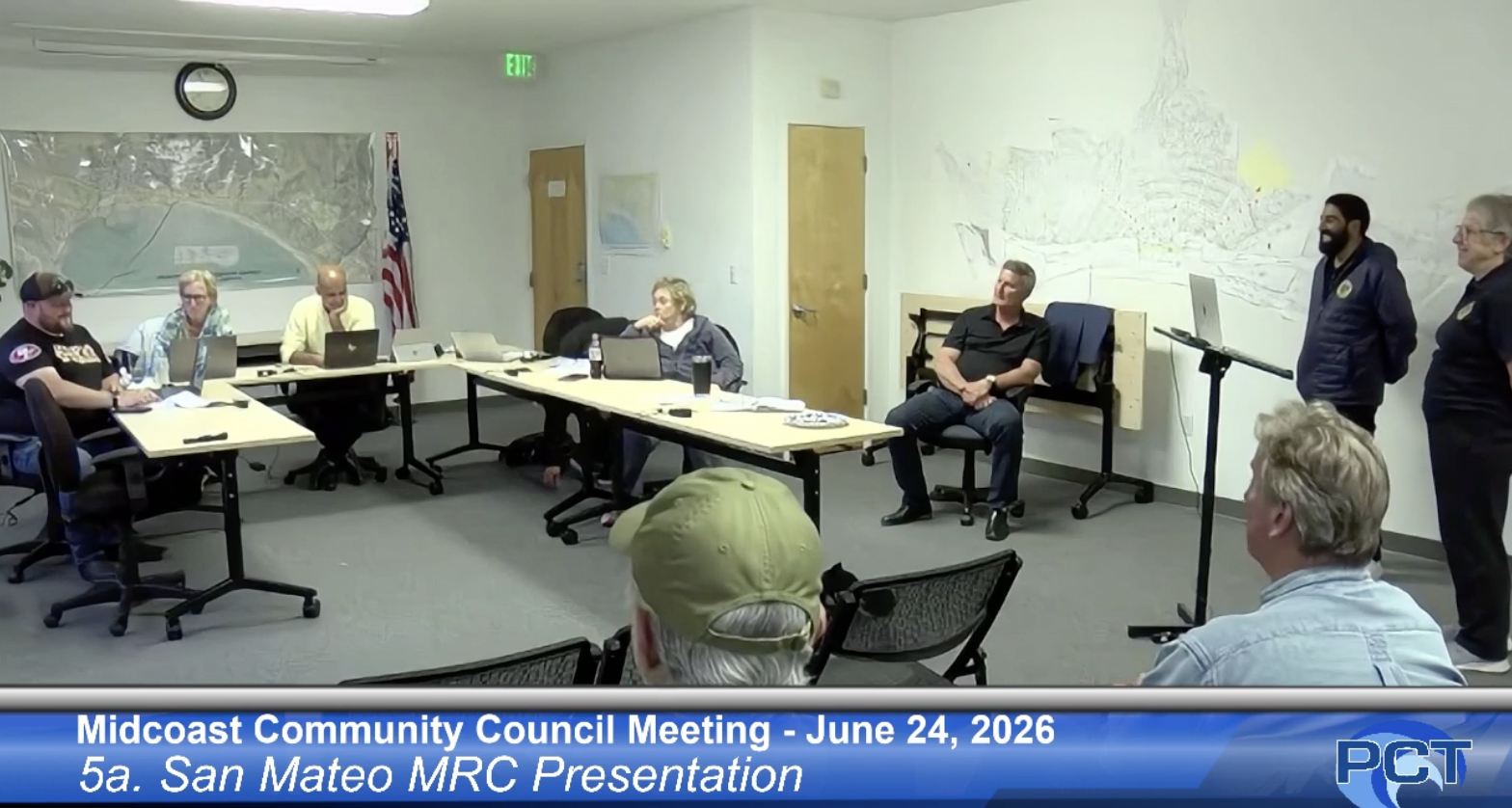
Where things stand: Susie Castoria from San Mateo County Emergency Medical Services presented the Medical Reserve Corps' Coastside operations. The program grew from 10 members in January 2025 to approximately 50, with about 28 sworn in as disaster service workers and 30 more awaiting background checks and fingerprinting.

The Coastside MRC is funded by a three-year Measure K grant expiring in June 2027. The corps maintains an emergency operations trailer at a Half Moon Bay city lot equipped with shelter and generator capabilities. Volunteers receive liability protection and workers' compensation benefits once sworn in.

The program targets an 80/20 split between medical and non-medical volunteers. Training includes quarterly sessions of four to six hours, bimonthly meetings, ICS certification, CPR, stop-the-bleed, and wilderness first aid. The MRC coordinates with CERT, KEEP (Coastside Emergency Action Program), and regional Bay Area MRC coordinators.

Council members asked about CERT coordination, geographic scope, and recruitment needs. The corps is especially seeking pediatricians and mental health professionals.

What's next: Residents interested in joining can connect through San Mateo County Emergency Medical Services. The Measure K grant's mid-2027 expiration raises sustainability questions the council may revisit.


Facilitator's $5,000 Contract Under Scrutiny

Council members questioned whether the contracted facilitator, Charles, is delivering value on a $5,000 agreement to organize Coastside stakeholder meetings on parking and interagency collaboration.

Chair Kimberly Williams reported that Charles is working with Jasneet Sharma from the Office of Sustainability to convene a subgroup and plan the agenda for a proposed July quarterly meeting. But Councilmember Connie Santilli questioned what deliverables remain and whether the contract provides value beyond meeting logistics that agencies could handle themselves. The original scope included facilitating discussions between the Harbor District, Caltrans, and the Coastal Commission on alternatives to an already-approved parking plan.

Dan, a public commenter, expressed confusion about the relationship between the stakeholder meetings and the parking lot project. Williams noted the contract was structured in two phases and asked Charles to review whether amendments are needed.

Decisions: The council agreed that Charles must present in person at the next regular meeting with a written report before any further payments are made.


Minor Items

  • May 27 meeting minutes approved unanimously (5-0) by roll call vote after a late posting required on-screen review before the vote.

  • MWSD board member Sid Young announced three seats are open on the Montara Water and Sanitary District board in November — Divisions 1, 3, and 5 — with Division 5 (Moss Beach Heights area) having no incumbent.

  • Public commenter Anne urged the MCC to write to the Board of Supervisors requesting that Cypress Point in Moss Beach be designated as 55-and-older senior housing, citing a recent board presentation on senior isolation and arguing the coastside is underserved for senior services.

  • Board of Supervisors approved midcoast design standard changes: The Coastside Design Review Committee exemption threshold was raised from 150 to 500 square feet, meaning smaller residential projects now bypass design review. Story poles are now mandatory for projects above 800 square feet. New lighting standards and bird-safe glass requirements were also adopted. ADUs remain ministerial. Councilmember Connie Santilli reported the changes.

  • Vice Chair Scott Bollinger acted as in-person chair; Chair Kimberly Williams attended remotely under AB 2449.

Midcoast Council Mobilizes Against County Plan to Nearly Double Housing Permit Cap | Midcoast Community Council | Locunity