
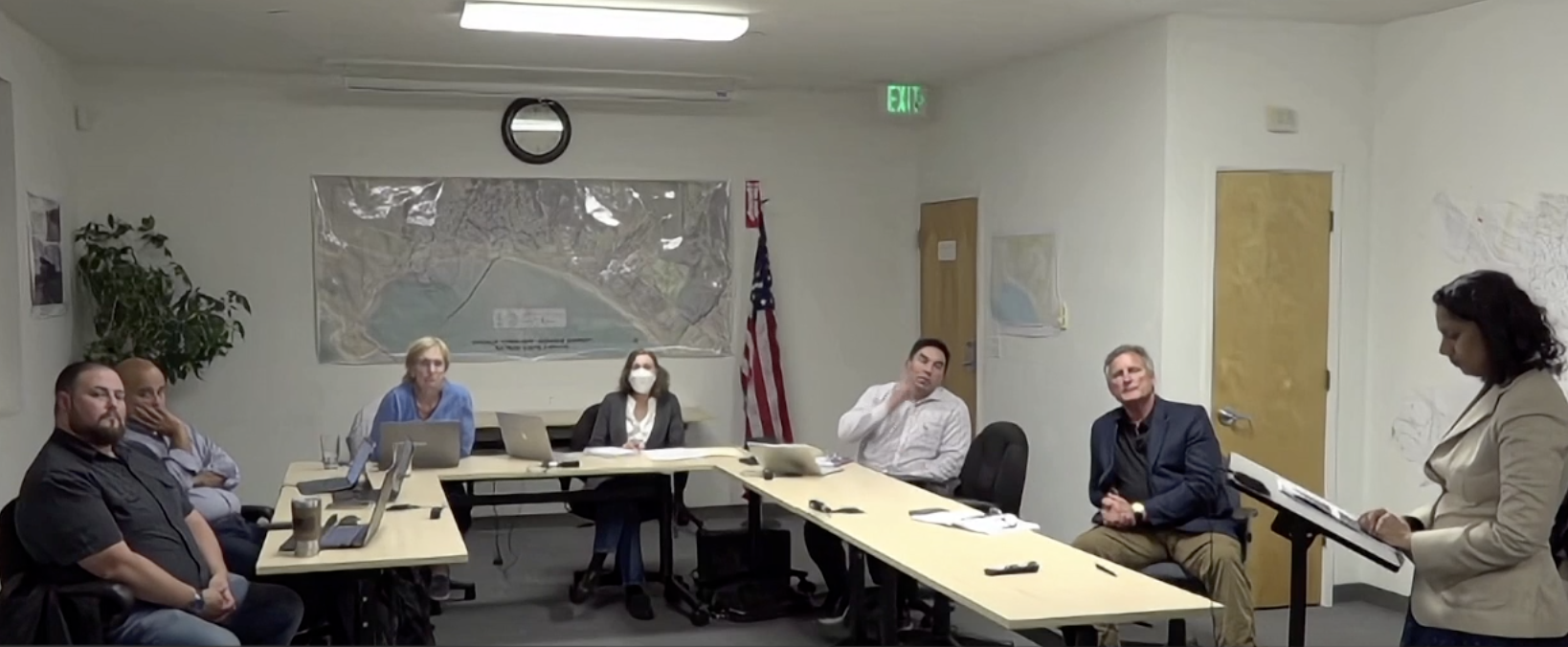
Midcoast Community Council - Apr 22, 2026 - Meeting

Midcoast Community Council - Apr 22, 2026 - Meeting

Midcoast Community CouncilSan Mateo CountyApril 22, 2026

Sources:

Locunity is a independent informational service and is not an official government page for this commission.We use AI-assisted analysis and human editorial review to publish information.

Emergency Officials Tell Midcoast: Leave Early or Face Deadly Gridlock

The Midcoast Community Council's April 22 meeting became an extended lesson in survival math. With only three exit routes, seven deputies patrolling the coast, and cell towers that can burn in a wildfire, county emergency officials told residents the single variable they control is how quickly they get in their cars and go. The evening also brought a major transit funding pitch, news that Half Moon Bay scrapped its rent protections, and a milestone for the council's standing in regional infrastructure planning.

  • Emergency officials deliver blunt wildfire message: leave before gridlock sets in — one-minute delays cause exponential traffic growth

  • SamTrans pitches $50M-per-year transit plan from proposed half-cent sales tax; critics say 63% of county dollars would leave San Mateo

  • Half Moon Bay revokes rent stabilization ordinances, shifting to nonprofit-based rental assistance

  • County outlines four-part Seal Cove stabilization plan with summer deliverables on road abandonment and development guidelines

  • MCC gains equal seat at Caltrans-hosted 18-agency coastal infrastructure coordination meetings

  • Cypress Point hazardous waste test results remain secret from neighboring homeowners, resident says


Leave Early or Get Stuck: Emergency Officials Lay Out the Coast's Survival Equation

A joint panel of Dr. Shruti Dhapodkar, Director of Emergency Management; Chief Jed Wilson, Cal Fire San Mateo/Santa Cruz Unit Chief; and a Lieutenant from San Mateo County Sheriff's Office, delivered the meeting's most extensive presentation — roughly 65 minutes of briefing and community Q&A on wildfire evacuation, alert systems, and personal preparedness.

Why it matters: The midcoast has three exit routes — Highway 1 north, Highway 1 south, and Highway 92 — limited law enforcement, and no emergency shelter. The December 2024 tsunami warning demonstrated that even a best-case scenario overwhelms the roads. The January Los Angeles fires brought the lesson closer to home.

Where things stand: Dr. Dhapodkar framed the challenge in stark terms: "There's only one variable that we really control. We can't change the infrastructure. We can't change the amount of deputies we have here. We can't change our geography. There's one variable that we can change — leave early."

She explained that traffic modeling shows the first 60–90 minutes of an evacuation are relatively gridlock-free, but each minute of delay after that causes exponential growth in congestion. The county has developed an all-hazard evacuation plan that went through both fire and police chiefs' groups and is near its final draft. A simulation tool called LADRA is being used for zone-based evacuation modeling.

Chief Wilson drew on personal experience evacuating from wildfire in Mariposa County to stress that waiting for official orders can be fatal. The message from all three officials was consistent: have a go bag packed with medications and documents, know multiple routes, and do not rely on any single alert system — cell towers can burn and notifications can fail.

The Lieutenant outlined the notification toolkit: high-low sirens on police vehicles (now mandated by the state legislature), door-to-door notifications, multilingual pre-recorded messages, and the SMC Alert system. He acknowledged the coast has only seven deputies on patrol. "It's technically a misdemeanor if you don't evacuate. I've been doing this a long time, and I've never arrested anybody because they said they didn't want to leave their house," he said, noting the focus is on notification and tracking rather than enforcement.

Dr. Dhapodkar also highlighted the county's tsunami viewer website, built after the December 2024 warning, which drew 78,000 users during the July event. She described the county's broader mission: "We are resilient county. That is what our mission is, to make San Mateo County the most resilient county in the country."

The other side: Community members pushed back on the emphasis on individual responsibility. Public commenter Dan Hagerty argued the onus is placed too heavily on residents and questioned the adequacy of mass messaging efforts. Greg Diego proposed specific infrastructure changes: more refuge points including the top of El Granada Boulevard, forced cell tower upgrades, clearing trees north of Lantos Boulevard, opposing bike lanes and roundabouts that reduce road capacity, and compelling Caltrans to clear Montara bypass fuel loads. Anne Rothman echoed calls to clear trees north of the tunnel toward Pacifica and urged the county to ensure SMC Alert reliability. A commenter identified as Sid described the gridlock during the December 2024 tsunami warning and asked whether a disaster preparedness event could be held on the coast, noting there is currently no emergency evacuation center in the area.

What's next: Councilmember Gus Mattammal proposed posting an edited video of the presentation on the MCC website as a standalone community resource: "If we take a copy of it and pare it down to just this presentation, and then we make that a separate link on the website so that if we're in a conversation with a community member who asks about that, we can just send them directly to that link." The council also discussed promoting CERT training and creating a dedicated disaster preparedness page.


SamTrans Makes Its Case for $50M-a-Year Transit Tax — and Draws Fire

Jessica Epstein, SamTrans Director of Government and Community Affairs, presented the agency's proposed local investment plan under SB63, the Connect Bay Area Act. The plan outlines how San Mateo County would spend its share of a proposed 14-year, half-cent sales tax across five Bay Area counties (a full cent in San Francisco) that would go before voters as a citizens' initiative requiring 50%+1 approval.

Why it matters: If approved, SB63 would be the largest new transit funding source for San Mateo County, generating approximately $50 million per year. But the structure pits local investment priorities against regional deficit spending for BART, Muni, and Caltrain — a tension that dominated the evening's debate.

Where things stand: SamTrans is developing a local investment plan with 10 priority categories shaped by surveys and stakeholder engagement. Epstein described the demographics driving SamTrans: "94% are low income, 68% extremely low income, 80% don't drive or have access to a car. They really need our service." She acknowledged the agency projects a $30 million average annual deficit starting in fiscal year 2028 but emphasized SamTrans has more fiscal runway than larger Bay Area transit agencies.

Council members pressed Epstein on service to the coast. She clarified the three on-demand services available — Ride Plus, Ready Coast, and SamCoast — noting that SamCoast requires only a one-day advance call.

The other side: Greg Diego delivered a detailed rebuttal, arguing that "depending on how you count Caltrain, 63% of San Mateo County taxes will go outside the county." He listed historical transit tax increases, advocated for micro-transit and autonomous vehicle alternatives, and suggested the county create its own sales tax to keep all revenue local rather than subsidizing other agencies. Epstein responded that funding flowing to BART, Muni, and Caltrain serves San Mateo residents who use those systems daily, and noted SB63 includes accountability mechanisms that don't currently exist.

Public commenter Cynthia praised the Ready Coast service but criticized Ride Plus for not covering Moss Beach and Montara, and asked about school bus service. Dan Hagerty expressed concern about sales tax levels being already too high, and requested rustic-style bus shelters appropriate for the coast rather than urban designs.

What's next: The SamTrans survey is open through the end of April. The SamTrans board will receive an information item May 6 and is scheduled to adopt the local investment plan June 3.


Half Moon Bay Scraps Rent Stabilization, Bets on Nonprofits

Councilmember Deborah Penrose, City of Half Moon Bay, reported that her city council voted to revoke its rent stabilization and rent registry ordinances, redirecting tenant protection efforts toward voluntary rental assistance administered through nonprofits — particularly COSI Hope.

Why it matters: The reversal strips regulatory protections for renters in the middle of a coastal housing affordability crisis, replacing enforceable ordinances with a voluntary assistance model.

Where things stand: "We as a council decided to revoke the ordinances on rent stabilization and rent registry and put all of our efforts into rental assistance using our nonprofits, especially COSI Hope," Penrose said. The current city contribution is about $40,000, with plans to increase to $100,000. She expressed personal disappointment but accepted the council's decision.

Penrose also discussed the city's housing element, which is three years overdue. The state and governor are pressing for the 555 Kelly affordable housing project (Mercy Housing) to proceed. She identified the Coastal Commission as the primary obstacle: "The biggest problem with our housing element is not trying to figure out where we've got options for affordable housing, but it's the Coastal Commission and their interference."

A moratorium on new residential structure permits remains in effect, with the county and state still in active conversations about what it means and what's needed to lift it. Penrose noted that the El Granada CUSD parcels were not included in the current housing element cycle — a development she described as providing temporary relief for the coast.


County Advances Four-Part Seal Cove Stabilization Plan

County official Nicholas Calderon delivered an update on four commitments made at the last Seal Cove meeting, all aimed at addressing the geologically unstable area in Moss Beach where earth movement threatens homes and roads.

The basics: Seal Cove sits on an active landslide zone. The county's plan includes: (1) a surface water management plan, now in final scope-of-work review with a contractor expected within six weeks; (2) a surface monitoring program, with an RFP under review and a firm expected in six to eight weeks; (3) defined criteria for when the county will abandon roads impacted by earth movement; and (4) development guidelines within zones defined in the Cottonshires report, expected for public review by summer.

Why it matters: "Abandonment" would mean the county no longer maintains or repairs affected roads — a significant shift for residents whose properties depend on county-maintained access. The development guidelines will determine what, if anything, can be built in high-risk zones going forward.

Where things stand: Funding for the water management plan and monitoring program has been identified and set aside. The meaning of "abandonment" is still being defined, though Nicholas noted the precedent of Ocean Boulevard's abandonment. Discussion also touched on whether the stormwater management effort would extend beyond Seal Cove to the broader Moss Beach area.


MCC Wins Equal Standing at 18-Agency Coastal Infrastructure Table

Chair Kimberly Williams reported on a Caltrans-hosted stakeholder meeting she attended alongside approximately 18 agencies — including multiple county departments, the Harbor District, and the Office of Sustainability. For the first time, the MCC had an equal seat rather than an audience chair.

Why it matters: Historically excluded from project coordination, the MCC's inclusion means community input can now shape how overlapping road, sewer, and park projects are sequenced to minimize disruption to coastal residents.

"I had a seat at the table, which is a first," Chair Williams said. "Usually I'm sitting in the audience — this was just a new level of engagement." She reported that agencies presented their projects, with some learning about overlaps for the first time. The group discussed coordinating public engagement and construction sequencing — for instance, avoiding paving a road twice when pipeline installation and road rehabilitation overlap.

The council debated whether to continue the contract with facilitator Charles Gardner, who joined via Zoom and was well-received, including whether costs should be shared among agencies. The council agreed on a core working group of Chair Williams, Councilmember Connie Santilli, and Councilmember David Santoro, with plans to further discuss at the April 30 retreat.

Public commenter Dan Hagerty pressed for greater transparency, arguing the MCC should be offering ideas at the stakeholder meetings rather than just observing, and asked for details of the projects discussed to be shared publicly.

What's next: The quarterly meetings will continue, with the next session in July.


County Convenes 25-Agency Wildfire Fuel Reduction Summit

David Osprey, aide to Supervisor Mueller, reported on what he described as an unprecedented 25-person, in-person meeting bringing together Caltrans, Public Works, Parks, PG&E, Cal Fire, multiple fire agencies, and the Resource Conservation District to coordinate vegetation management along critical evacuation corridors.

"It's the first time in my career that I've seen all those people at the table in person," Osprey said. Key projects discussed include eucalyptus fuel reduction at Pedro Point away from the highway, fuel reductions on the Montara bypass, and extensive clearing along Highway 92 in the San Francisco watershed area between upper and lower Skyline. Agencies were asked to coordinate with the public since tree trimming cannot be done at night and will affect traffic. The group also discussed Zone Zero and Firewise Communities, with follow-up meetings committed to.


Minor Items

  • April 8 meeting minutes approved unanimously by roll call vote (For: 5, Against: 0, Absent: 1 — Claire Toutant absent).

  • Capistrano Road parking restrictions: The county will pursue a no-oversized-vehicle parking restriction on Capistrano between Highway 1 and Prospect, extending restrictions along the airport perimeter.

  • Cypress Point hazardous waste: Anne Rothman reported that soil and tank test results from the Cypress Point MidPen housing development in Moss Beach were received by the San Mateo County Health Department as of April 16 and remain under review, with no information shared with neighboring homeowners. She questioned the CEQA exemption granted for the 71-unit affordable housing project.

  • Design review transparency: A commenter identified as Sid raised concerns about the coast-side design review meeting's lack of video, audio, and transparency for virtual attendees, and requested the MCC write a letter to the planning department.

Emergency Officials Tell Midcoast: Leave Early or Face Deadly Gridlock | Midcoast Community Council | Locunity