
Metro Council - Aug 13, 2026 - Meeting

Metro Council - Aug 13, 2026 - Meeting

Metro CouncilLouisvilleAugust 13, 2026

Sources:

Locunity is a independent informational service and is not an official government page for this commission.We use AI-assisted analysis and human editorial review to publish information.

Council Passes Data Center Moratorium, Renews LG&E Franchise Amid Municipalization Push

Louisville Metro Council capped a marathon session by adopting a six-month moratorium on all data center development applications — closing a loophole along the way — while defeating a bid to double the freeze to a full year. Earlier in the evening, the body renewed its gas franchise with LG&E on an 18-3 vote, but not before a spirited debate that put utility municipalization squarely on the council's radar.

  • Data center moratorium adopted 24-1 after council rejects push to extend freeze from 180 days to one year

  • LG&E gas franchise renewed 18-3 as members from both parties pledge to explore municipalization and competitive bidding

  • Massage therapists warn anti-trafficking licensing ordinance threatens small businesses with $6,000/month in new costs

  • Feed Louisville and Celebrate Recovery each see NDF funding boosted on the floor as council members rally around food insecurity and substance recovery

  • Violence prevention advocate pitches community-led Louisville Peace Project targeting four high-violence zip codes


Louisville Hits Pause on Data Centers

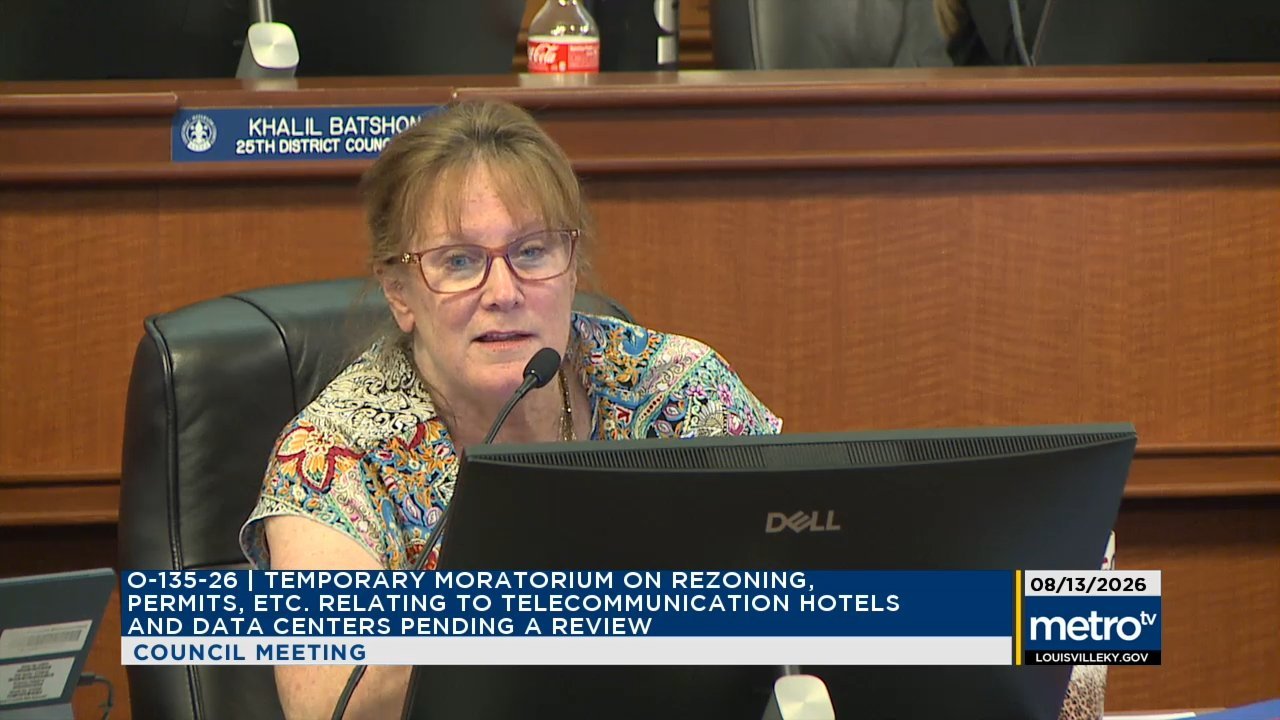
After eight committee meetings, an 11-month administrative freeze, and heated public testimony, Louisville Metro Council formalized a 180-day moratorium on all rezoning, conditional use permits, and development plan applications for data centers and telecommunication hotels. The vote was 24-1.

The basics: O-135-26 codifies what has been an informal stop on data center applications since the Campground Road hyperscale project drew fierce neighborhood and environmental opposition. The ordinance also now includes an amendment from Councilmember Jennifer Chappell (D-District 15) that closes a building-permit loophole for developers seeking to repurpose existing structures as data centers — a gap exposed by a recent application.

Assistant County Attorney Laura Ferguson explained that the original moratorium language covered only new development applications, meaning a building owner could file for a building permit to convert an existing warehouse into a data center without triggering the freeze. Chappell's amendment, adopted by voice vote, blocks that pathway.

The Year-Long Fight

The real fireworks came over an amendment from Councilmember Tammy Hawkins (D-District 1) to extend the moratorium from 180 days to 365 days. Supporters argued six months was not enough time for the Planning Commission to develop adequate regulations, especially given what they described as the administration's track record.

"You're asking us to trust an administration that's already rolled out the red carpet for Campground Road," said Councilmember Chappell. "You're asking us to trust an administration that did not hold the planning commission that they appointed and we approved to provide the amendments, the draft amendments, in a timely manner."

Councilmember Paula McCraney (I-District 7) backed the longer timeline and demanded more transparency from the mayor's office: "I am also calling on the mayor to notify and engage at a minimum the metro council member whose district would be affected by a proposed data center before the project reaches the Planning Commission."

Councilmember Shameka Parrish-Wright (D-District 3) called for outside expertise, saying, "We need an advisory council of qualified citizens and experts to help the Office of Planning make sure all aspects of data center impact are covered. They need help."

Councilmember J.P. Lyninger (D-District 6) cast the debate in broader terms, calling hyperscale data centers "driven by the need to expand a surveillance state that keeps us all as permanent suspects in an investigation that will never end."

The Other Side

Opponents said six months was sufficient and warned that a year-long moratorium was functionally a ban.

Councilmember Anthony Piagentini (R-District 19) delivered the most pointed rebuttal, urging colleagues to hold the administration to the six-month deadline rather than extending it. "What I'm not going to do is negotiate with the marxist mob," he said, referencing recent Planning Commission testimony. He pushed the council to focus on getting regulations written quickly.

Councilmember Markus Winkler (D-District 17) said he supported strong regulation but believed the shorter window, which can be renewed, was the right approach.

Decisions: The 365-day amendment failed 10-15. The final ordinance, with the Chappell loophole-closing amendment, passed 24-1.

Community Voices

Two public commenters delivered forceful remarks ahead of the vote. Danielle Ray demanded a one-year moratorium without loopholes and called out developer Steve Poe and Mayor Craig Greenberg by name. Sauda Brown accused the council of environmental racism and criticized what she characterized as inaction from council leadership.

What's next: The Planning Commission now has 180 days to develop and recommend new land development code regulations for data center siting — a clock that follows 11 months of administrative freeze. Whether that timeline holds will be the test of the council's leverage.


LG&E Gas Franchise Renewed After Municipalization Debate

The council renewed Louisville Metro's gas franchise agreement with Louisville Gas & Electric on an 18-3 vote, with four members voting "present," after defeating a motion to send the item back to committee. But the debate revealed a growing appetite — across party lines — for rethinking the city's utility relationship.

The basics: O-188-26 renews the franchise using the same language as the 2016 agreement. The franchise serves as the legal framework for any future rate challenge before the Kentucky Public Service Commission. The item had been postponed from July 30.

Where things stand: Councilmember Kevin Kramer (R-District 11) walked colleagues through the franchise's history and mechanics: "If we passed the franchise agreement that's before us tonight, we have an opportunity to do the same thing in the next six months, year, that we tried to do sixteen years ago or ten years ago. If we don't pass the franchise agreement, then we don't have any framework to work from to move forward."

But Councilmember Lyninger seized the moment, moving to send the item back to committee and making the case for municipalization. "You have no idea how much it warms my heart to hear this chamber talking about municipalization of our utilities, which is our right under state law," he said. He argued LG&E is owned by a Pennsylvania corporation, traded on Wall Street, and won't exit coal until 2065 — making it a poor steward of Louisville's energy future. The motion to recommit failed 8-16, with one member voting "present."

The other side: Council President Brent Ackerson (D-District 26) left the chair to argue the franchise needed to pass immediately given time constraints and pushed back hard on the idea that the council could casually renegotiate a major corporate agreement at the last minute. He defended private utility management over government-run alternatives, saying, "Government is one of the worst runners of business possible. The perfect example is we build sidewalks for sixteen hundred dollars a sidewalk square, whereas the average person could build it for two hundred dollars."

Councilmember Betsy Ruhe (D-District 21) took a pragmatic line, supporting passage while urging continued work on alternatives.

Decisions: The franchise passed 18-3 with four members voting "present." The relatively narrow margin — compared to the routine 25-0 that franchise renewals typically produce — signals real political energy behind exploring competitive bidding and municipalization before the next renewal cycle.


Massage Therapists Say Anti-Trafficking Ordinance Is Crushing Small Businesses

Three massage industry professionals used public comment to urge the council to amend the city's massage establishment licensing ordinance — Chapter 51 of the Louisville Metro Code of Ordinances — which was designed to combat human trafficking but has imposed steep compliance costs on legitimate small businesses.

Why it matters: The ordinance requires video surveillance, staffing changes, fingerprinting, and additional licensing that speakers say are unworkable for sole practitioners and small salons.

Gabriel Bolds, an employee at McCosh Holistic Massage, told the council that compliance has added more than $6,000 per month in fixed expenses for a four-room business, a burden he said falls disproportionately on small operations.

Shay Newtz, a solo practitioner sharing space with mental health professionals, said the ordinance's video surveillance requirements conflict with HIPAA in her clinical setting and objected to inspection provisions she described as designed to "catch them in the act."

Laura Watkins, owner of Pure Salon Spa — a full-service salon already licensed by the Kentucky Board of Cosmetology — said the additional requirements for fingerprinting, surveillance, and record-keeping may force her to eliminate massage services entirely and lay off a 17-year employee. She asked for exemptions for businesses where massage is an ancillary service.

What's next: No council action was taken, but the speakers' unified message suggested an organized push for amendments. The council could take up revisions through committee.


Feed Louisville and Celebrate Recovery See Funding Swell on the Floor

In a pair of feel-good moments, council members from across the political spectrum pooled Neighborhood Development Fund contributions on the floor to boost funding for two community organizations.

Feed Louisville

Councilmember Parrish-Wright presented O-194-26, a $4,250 NDF appropriation for Feed Louisville — an organization that redistributes restaurant food waste to residents without income qualification barriers. The original ask was $78,000. On the floor, members from at least 10 districts added NDF contributions: Councilmember Betsy Ruhe ($1,000), Councilmember Ken Herndon (noting $10,000 coming via a development agreement), Councilmember Winkler ($500), Councilmember Barbara Shanklin ($1,000, noting 130 people at her Monday pantry), Councilmember Hawkins ($500), Councilmember Dan Seum Jr. ($250), Councilmember Crystal Bast ($250), Councilmember Stuart Benson ($500), Councilmember Andrew Owen ($1,000), and Councilmember Josie Raymond ($500). The amended ordinance passed 23-0.

Celebrate Recovery Fairdale

Councilmember Seum presented O-207-26 for Celebrate Recovery Fairdale, a faith-based substance recovery program based at Fairdale Christian Church. Larry Mitchum, the program's leader, told the council during public comment that the program has grown from 25 participants to more than 250 weekly attendees over nine years and was recognized by the Kentucky Opioid Commission. The original ordinance included $12,750 from four districts; the full request was $22,000. Ten council members added floor donations to close the gap, with Councilmember Benson covering the final $2,250. The fully funded ordinance passed 25-0.


Violence Prevention Advocate Pitches Community-Led Peace Infrastructure

Richard Whitlock Jr., a self-described violence prevention pioneer, presented the Louisville Peace Project during public comment. He cited more than 1,300 murders in Louisville from 2016 through 2025 — which he called the deadliest decade in the city's history — and proposed deploying over 20 trained peacemakers as violence interrupters across four zip codes (40203, 40210, 40211, 40212) using the Cure Violence model. The program would connect to youth programs with referrals from the Department of Juvenile Justice and focus on JCPS alternative school students. Whitlock said he has worked in violence prevention for 17 years without ever receiving OSHA or OVP funding and called for community-led infrastructure for peace.


Minor Items

  • Consent calendar (items 20-50) passed 24-0, including R-097-26 authorizing acceptance of up to $107.25M in state Department for Local Government funding, a general obligation bond intent resolution, 15 board appointments and reappointments, multiple NDF appropriations, and zoning items.

  • Budget reallocation ordinance (O-209-26) adopted 25-0, reallocating FY 2026-2027 operating budget funds between departments and rolling over District 1 lawn maintenance funds from FY26.

  • Fern Creek Babe Ruth 8U Girls All-Stars honored with a proclamation for winning the World Series Championship. Councilmembers Kevin Bratcher (R-District 22), Ginni Mulvey-Woolridge (R-District 24), and Jeff Hudson (R-District 23) presented the recognition.

  • Lee Maddox shared a personal story about reversing diabetes through plant-based lifestyle changes and asked the council to endorse the Plant Based Treaty.