Metro Council - Jul 30, 2026 - Meeting

Metro Council - Jul 30, 2026 - Meeting

Metro CouncilLouisvilleJuly 30, 2026

Sources:

Locunity is a independent informational service and is not an official government page for this commission.We use AI-assisted analysis and human editorial review to publish information.

Council Tables LG&E Franchise, Passes Late-Night Security Ordinance

Louisville Metro Council surprised observers by indefinitely shelving LG&E's gas franchise renewal and, after a late-night debate, adopted a new security mandate for businesses plagued by gun violence — all while approving a $74 million hotel deal, a Habitat for Humanity rezoning, and incentives to keep a major tea manufacturer in town.

  • Council votes 18-7 to table LG&E gas franchise renewal, opening the door to renegotiate terms and explore public power

  • Late-night business security ordinance passes 20-2 after nine months of work and an emotional appeal from its sponsor about gun violence

  • $74M Landmark Building hotel conversion wins TIF approval 21-2-1, drawing objections over subsidizing hotels instead of housing

  • Habitat for Humanity rezoning sails through 25-0 for 40 single-family homes on Mount Holly Road

  • Bigelow Tea expansion incentives approved unanimously to retain jobs paying $21-$23/hour

  • Licensed massage therapists warn Council the facility ordinance is driving businesses out of Jefferson County

  • Metro employees challenge new pay scale that shortchanges decades of service


LG&E Gas Franchise Hits a Wall

In the meeting's most extensive debate, Metro Council voted 18-7 to indefinitely postpone the renewal of Louisville Gas and Electric's gas franchise agreement — a decision that leaves the city without a formal franchise when the current deal expires in August and signals growing frustration with the utility's corporate posture.

Why it matters: Louisville currently collects zero franchise fee revenue from LG&E gas service. A 2016 Public Service Commission ruling determined that any franchise fee would apply only to ratepayers in the urban service district and unincorporated areas — not the 83 suburban cities that also benefit from LG&E's use of public rights-of-way. That made any fee effectively an inequitable tax on a subset of residents, so Metro has never charged one.

Where things stand: Councilman Jeff Hudson (District 23) presented the five-year renewal of the 20-year franchise. County Attorney Quan Nguyen confirmed the structural problem: "Under PSC rules, any franchise fee would only be charged to customers in the urban service district and unincorporated areas."

Councilman Kevin Kramer (District 11) provided the institutional backstory. A previous mayor tried to dramatically raise the franchise fee; LG&E refused, the dispute went to the PSC, and Metro lost. "LG&E was able to convince the Public Service Commission that because the gas was passing through our right of way into some other end user's possession, we couldn't charge that other end user," he said. "Our argument was we don't care where the gas is going, it's going through our right of way."

Kramer urged the body to consider revisiting the issue with a newly constituted PSC, noting the current arrangement leaves millions on the table.

The other side: Councilman J.P. Lyninger (District 6) moved to table, framing the debate as a question of corporate accountability. "LG&E is a fully owned subsidiary of a corporation headquartered in Pennsylvania, traded on Wall Street," he said. "Has no relationship to the city of Louisville other than the money that is extracted from the people of Louisville. I'm a big believer in public power, something that we have a strong avenue to explore under state law."

Councilman Ben Reno-Weber (District 8) piled on, citing a recent letter from LG&E explaining its refusal to bury power lines. "It said this is why we don't bother to bury power lines, because it's too expensive for us as a corporate entity," he said. "So we're willing to continue to overcharge you and not make the long-term investments that we should because it's inconvenient for our corporate earnings report."

Decisions: The motion to table and postpone indefinitely passed 18-7. Louisville will operate without a formal gas franchise agreement while Council explores whether to challenge the 2016 PSC precedent or pursue alternative arrangements.

What's next: The franchise expires in August. Council could revisit the issue at a future meeting, potentially with proposals to renegotiate terms or study public power options.


Late-Night Security Ordinance Passes After Emotional Debate

After nine months of development, multiple postponements, and two floor amendments adopted on the spot, Metro Council passed the criminal activity nuisance ordinance (O-280-25) requiring in-person security at late-night businesses with repeated criminal activity. The vote was 20-2, with three members voting present.

Why it matters: The ordinance gives Louisville a codified enforcement framework to address gun violence at nightlife venues — a persistent problem that has defied informal intervention. But the debate exposed deep tensions over whether the tools could be wielded selectively along racial lines.

Where things stand: Councilwoman Tammy Hawkins (District 1), the primary sponsor, framed the ordinance as prevention, not punishment. In an emotional floor speech, she invoked her brother's murder: "It is not okay if there's white-on-Black crime, but it's okay when it's Black-on-Black crime, because that's what's going on in the West End right now."

Co-sponsor Councilwoman Betsy Ruhe (District 21) noted the ordinance was prompted by a violent incident at an event space in her district.

Councilwoman Ginni Mulvey-Woolridge (District 22) proposed two floor amendments, both adopted by voice vote: one referencing LMCO 124.01 to clarify that required security officers are not law enforcement, and another requiring security providers to be in "good standing."

Councilman Andrew Owen (District 9) praised the ordinance's evolution. "If a piece of legislation can mature, can improve — this piece has matured as much as any I've seen since I've been here," he said. "And I think that's a credit primarily to Councilwoman Hawkins."

The other side: Councilman Lyninger voted no, raising the specter of the Atomic bar controversy. "The owner of Atomic said that an unnamed member of Metro government encouraged them to open a bar in the West End so that West End patrons — and we all understand that West End patrons means Black patrons — would no longer attend clubs and bars on Bardstown Road," he said, warning the enforcement process was "open to bad action from political forces."

Councilwoman Barbara Shanklin (District 2) asked to be added as a co-sponsor.

Decisions: The amended ordinance passed 20-2, with 3 members voting present. Late-night businesses flagged for criminal activity nuisances must now provide in-person security under the new framework.


$74M Landmark Building Hotel Gets TIF Approval — With Dissent

Metro Council approved a 20-year tax increment financing deal for a $74 million private investment to convert the Landmark Building — an 1850s structure fully vacant since 2017 — into a hotel. The vote was 21-2, with 1 abstention.

Why it matters: The deal revives a prominent downtown vacancy but reignited a recurring debate about whether public tax incentives should flow to hotel development when the city faces acute housing needs.

Where things stand: Councilman Ben Reno-Weber (District 8) presented the ordinance. Councilman Ken Herndon (District 4), in whose district the building sits, described it as "the one final missing tooth" between the Marriott, Omni, and proposed JW Marriott.

The other side: Councilman Lyninger voted no and did not mince words: "I am once again disappointed that we are going to be giving away our tax base for hotel development rather than housing." He argued that developers would be "fools not to tell us that they need the money, because we're going to give it."

Councilman Owen abstained due to his employer's involvement in the project.

Decisions: Passed 21-2-1 (For: 21, Against: 2, Abstain: 1). The TIF commits 20 years of incremental tax revenue to the conversion.


Massage Therapists Sound the Alarm on Ordinance Fallout

Three licensed massage therapists used public comment to urge Council to revisit the massage facility ordinance passed last November, painting a picture of an industry in retreat.

Public commenter Lance Muniz said he closed his Louisville practice and knows of at least three others who shut down or left Jefferson County. He argued the ordinance forces therapists to violate HIPAA by disclosing client identities, violate Kentucky confidentiality statutes, and install cameras that could film minors in healthcare settings.

Public commenter Jennifer Coyle, the fifth business to receive a facility license, reported that only 175 of an estimated 375 massage businesses have applied, only five licenses have been issued, and just eight inspections have occurred since June 3. She argued the ordinance targets legitimate small business owners who are "low-hanging fruit" while 70% of trafficking victims are exploited in industries untouched by the regulation.

Public commenter Lane Alexander advocated for exempting independent solo practitioners, arguing a single therapist cannot physically traffic someone and that enforcement resources should target unlicensed operators already violating state law.

No Council action was taken.


Metro Workers Say New Pay Scale Ignores Decades of Service

Two long-tenured Metro employees told Council the new union pay structure shortchanges workers who transferred between divisions.

Public commenter Nicholas King, a 22-year Metro Parks employee, said he was placed at a 6-year employee pay step instead of the top of the scale after transferring from the golf division to maintenance during a prior administration's restructuring. He said the loss costs him hundreds of dollars monthly and will reduce his retirement.

Public commenter Lisa Trusty, a 31-year Louisville Zoo employee and AFSCME member, reported a similar experience — placed at step 6 instead of step 12 after moving from keeper to registrar. Both urged Council to work with Parks, the Zoo, and the union to protect credit for years of service in contract language.


Minor Items

  • Consent calendar (items 22-32) passed 24-0, covering more than $80,000 in neighborhood development fund spending, two honorary street namings, a City of Prospect annexation, and other routine items.

  • Habitat for Humanity rezoning at 603/603R Mount Holly Road from R4 to R5 for approximately 40 single-family homes passed 25-0. Councilman Dan Seum Jr. (District 13) praised the project for creating homeownership and generational wealth opportunities rather than apartments.

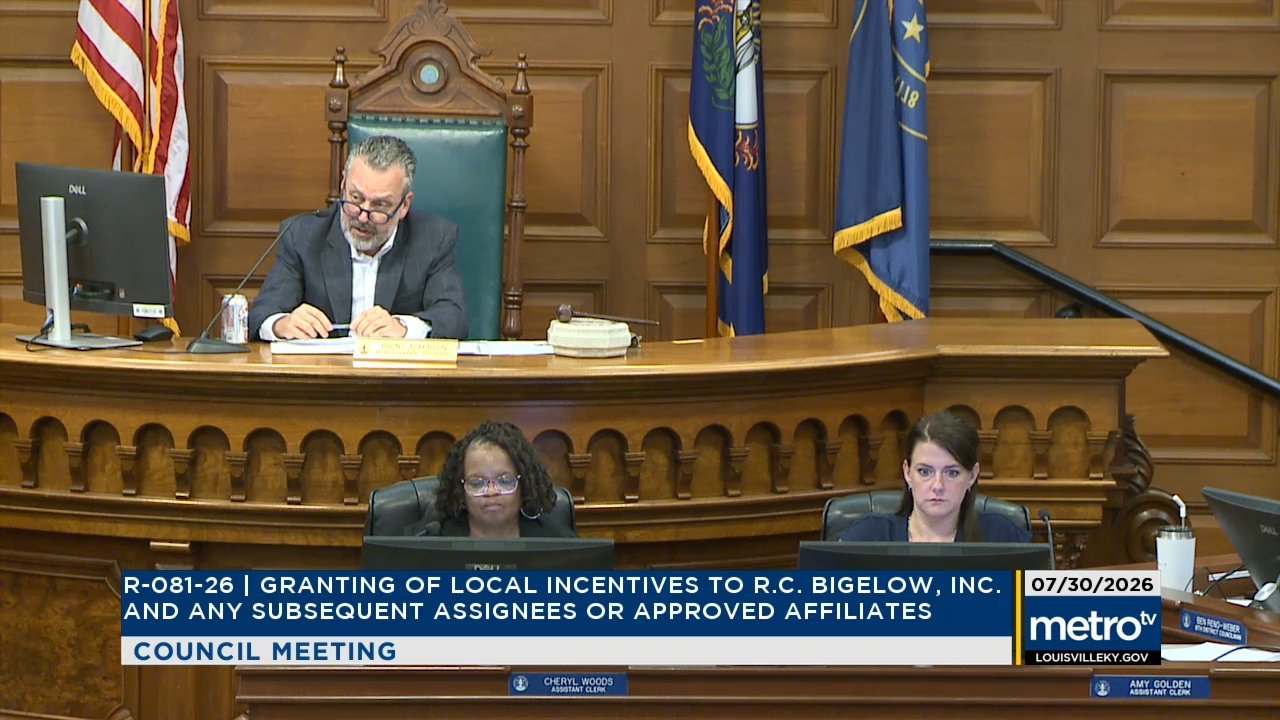
  • R.C. Bigelow Tea incentives passed 24-0 with 1 abstention to retain the company's expansion at a Louisville industrial park. Councilman Kramer noted Bigelow pays $21-$23/hour and that "it's always better to grow a business that's already here than it is to try and reach out and grab a new one."

  • Friends of Nicole youth career readiness (O-181-26) received $21,000 in NDF funds after four additional council districts contributed on the floor. Councilwoman Jennifer Chappell (District 15) described the program: "Students will not only have something to do, but they'll also get paid for their time for doing projects throughout the community." Passed 25-0.

  • Jim King Senior Wellness Center (O-190-26) received additional NDF contributions from four districts on the floor, with the late Council President Jim King's family matching Councilwoman Chappell's $10,000 contribution. Passed 25-0.

  • General obligation bond ordinance (O-185-26) passed 25-0, amended in committee to consolidate Metro Parks debt issuance into a single market offering. Parks is responsible for its own portion with no Metro liability.

  • Plant-Based Treaty: Two public commenters — Mary E. Kreider and Chuck Morrison — urged Louisville to become one of the first 10 U.S. cities to endorse the treaty, citing personal health transformations and limited plant-based dining options locally.

  • Downtown grocery: Public commenter Deborah O'Gorman noted that 2,600 new apartments and six new hotels have been built downtown with no grocery store. She said Aldi and Kroger have expressed interest and petitions are circulating.

  • 24 new business items were assigned to committees, including the SAFE Law (O-009-26) police reform ordinance — held in committee since January with multiple hearings but no vote — and a resolution to accept up to $107.25 million in state funding through the Department for Local Government.