
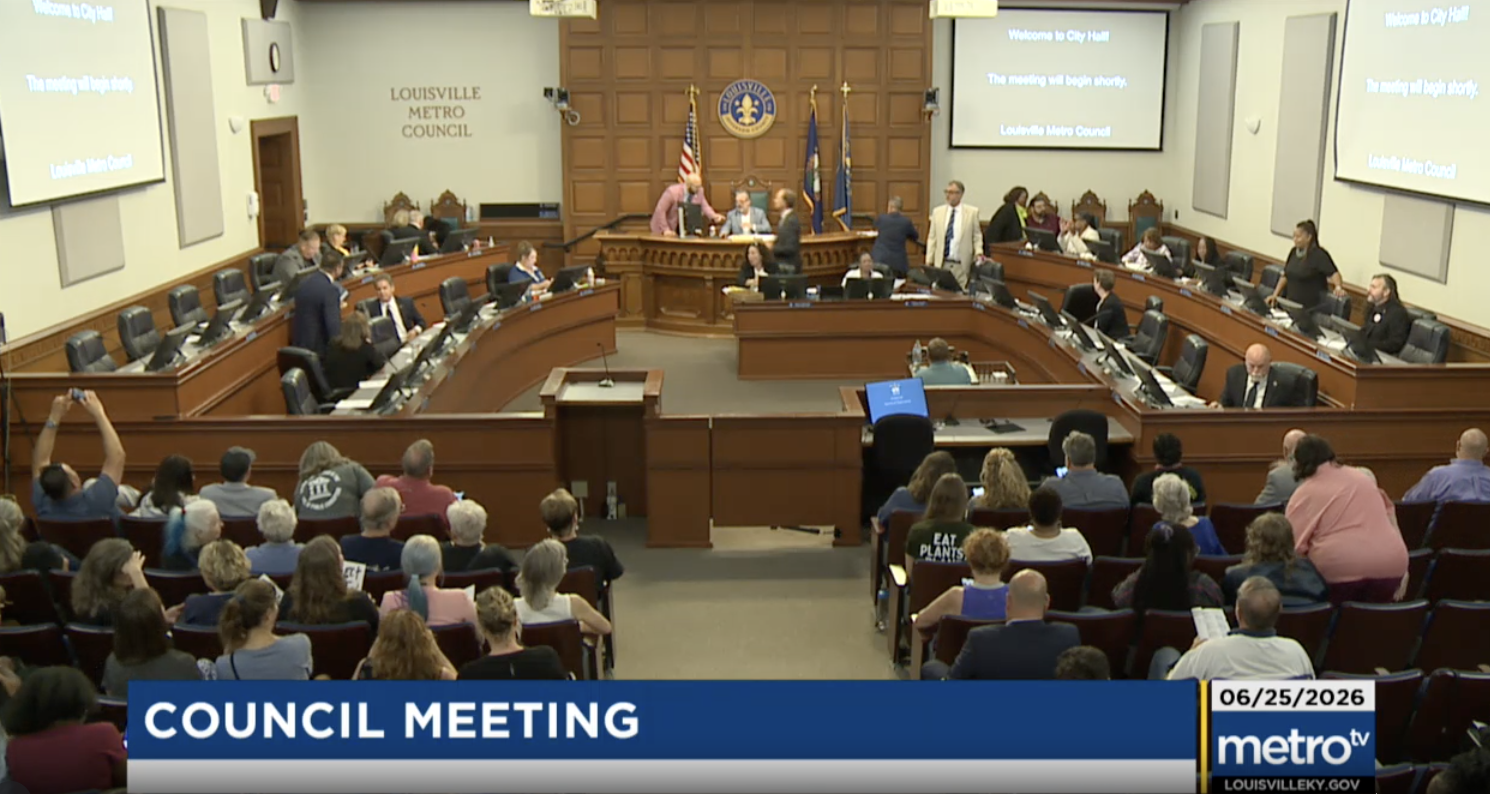
Metro Council - Jun 25, 2026 - Meeting
Metro Council • LouisvilleJune 25, 2026
Locunity is a independent informational service and is not an official government page for this commission.We use AI-assisted analysis and human editorial review to publish information.
Council Adopts $1.1B Budget Amid Sharp Debate Over Housing Cuts
Louisville Metro Council locked in the city's fiscal direction for the next two years on June 25, approving the $1.1 billion operating and capital budgets over fierce objections about shrinking housing funds and a process critics called opaque. The same meeting greenlit a $275 million mixed-use development downtown, rewrote the city's noise rules, and saw the council president abandon decades-old speech restrictions under legal pressure.
- $1.1B operating budget passes 22-3 after housing advocates and three council members decry cuts to the Affordable Housing Trust Fund and a down payment program funded at less than half what residents demanded
- $275M mixed-use project near Slugger Field advances with TIF financing, industrial revenue bonds, and surplus land — 10% affordable housing required for life of the incentive
- New noise ordinance sets measurable decibel standards, replacing vague "harsh noise" language; passes 20-4 amid equity concerns about enforcement
- Licensed massage therapists push back on anti-trafficking facility ordinance, warning it will drive trauma survivors away from care
- Council president drops profanity ban in chambers after speaker threatens First Amendment lawsuit
- Consent calendar clears $750M in Norton Healthcare revenue bonds, TARC transit budget, and a library workers union contract through 2030
The $1.1B Budget Fight: Housing, Policing, and a Transparency Reckoning
The FY 2026–2027 operating and capital budgets consumed the longest debate of the night, exposing deep fault lines over where Louisville's money goes — and who gets a say.
Why it matters: The budget reduces spending from the Affordable Housing Trust Fund and increases police funding to roughly 2.5 times its post-merger level, according to Councilmember J.P. Lyninger (D-6), even as the city faces a 30,000-unit affordable housing shortage. Down payment assistance landed at $1.25 million — up from the $1 million originally proposed, but far below the $3 million advocates demanded.
Where things stand: The debate broke along three axes — housing, public safety spending, and process.
Councilmember Paula McCraney (I-7) delivered the evening's most impassioned plea for housing investment. "Nothing is more important to me or should be more important to anybody else in this community than ensuring people have a safe, stable place to call home," she said, calling housing "the foundation upon which families build stability" and urging restoration of the Trust Fund to $15 million.
Councilmember Lyninger argued the budget's priorities are backward. "If we kept spending flat on policing this year, we could fund pretty much every other priority. Every other ask could be filled if we kept police spending flat," he said. Lyninger reported that both of his district budget town halls sent him the same instruction: "Unanimously. At both town halls, I was told, do not vote for this budget."
The other side: Budget Committee Chair Councilmember Kevin Kramer (R-11) and Vice Chair Councilmember Markus Winkler (D-17) were credited with bipartisan collaboration on the package. Winkler defended the process as the product of representative government. "At the end of the day, the things that get funded are the things that people advocate for. And the more people that advocate for something, the greater the chances that it gets into the budget," he said, acknowledging the $1.25 million figure fell short of the $3 million ask.
Councilmember Anthony Piagentini (R-19) echoed that sentiment, arguing that securing budget items requires building coalitions of 13 or more colleagues — standard legislative work, not a flaw.
Transparency fight: Councilmember Jennifer Chappell (D-15) — the lone no vote in committee — laid out a timeline that drew audible reactions. "On 6/22, which was this past Monday, we received the amended budget at 2:41 p.m. and we were expected to vote on that billion-dollar budget merely 20 minutes later," she said. She described canceled meetings and closed-door discussions she was excluded from. Lyninger backed her account, arguing too much happens behind closed doors.
On the capital side, Councilmember Tammy Hawkins (D-1) urged colleagues to fight harder for their districts. "This is not the mayor's budget. This is supposed to be the city's budget," she said, pointing to Councilmember Barbara Shanklin's (D-2) years-long effort to secure a Newburg community center as proof that persistence works.
Councilmember Shameka Parrish-Wright (D-3) raised concerns about the Arthur Street Hotel closure and its impact on residents, and questioned whether West End Dream Team and NEA Center priorities would survive the capital process.
Councilmember Andrew Owen (D-9) abstained from both votes, citing a potential conflict of interest with One Louisville.
Decisions: The operating budget passed 22-3 (no votes from Councilmember Lyninger, Councilmember Chappell, and Councilmember Parrish-Wright; one abstention from Councilmember Owen). The capital budget passed on the same margin. Total housing spending shifted from $42 million to $40 million in the final package.
What's next: Mid-year budget adjustments may revisit West End Dream Team and NEA Center funding. Advocates for down payment assistance signaled they will continue pressing for the $3 million target.
Residents Sound the Alarm on Housing Before Budget Vote
Before the budget debate began, a parade of public commenters laid the groundwork for the housing fight.
Public commenter Curtis Owens urged at least $3 million for down payment assistance, noting housing prices have risen 71% in 10 years. He argued homeownership builds generational wealth while renting builds it for landlords.
Public commenter Harry Kron, representing CLOUT (Citizens of Louisville Organized United Together), said over 500 Louisvillians identified housing as their overwhelming concern and cited a 30,000-unit shortage. He referenced research showing $2 million per 100 families in local economic impact from stable housing.
$275M Downtown Development: Three Votes, One Mega-Project
Slugger Field Mixed-Use Package
Council approved a three-part package creating a Baseball New Development Area with TIF financing, industrial revenue bonds, and surplus property transfer for a $275 million mixed-use project on the parking lot adjacent to Slugger Field.
Why it matters: The project would deliver 225–300 residential units, a 134–180 room hotel, retail, and office space to a surface parking lot in the heart of downtown — with 10% of housing units required to be affordable for the life of the TIF, at a level accessible to a JCPS bus driver.
Where things stand: Councilmember Ken Herndon (D-4), the primary sponsor, called it "multi-use dense infill — exactly what we who represent a lot of the downtown want to see more of." Councilmember Ben Reno-Weber (D-8) highlighted that the site is a difficult floodplain, making the development more costly, and emphasized the TIF is performance-based — it only activates upon project completion, meaning taxpayers bear no risk if the project stalls.
Councilmember Piagentini expressed enthusiasm about new residential competition downtown.
The other side: Councilmember Lyninger was the consistent dissenter, arguing the project is hotel-heavy rather than housing-focused and expressing broader concerns about TIF incentives. "I have long said that if we're going to have a successful, vibrant downtown, that has to be centered on housing. Young people want to live downtown," he said, voicing disappointment with only 10% affordable housing.
Councilmember Parrish-Wright asked whether the affordable units would be accessible to Louisville City Ambassadors — a question about whether the affordability threshold reaches the workers the city employs downtown.
Decisions: The Baseball New Development Area passed 23-1 with one present vote. The MGI Louisville industrial revenue bond inducement passed 22-2 with one present vote. The surplus property transfer passed 23-1 with one present vote. Lyninger voted no on all three.
New Noise Rules Pass 20-4, but Equity Questions Linger
The amended noise ordinance (O-133-26), co-sponsored by Councilmember Reno-Weber and Councilmember Khalil Batshon (R-25), replaces the existing subjective "harsh noise" language with clear decibel-level-at-distance standards and shares enforcement authority among LMPD, Codes & Regulations, and the Alcoholic Beverage Control board. A warning must be issued before any citation.
Why it matters: The ordinance gives residents and businesses a measurable standard for the first time, potentially enabling enforcement against loud vehicles and motorcycles that current law struggles to address. But critics warn the new tool could be wielded unevenly.
Where things stand: Councilmember Reno-Weber acknowledged the tension directly. "I also share the equity concerns around enforcement here, which is part of why we were really pushing for clarity around decibel and distance," he said, arguing that objective measurements reduce officer discretion.
Councilmember Hawkins lightened the room, admitting she'd likely be the first cited for blasting music in her convertible through Shawnee Park — but supported the ordinance.
Councilmember Donna Purvis (D-5) requested to be added as a sponsor, citing quality-of-life complaints from her district.
The other side: Four no votes reflected distinct objections. Councilmember Lyninger cited the lack of police reform under the consent decree, arguing new enforcement tools are premature. Councilmember Parrish-Wright raised equity concerns. Councilmember Chappell questioned how enforcement would actually work, noting that ABC, Codes, and LMPD all seem to avoid responsibility. Council President Brent Ackerson (D-26) voted no, saying the technology isn't cost-effective yet.
Decisions: Passed 20-4 with one present vote. No votes: Councilmember Lyninger, Councilmember Parrish-Wright, Councilmember Chappell, and Council President Ackerson.
Massage Therapists Clash Over Anti-Trafficking Ordinance
Four licensed massage therapists squared off during public comment over whether the proposed massage facility ordinance — designed to combat human trafficking — should apply to licensed healthcare practitioners.
Why it matters: The ordinance would require unlocked doors during sessions, surveillance cameras, and anti-trafficking signage in all massage facilities. Supporters say the rules close loopholes. Opponents say they will destroy client trust and harm trauma survivors.
Where things stand: Three therapists urged the council to exempt licensed practitioners. Public commenter River Wood, a 22-year licensed massage therapist, argued the ordinance treats an entire healthcare profession as suspicious. Public commenter Colette Wilson, a 20-year practitioner, cited duplicative regulation and barriers to care.
Public commenter Misha Soczyk, who specializes in somatic therapy for PTSD at Embody Mindful Body Work, delivered the most pointed critique, describing the "painful irony" that trafficking signage could "re-activate painful memories of abuse directly into the treatment environments of those working hardest to recover from it."
The other side: Public commenter Karen Frazier, a 28-year licensed therapist who served on the task force that developed the ordinance, supported including licensed therapists. "One-third of these illicit businesses have at least one person with a valid state-issued massage therapy license," she said, citing national data.
No vote was taken on this item at this meeting.
First Amendment Challenge Ends Chamber Speech Ban
Council President Ackerson opened the public comment period with an unusual announcement: the council would no longer stop speakers from using profanity or derogatory language. The change came after public commenter Tina Burnell threatened a First Amendment lawsuit challenging the council's decades-old prohibition.
"I'm of the opinion that her legal claims on this particular matter, while unfortunate, is likely correct," Ackerson said after consulting constitutional lawyers. He warned parents watching Metro TV to "beware what is to potentially come."
When Burnell subsequently spoke, she attacked the council for filing a taxpayer-funded lawsuit against her, calling it "punitive, malicious and retaliatory" and an "outrageous abuse of your elected positions." She disclosed $13,000 in personal legal fees and connected the timing of the lawsuit to a $6 million LDG settlement.
Minor Items
- 524 Baxter Avenue rezoned unanimously (26-0) from M2 to C1/C2, clearing the way for a potential brew pub and housing.
- Handbill/sign ordinance (O-043-26) passed 19-0 with three present votes, establishing a warnings-first approach for illegal signs on public property and reducing fines for nonprofits, effective Dec. 1.
- Park permitting ordinance (O-177-26) passed 23-0, requiring park event permit applicants to comply with Metro's non-compliance list.
- Consent calendar (25-0) included up to $750M in Norton Healthcare revenue bonds for facility construction and debt refinancing; the FY 2026–2027 TARC transit budget; ratification of the AFSCME Local 3425 collective bargaining agreement for Louisville Free Public Library employees through June 2030; digital billboard code amendments; Urban Services District ad valorem tax subclassifications; a provision blocking zoning applications from applicants with delinquent taxes or liens; and 16 board appointments across fire districts, Police Merit Board, Landmarks Commission, and KentuckianaWorks.
- Seven Neighborhood Development Fund appropriations amended on the floor with multi-district contributions for community events including St. Joe's Picnic, StageOne Theatre, St. Matthews Freedom Fest, and adaptive recreation programs.
- Council honored Allysa Pollard, Ballard High School valedictorian and Girl Scout Gold Award recipient.
- 18 new business items read into record and assigned to committees, including the Landmark Building TIF, LG&E franchise renewal, general obligation bonds, R.C. Bigelow incentives, and the City of Prospect annexation.