
Metro Council - Feb 26, 2026 - Meeting
Metro Council • LouisvilleFebruary 26, 2026
Locunity is a independent informational service and is not an official government page for this commission.We use AI-assisted analysis and human editorial review to publish information.
Residents Demand ICE Mask Ban as Massage Therapists Fight Anti-Trafficking Ordinance
Louisville Metro Council's Feb. 26 meeting became a forum for two passionate community campaigns — residents urging the council to regulate federal immigration agents and licensed massage therapists demanding relief from an ordinance they say punishes their profession — while five zoning cases exposed cracks in the city's planning process and a rare display of bipartisan floor fundraising nearly doubled youth civic engagement funding.
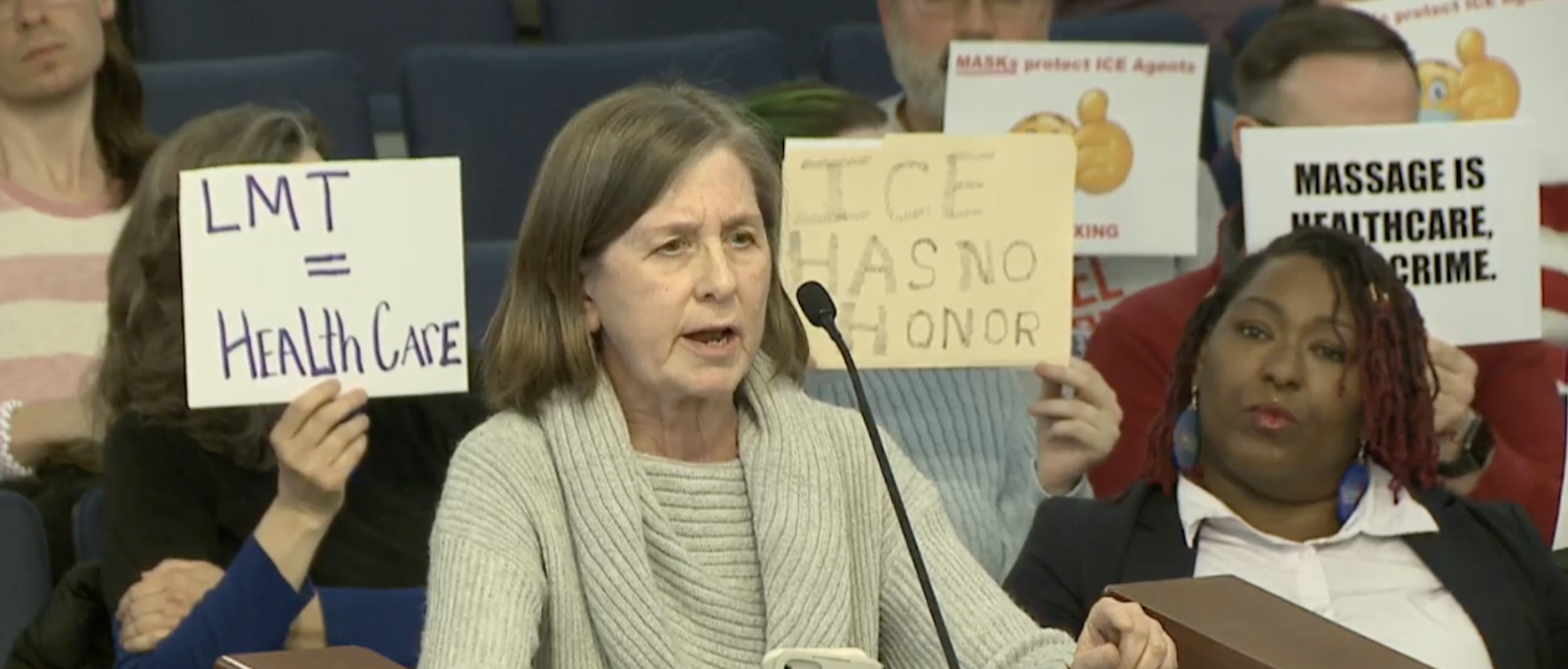
Three residents urge council to require ICE agents to identify themselves and ban masks; one speaker pushes back, calling the effort "political theater"
Four licensed massage therapists demand exemption from anti-trafficking ordinance they call a "branding of shame"
Five zoning cases approved, four unanimously, as council confronts friction in planning commission bypass process
Live floor pledges from 15+ districts boost License to Vote Art Contest funding from $13,750 to $23,100
Councilman Lyninger's bid to revive Ordinance 04126 fails narrowly, 11-12
New business includes search warrant reform ordinance responding directly to the evening's ICE testimony
Residents Draw a Line on Federal Immigration Enforcement
Seven public speakers commanded the longest stretch of the evening, splitting sharply over whether Louisville should regulate how ICE agents operate in the community. Three speakers urged the council to pass legislation requiring federal immigration agents to identify themselves and prohibiting them from wearing masks — while one speaker forcefully opposed any restrictions.
Why it matters: A new search warrant ordinance (Item 48) was introduced to new business the same night, signaling the council may be preparing to act on at least some of the enforcement transparency demands residents raised.
Where things stand: Eric Hanson, a District 8 resident, opened the public comment period by framing the issue in constitutional terms. "They are shredding the Constitution in broad daylight," he said of current federal enforcement actions, arguing that council members are "the guardrails."
Stephen B. Cherry, a District 16 architect, detailed operational concerns about ICE agents, citing their lack of formal training, identifiable uniforms, and constitutional warrant procedures. He noted at least two deaths of innocent U.S. citizens at ICE hands.
The most detailed legal argument came from Mary Schoening, a retired attorney and former prosecutor, who asserted that local identification requirements for law enforcement have been upheld in federal court — directly rebutting Councilman Scott Reed's prior email claim that federal law supersedes local ordinances. She quoted a naturalized citizen working with the immigrant community: "ICE actions make people feel afraid, isolated, unsafe even in their own homes."
The other side: Jose Vasquez, a District 6 public safety advocate, called the mask ban effort "pure political theater" driven by Democratic Socialists of America. He characterized it as a "Marxist insurgency" and argued the city has no jurisdiction over federal agents. The audience reacted negatively to Vasquez's remarks, prompting Council President Brent Ackerson to intervene: "The folks that were here to speak against the masks and for the mask ordinance, respect was paid to you, even though these folks disagree, show the same respect this man and his position."
What's next: Item 48, introduced to new business that same evening, proposes an ordinance creating search warrant issuance requirements — a direct legislative response to the enforcement transparency demands. It has been assigned to committee.
Massage Therapists Deliver Forceful Challenge to Anti-Trafficking Ordinance
Four licensed massage therapists delivered coordinated, detailed testimony demanding the council exempt their profession from the massage facility ordinance, which was enacted to combat human sex trafficking but which they argue unfairly burdens legitimate healthcare professionals.
The basics: The ordinance (LMCO 115.194/115.196) imposes licensing and operational requirements on massage facilities. Therapists argue it conflates their regulated healthcare profession with illicit operations.
Why it matters: Therapists warn the ordinance could drive compliant businesses out of Louisville or underground, undermining both the local economy and anti-trafficking goals.
Where things stand: Rachel Helm, a licensed massage therapist, set the tone, calling the ordinance "a branding of shame that LMTs of Louisville do not deserve." She warned that criminals have been "provided with an instruction manual for how to evade detection" while lawful businesses bear the regulatory burden.
Michael Newman, a licensed massage therapist who operates a Highlands studio serving more than 600 clients over seven years, framed the stakes in economic terms: "Do we stay in Louisville and operate illegally out of financial necessity? Or take my home, my practice, my clients and my tax dollars to another county?"
A District 4 resident and college adjunct, attacked Section 115.196's exceptions, which exempt physicians, chiropractors, and other health professionals but not licensed massage therapists operating in facilities. He called for striking the entire ordinance and refocusing enforcement on actual trafficking.
Marcella Thompson, a licensed medical massage therapist with 30 years of experience who witnessed the 1996 Okinawa Health Spa trafficking raid, detailed the rigorous pathway to licensure: 600 hours of training, an FBI background check, and more than $33,000 in investment. She argued existing state law already provides the enforcement tools needed.
All four speakers asked the council to exempt licensed massage therapists from the ordinance entirely and redirect enforcement toward unlicensed operations.
What's next: No council action was taken during public comment, but the volume and coordination of the testimony signals organized advocacy that is likely to seek a sponsor for amendatory legislation.
Five Zoning Cases Expose Gaps in Planning Bypass Process
The evening's old business was dominated by five zoning ordinances — most of which had passed the Planning Commission unanimously but were pulled back to Metro Council so that binding elements could be added. The recurring pattern prompted Councilman Andrew Owen, Planning and Zoning Committee chair, to repeatedly direct members to new business Item 47, a resolution that would allow council members to request binding elements directly through the Planning Commission.
Why it matters: A prior ordinance allowed unanimous Planning Commission decisions to bypass council entirely. But the alternative pathway keeps generating more council work rather than less, as council members and aggrieved residents request binding elements after the fact.
Westport Road Bank (Item 24): 24-0
Councilwoman Paula McCraney (District 7) pulled this case to add a standard binding element ensuring that if the proposed bank or credit union at 4700 Westport Road changes use, the community retains review authority. She explained the need to protect the neighborhood from incompatible future development. Approved unanimously.
East Oak Street, Shelby Park (Item 25): 24-0
An aggrieved party in the Shelby Park neighborhood requested binding elements after insufficient project details were presented at Planning Commission. Councilman Owen used the case to explain the systemic issue: "On new business tonight on the agenda on item 47, we've been working together trying to figure out a way that we can allow this standard binding element to be added to the zoning cases that people want them added to without having to go through this process."
Councilman J.P. Lyninger (District 6) supported the binding element addition for his district. Approved unanimously.
Mason Boulevard Townhomes (Item 26): 24-0
The most contentious unanimous vote of the evening. The original developer proposed 22 condominiums at 6205 Mason Boulevard (District 16), then sold to a new developer who changed the project to townhomes — prompting "bait-and-switch" accusations from six residents at the Planning Commission level.
Councilman Owen noted the resident frustration but emphasized process: "If you have an aggrieved party or anybody who has a concern about a development project, the place to address that grievance or to express that grievance is at the Planning Commission meeting."
Councilman Anthony Piagentini (District 19) offered a key legal clarification: "Any increase in density on residential zoning cases, even if it's unanimous, vote comes to us for a vote" — meaning state law requires these cases to come before council regardless of the alternative pathway. Approved unanimously.
Preston Highway Nightclub (Item 27): 21-3
The only split vote of the evening. The C1-to-C2 rezoning at 5045 Preston Highway would allow a nightclub operating from 9 p.m. to 4 a.m.
Councilwoman Betsy Ruhe (District 21) explained her support despite initial reservations: "Normally I would be opposed to a nightclub that's open from 9pm to 4am however, Mayor David Pearl of the city of Lynview, which is shopping center is immediately adjacent to, has worked with the owners of the club and the shopping center and that the developers have agreed to on site security during all business hours."
Decisions: Passed 21-3. The three no votes signal lingering neighborhood concern about late-night entertainment despite the negotiated security conditions.
Beulah Church Road Townhomes (Item 28): 24-0
The 25-unit townhome project at 7402 Beulah Church Road (District 23) required an R4-to-R5A rezoning. Councilman Jeff Hudson (District 23) said he had initially opposed the project but the applicant addressed his concerns between the committee and full council votes. "This is one where the planning commission just got it wrong on a couple of issues and an aggrieved party asked for recourse through Metro Council," he said.
Hudson successfully amended the ordinance on the floor to require the applicant to install double the tree plantings required by the Land Development Code along Beulah Church Road, a designated parkway — setting a green infrastructure precedent for parkway-adjacent development. Assistant County Attorney Laura Ferguson confirmed the amendment language. Approved unanimously as amended.
What's next: Item 47, introduced to new business, proposes a permanent fix allowing district council members to request binding elements directly through the Planning Commission, which would eliminate the back-and-forth that brought most of the evening's zoning cases to council.
Floor Fundraising Nearly Doubles Youth Art Contest Budget
In a rare display of bipartisan enthusiasm, council members pledged additional neighborhood development funds live on the floor to boost the License to Vote Art Contest from $13,750 to $23,100.
Councilman Khalil Batshon (District 25) presented the appropriation, hosted by Clerk David Yates' office. "This program was started under the Lake Clerk host law and continues to be a great way to engage our young people in civic engagement in life," he said, noting a goal of $22,000 to $30,000.
Pledges came from across the political spectrum: Councilwoman Tammy Hawkins ($1,000, D1), Councilwoman Barbara Shanklin ($500, D2), Councilmember Parish-Wright ($1,350, D3), Councilman Ken Herndon ($750, D4), Councilwoman Donna Purvis ($500, D5), Councilman Ben Reno-Weber ($500, D8, remotely), Councilman Owen ($500, D9), Councilwoman Crystal Bast ($500, D14), Councilwoman Jennifer Chappell ($250, D15), Councilwoman Ruhe ($1,000, D21), and Councilman Hudson ($1,000, D23).
Decisions: The amended total of $23,100 passed 24-0.
Minor Items
Consent calendar (Items 18–23) passed 24-0, including a $503,738 emergency services GRANT grant acceptance, neighborhood development fund appropriations, Kentucky Shakespeare Festival sponsorship, Preston Highway street light funding, Fairness Campaign dinner sponsorship, and a public health contract.
Conservation easement for property at 3011 North Buckeye Lane in Oldham County accepted by voice vote, setting a precedent for cross-jurisdictional easement donations that required approval from the Oldham County executive judge.
Councilman Lyninger's special request to place Ordinance 04126 on new business under Council Rule 7.03 failed 11-12, with one member voting present — three votes short of the 14 required. The ordinance's substance was not debated.
Mayoral appointments: Mayor Greenberg sent a batch of board appointments and reappointments to council for confirmation, including positions on the Code Enforcement Board, Human Relations Commission, Downtown Management District, Planning Commission, Kentucky Science Center board, and Medical Center Commission.
New business (Items 31–52): 22 items read into the record and assigned to committees, including a search warrant ordinance (Item 48), kids and guns resolution (Item 40), planning commission binding element resolution (Item 47), handbills and signs ordinance (Item 50), illegal drop-off bins penalty ordinance (Item 51), and acceptance of a Southeast Louisville Connector feasibility study grant (Item 52).