Metro Council - Apr 23, 2026 - Meeting
Metro Council • LouisvilleApril 23, 2026
Locunity is a independent informational service and is not an official government page for this commission.We use AI-assisted analysis and human editorial review to publish information.
Sign Ordinance Stalls on Free Speech Fears as Council Passes Budget-Season Slate
Louisville Metro Council received Mayor Craig Greenberg's sweeping FY 2026-2027 budget pitch, then plowed through a packed legislative calendar — blocking a grocery store on a two-lane highway, guaranteeing day-one health insurance for new city workers, and sending a contentious sign-posting ordinance back to committee after a floor fight over political speech that split the body 13-13.
Sign ordinance stalls after 13-13 tie and heated First Amendment debate over whether enforcement could be weaponized against political campaigns
Council overturns Planning Commission 23-2 to block a 54,000 sq ft grocery store on Taylorsville Road, citing traffic safety on a two-lane highway
Day-one health insurance for Metro employees passes 23-1, backed by five unions, effective July 1, 2028
Mayor proposes $20M+ for affordable housing, record parks spending, Dosker Manor demolition, and continued public safety expansion — all without a tax increase
ALPR camera transparency ordinance fails 4-20 as Council backs law enforcement over surveillance disclosure
22 of 26 members sign bipartisan gun safety letter to Frankfort, replacing a withdrawn resolution
Council unanimously adopts a "Dignity Pledge" for civil discourse inspired by Braver Angels
Signs, Speech and a Split Vote
A straightforward ordinance to crack down on illegal signs in the public right-of-way turned into the night's most contentious fight — consuming more than 75 minutes of floor debate and exposing a genuine divide over where public order ends and political speech protections begin.
The basics: O-043-26, sponsored by Councilman Scott Reed (R-16) and developed with Deputy Mayor Nicole George and Public Works, would convert the existing criminal violation for posting signs on public property to a civil violation, raise fines from $10/$250 to $50/$500, and — critically — allow enforcement against sign owners, not just the person who physically places the sign.
Why it matters: The bill was designed to address chronic commercial clutter — think yard-sale signs, contractor ads, and bandit signs zip-tied to utility poles. But the moment members realized it could also reach political yard signs moved into a right-of-way by a rival campaign, the debate shifted from code enforcement to the First Amendment.
Where things stand: Council President Brent Ackerson (D-26) moved to send the bill back to committee, warning that campaigns could be targeted by opponents who relocate their signs to prohibited spots. "If someone dislikes their opponent, they grab some of their signs and go stick it somewhere they shouldn't be. And now all of a sudden that campaign is getting hit with a fine," he said.
Councilman J.P. Lyninger (D-6) escalated the concern beyond campaign signs, warning that fines could silence smaller organizations. "I am worried about the effort to cause fines to these organizations that could wipe these organizations out. That would essentially silence disfavored political speech," he said.
The other side: Councilman Kevin Kramer (R-11) pushed back forcefully, arguing the Council should not carve out special treatment for politicians. "I roundly reject the idea that we should not pass ordinances because there is a fear of selective enforcement. That argument could be made for every single ordinance and resolution that this council passes tonight," he said.
Councilman Anthony Piagentini (R-19) echoed the point, arguing that politicians should not be a protected class and that the bill treated all signs equally. County Attorney's Office staff member Laura Ferguson walked members through the legal framework, but the procedural complexity deepened divisions rather than resolving them.
Decisions: Ackerson's motion to recommit failed on a 13-13 roll call tie. Councilman Markus Winkler (D-17) then offered an amendment adding "for commercial purposes" to the prohibition, which passed 16-10. But even that compromise did not settle the dispute — Councilman Reed moved to reconsider and recommit, and this time the voice vote carried. The bill returns to the Public Works Committee, where members will attempt to craft language that addresses commercial sign clutter without chilling protected speech.
What's next: The Public Works Committee will take up the revised ordinance. The central unresolved question: Can the city penalize sign owners without creating a tool that opponents can weaponize during election season?
Council Blocks Grocery Store on Two-Lane Highway
Councilman Stuart Benson (R-20) led a successful effort to overturn the Planning Commission's narrow 4-3 approval of a zoning change from R4 to C1 that would have allowed a 54,000 sq ft grocery store with 273 parking spaces on Taylorsville Road near Sweeney Lane.
Why it matters: The site sits on a two-lane state highway in one of Louisville's fastest-growing areas. More than 300 residents petitioned for a night hearing on the case, reflecting deep community concern about traffic safety and neighborhood compatibility.
Where things stand: The County Attorney's office prepared findings of fact identifying nine policy violations and three unmet comprehensive plan goals. Key problems included homes across Taylorsville Road with driveways directly opposite the proposed development's entrance, and the Kentucky Transportation Cabinet had not committed to installing a traffic signal.
"Taylorsville Road, where they're wanting to do this, is a two-lane highway. We've made apartments and all. On the other side there's a four lane and we approved them. Two-lane highway. You talk about a nightmare down there," said Councilman Benson.
Councilman Winkler offered a more nuanced view, acknowledging the driveway concern while raising the philosophical question of whether blocking the grocery store could lead to even less desirable development under existing zoning.
Decisions: The amendment by substitution with new findings of fact passed by voice vote. The final amended ordinance overturning the Planning Commission passed 23-2 with one member voting present — a decisive rejection that signals the Council will override the commission on traffic-impacted zoning cases in fast-growing districts.
Day-One Health Insurance Clears Council 23-1
New Louisville Metro Government employees will receive health insurance starting their first day on the job beginning July 1, 2028 — a major change to employee benefits that drew near-unanimous support and endorsements from five unions.
Why it matters: Under current policy, new hires go without coverage during their first month — a gap that hurt recruiting and left workers exposed. The change aligns Louisville with state employee policy enacted by Governor Beshear last year.
Where things stand: Councilwoman Josie Raymond (D-10) shepherded O-024-26 through multiple committee hearings over several months. The ordinance provides first-day coverage for health insurance, HRA, FSA, EAP, life insurance, AD&D, and long-term disability.
"The projected cost is just a hair over $1 million, not the 1.74 million initially projected. And making this change will put us in line with state employee policies enacted by Governor Beshear last year," Raymond said.
The bill is backed by AFSCME Local 3425, Louisville Professional Firefighters, Teamsters 783, IBEW Local 369, and River City FOP 614. Councilman Piagentini praised the deliberate committee process and offered to work on interim solutions to help employees before the 2028 effective date. Councilman Lyninger shared a personal story about his family needing first-day coverage for rabies treatment, underscoring the real-world stakes.
The other side: Councilwoman Marilyn Parker (R-18) cast the lone no vote, citing concerns about potential abuse and rising healthcare costs.
Decisions: O-024-26 passed 23-1 (For: 23, Against: 1, Absent: 2). Nearly all members added themselves as co-sponsors.
Mayor's Budget: $20M for Housing, Record Parks Spending, No Tax Hike
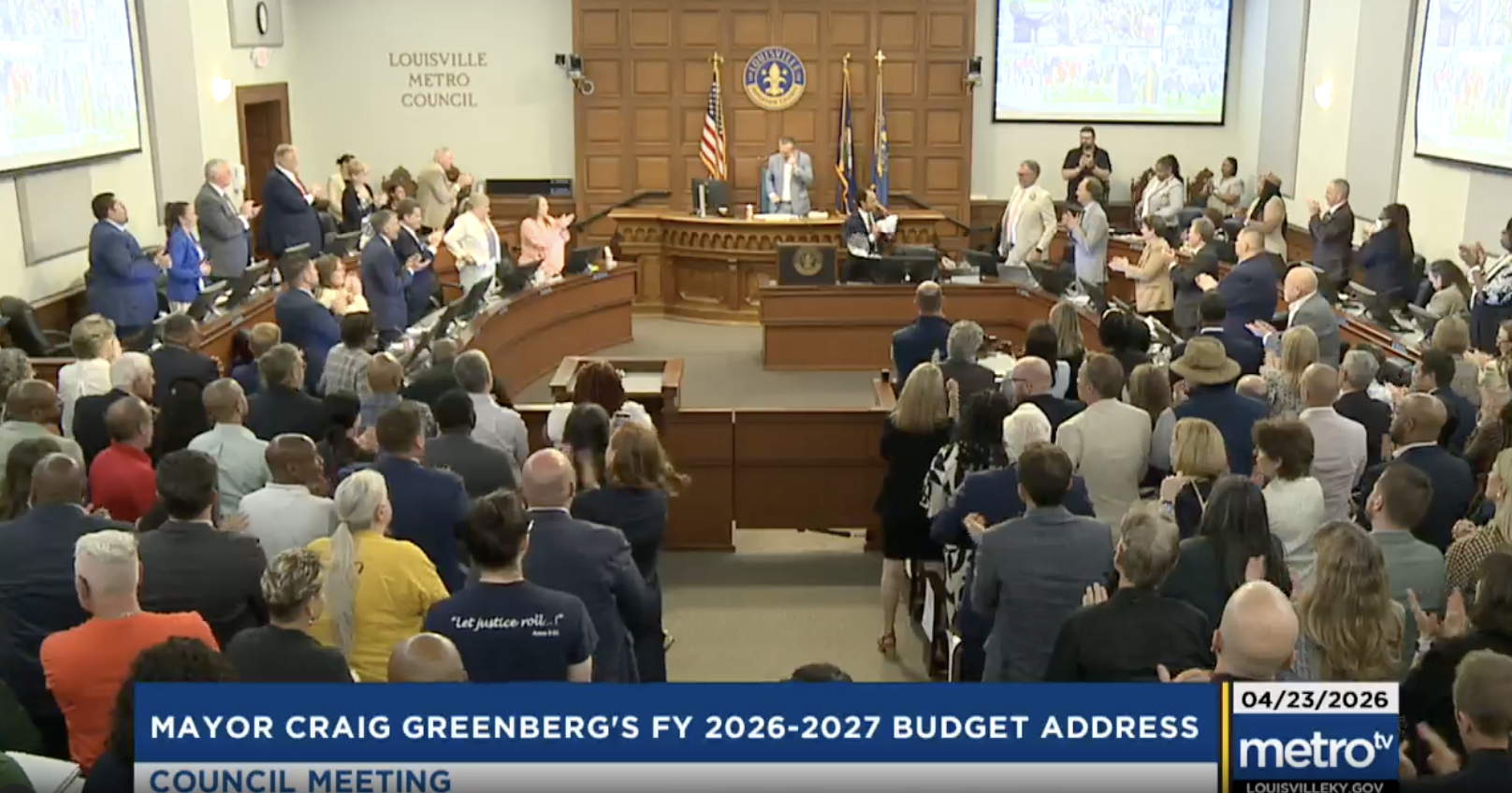
Mayor Craig Greenberg delivered his FY 2026-2027 budget address, presenting a sprawling spending plan that leans into affordable housing, parks capital, and public safety — powered in part by a transformative $1 billion state legislative investment in Louisville and sustained revenue growth without tax increases.
Why it matters: Louisville faces federal funding uncertainty, rising costs, and the loss of Medicaid coverage for more than 50,000 adults. The mayor's budget attempts to fill gaps while leveraging the largest state investment the city has ever received.
Where things stand: The mayor opened with a personal story about a grandmother receiving a Thrive by Five early learning scholarship, then outlined a sweeping agenda: Thrive by Five expanding to 225 children with $5 million in private matching funds; $3 million for Dare to Care's new hunger relief center in west Louisville; $1 million for Home of the Innocents; more than $20 million for affordable housing including the demolition of Dosker Manor.
"We're finally going to tear down Dosker Manor and replace it with new affordable housing," said Mayor Greenberg.
Parks capital is on track to exceed $100 million — including the nation's longest canopy walk at Jefferson Memorial Forest and the Belvedere redevelopment. On public safety, the mayor cited a 40% decline in shootings during his tenure. "In 2025, we saw fewer shootings than at any year in the past decade, down 40% in the time that I've been mayor," he said, proposing continued community violence intervention funding as federal dollars expire, a StarChase pilot technology for LMPD, and countywide drone first responder expansion.
"Just two weeks ago, the Kentucky General Assembly finalized a state budget that will deliver a transformative $1 billion investment into Louisville," Greenberg said — referencing state highway, infrastructure, and development funding that will shape the city for years.
Other highlights include the Big Streets Small Business Fund for commercial corridor revitalization, a Home for Good initiative targeting 250+ permanent supportive housing placements, and new employee benefits: day-one wellness center access and child care cost matching for Metro workers.
What's next: The Council will now begin its review of the proposed budget, with a deadline to pass a balanced spending plan by the end of June.
Gun Resolution Withdrawn for Bipartisan Letter
Councilman Ken Herndon (D-4) formally withdrew his "Kids Over Guns" resolution (R-019-26) after 22 of 26 council members signed a bipartisan letter to the Kentucky General Assembly on gun safety — a compromise brokered by Councilman Andrew Owen (D-9) and Councilwoman Ginni Mulvey-Woolridge (D-22).
Three weeks earlier, Herndon had agreed to explore the letter as an alternative to the resolution. On the floor, he noted that the four members who did not sign had "personal, thoughtful reasons." Councilman Kramer praised Herndon's sincerity, saying the letter "has a better opportunity to accomplish the goal." Herndon also announced he would pull related resolutions still in committee.
ALPR Camera Mapping Fails 4-20
Councilman Lyninger's ordinance (O-062-26) requiring Louisville Metro to publicly map and list government-owned automated license plate reader camera locations was overwhelmingly rejected.
"All it deals with is the right of the public to know the location of cameras that are recording them with data that is being analyzed, shared between agencies, sometimes within the law, sometimes outside of the law," Lyninger argued, noting Lexington already discloses its camera locations.
Opponents cited practical and financial concerns. Councilman Piagentini noted that previously disclosed locations led to camera destruction. Councilwoman Mulvey-Woolridge cited $6,000 per camera in replacement costs. Councilman Dan Seum Jr. (R-13) highlighted ALPRs' role in finding Alzheimer's patients and stolen vehicles. Councilwoman Parish Wright supported the bill as a transparency measure, and Councilman Owen acknowledged the tension between safety and surveillance but ultimately voted no.
Decisions: O-062-26 failed 4-20 with 1 present (For: 4, Against: 20, Absent: 1). The committee had recommended disapproval.
Council Unanimously Adopts Dignity Pledge
All 26 members backed R-037-26, a resolution committing to respectful dialogue inspired by Braver Angels and the National League of Cities' civility pledge.
Councilman Kramer explained how the initiative came together after Councilwoman Betsy Ruhe (D-21) introduced him to Braver Angels, a nonpartisan organization facilitating cross-partisan dialogue. "Together we were able to figure out a way to take advantage of the Braver Angels project that Betsy had already invited to come to Louisville and merge that together with a conversation around the Dignity Index," Kramer said.
Councilwoman Parish Wright said she hopes colleagues will "practice every word." Councilman Seum said "we all bleed red" and "our tears are clear." Nearly every member asked to be added as co-sponsor. The resolution passed by voice vote with no opposition.
Minor Items
Consent calendar passed 26-0, approving multiple NDF appropriations, committee minutes, board appointments, an HIV testing contract, a street closure, and a $2.4 million state grant for Shelby Park traffic improvements.
Rule 7.03 amended unanimously to create a two-step process for refiling failed legislation: Committee on Committees flags the bill, then the sponsor needs 14 signatures to proceed — similar to a congressional discharge petition.
Opioid settlement fund reallocation (O-069-26) passed 25-0, moving money between departments while keeping spending purposes unchanged for housing, case management, and behavioral health services. Councilwoman Parish Wright raised transparency concerns but supported the bill after receiving additional details.
Back to School Festival NDF appropriation (O-071-26) passed 24-0, pooling $7,000 from multiple districts for a neighborhood place event.
Ken-Ducky Derby funding (O-084-26) passed 25-0 after floor amendments grew district contributions to $16,550 for Harbor House, a multi-generational facility serving disabled individuals across Louisville and seven surrounding counties.
Councilwoman Barbara Shanklin (D-2) delivered a pointed critique during the NDF process, alleging racial disparities in funding support. "Every time it's a vote coming from an African American area, there's no money coming. But as soon as it's a different one, everybody gives," she said.