
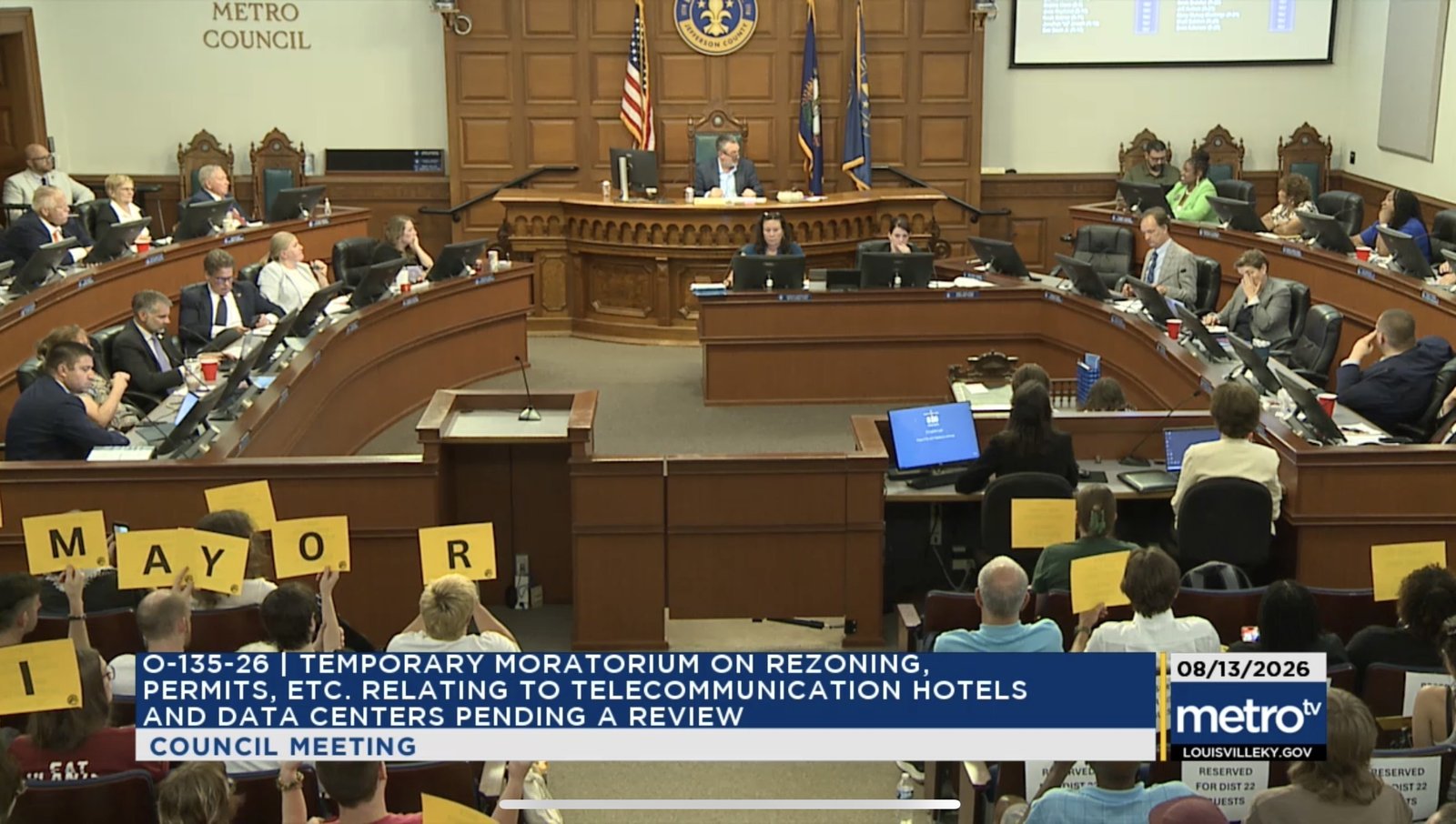
Louisville, KY – Metro Council – Aug 13, 2026
Metro Council • LouisvilleAugust 13, 2026
Locunity is a independent informational service and is not an official government page for this commission.We use AI-assisted analysis and human editorial review to publish information.
Council Passes Data Center Moratorium, Renews LG&E Franchise After Municipalization Push
Louisville Metro Council approved a six-month freeze on all data center development applications and closed a critical building-permit loophole — but rejected a push to extend the moratorium to a full year. In a separate contentious debate, the council renewed Louisville Gas & Electric's five-year gas franchise 18-3, but not before members openly discussed competitive bidding and buying out the utility's infrastructure under state law.
- Data center moratorium passes 24-1 with amendment closing building-permit loophole; one-year extension fails 10-15
- LG&E gas franchise renewed 18-3 after motion to send it back to committee for municipalization study fails 8-16
- Small massage businesses warn anti-trafficking licensing ordinance could force closures, cost jobs
- Celebrate Recovery gets full $22,000 ask from districts across the political spectrum for addiction ministry serving 250 weekly
- Feed Louisville funding expanded as council members report surging food pantry demand across the county
Data Centers on Ice — But for How Long?
The night's longest and most heated debate centered on Ordinance O-135-26, a 180-day moratorium on all rezoning, conditional use permits, and Category 2B and 3 development plan applications for data centers and telecommunications hotels.
Why it matters: Louisville joins a growing number of cities across the country pushing back against the rapid expansion of hyperscale data centers, which consume massive amounts of electricity and water. The moratorium freezes all new applications while the planning commission finalizes land development code regulations — but the debate exposed deep fractures over developer influence, environmental justice, and the pace of regulation.
Where things stand: Councilwoman Jennifer Chappell, the ordinance's sponsor, proposed an amendment discovered after planning staff flagged a loophole: without a new Section 2, developers could simply apply for building permits to convert existing structures into data centers, bypassing the moratorium entirely. That amendment passed by voice vote without opposition.
Councilman Andrew Owen noted the administration's existing administrative moratorium has already worked: "For the last eleven months we've had not a single data center application move forward," he said. "That was the point of the administrative moratorium, and it has worked."
But Councilwoman Tammy Hawkins pushed further, proposing an amendment to extend the moratorium from 180 days to 365 days. "It just seems like District 1 has became a target for data centers, so I hope everyone would take that into consideration," she said.
The 12-Month Fight
The extension amendment triggered some of the sharpest exchanges of the evening. Councilman J.P. Lyninger argued the proposed regulations were woefully inadequate, saying they "regulate one percent of all data centers in the United States and do not cover the concerns." He said he would support an indefinite moratorium and connected data centers to broader civil liberties concerns, calling hyperscale facilities tools of "a surveillance state that keeps us all as permanent suspects."
Councilwoman Betsy Ruhe shifted her position to support the extension, arguing that "if we extend it to twelve months, we will have time for the state legislature to come through, as they're feeling the same pressure we are."
The other side: Councilman Anthony Piagentini accused some moratorium advocates of using inflammatory rhetoric. He referenced planning commission meetings where, he said, "some of them used the language of class warfare, of Marxism, of anti-business, of antisemitism, and ultimately it ended with a group of people standing up and throwing streamers at the planning commission." He called the 12-month push performative, arguing the administrative moratorium had already proven effective and the council should force the administration to finalize regulations quickly.
Councilman Markus Winkler tried to lower the temperature, reminding colleagues of the recently adopted dignity pledge: "I would maybe just like to remind my colleagues to take the temperature down a little bit. It was only a few meetings ago that we passed — in fact, you walk by it on your way in — the dignity pledge." He urged the body to focus on getting actionable regulations passed before January, when a new council could take office.
Councilwoman Chappell herself drew a rebuke after accusing colleagues of being influenced by the administration, then apologized from the floor: "I violated the dignity pledge. I also lodged a baseless claim. I also assumed that the public wasn't more knowledgeable than they are."
Assistant County Attorney Laura Ferguson confirmed the ordinance could be extended by another six months at its expiration if regulations are not ready.
Public Fury Over Environmental Racism
During public comment, speakers Danielle Ray and Sauda Brown delivered forceful testimony accusing the administration of environmental racism, particularly regarding the proposed Campground Road data center in a predominantly Black and working-class community near rubbertown. Brown compared data center pollution to the gas facilities that she said have "reduced life expectancy by a decade." Both demanded the Kentucky Resource Council be brought in for independent advisement and called for a full-year moratorium.
Councilwoman Donna Purvis warned that the entire west end and southwest neighborhoods have been targeted for data center development.
Decisions: The 12-month extension amendment failed 10-15 (For: 10, Against: 15, Absent: 1). The final ordinance, with the loophole-closing amendment, passed 24-1 (For: 24, Against: 1, Absent: 1).
What's next: The 180-day clock begins upon the ordinance's effective date. The planning commission must finalize new land development code regulations for data centers during that window. The council retains the option to extend the moratorium for an additional six months.
LG&E Gas Franchise Renewed, but Municipalization Talk Gets Serious
Ordinance O-188-26, renewing Louisville Gas & Electric's five-year gas franchise, returned from the table where it had been parked two weeks earlier amid questions about the city's long-term energy relationship.
Why it matters: The franchise renewal preserves the status quo, but multiple council members used the debate to put energy alternatives — competitive bidding and outright municipalization — squarely on the public record. It was the most serious discussion of those options in Louisville's recent history.
Where things stand: Councilman Kevin Kramer, whose committee forwarded the item, explained the franchise is identical to the 2016 version and said he planned to meet with the county attorney's office within a month to explore re-litigating rate cases before the Public Service Commission. "The franchise agreement before us is precisely the same franchise agreement that we entered into in 2016, and using that franchise agreement, we tried to go to the Public Service Commission and make changes," he said.
Councilman Andrew Owen laid out two concrete alternatives. He noted the gas market has been open to competition since the 1990s and suggested the city could bid the franchise competitively. He also raised municipalization under state law, pointing out that LG&E earns a 9–11% return on equity compared with a market rate of 5–6%.
Councilman Lyninger was blunter, framing the issue in populist terms: "When you pay your electric and gas bill, you are paying for shareholder profits on Wall Street. Instead of having a dividend that can be reinvested in our city, you're buying them yachts." He noted LG&E is owned by Pennsylvania-based PPL Corporation and said the utility will not get off coal until 2065. Lyninger then moved to send the franchise back to committee to invite the administration for a broader discussion of gas delivery options.
The other side: Council President Brent Ackerson left the chair to argue forcefully against further delay. "We're a day late and dollars short of considering this," he said, calling the complexities of renegotiating a major corporate deal in two weeks "nuts." Ackerson also cautioned against government-run utilities, citing Louisville's own infrastructure costs: "We build sidewalks for $1,600 a square, whereas the average person could build it for $200."
Councilwoman Tammy Hawkins offered a pointed assessment of the utility's track record: "LG&E has been pimping us for years."
Councilman Winkler supported the renewal but urged colleagues to actually follow through on alternatives during the five-year term rather than forgetting about it until the next renewal cycle.
Decisions: The motion to send the franchise back to committee failed (For: 8, Against: 16, Present: 1). The franchise renewal passed (For: 18, Against: 3, Present: 4).
What's next: The five-year franchise term begins upon adoption. Councilman Kramer committed to meeting with the county attorney's office within a month to explore Public Service Commission rate challenges. The competitive bidding and municipalization options remain open for council pursuit during the term.
Small Massage Businesses Say Anti-Trafficking Rules Could Put Them Out of Business
Three massage therapy professionals told the council during public comment that the massage licensing ordinance — designed to combat human trafficking following Operation Delivered Justice — is imposing disproportionate costs on small, legitimate businesses.
Why it matters: The ordinance passed with strong anti-trafficking intent, but compliance costs are hitting solo practitioners and small shops hardest, potentially pushing licensed therapists into lower-paying franchise work or eliminating massage services altogether.
Gabriel Bolds, a licensed massage therapist and single mother at McCosh Holistic Massage in District 8, said she earns more than $50,000 at her small shop compared with $35,000 at a large franchise — but the ordinance has added $6,000 per month in new fixed expenses. She asked the council to amend the ordinance to better support small businesses.
Shay Newtz, a solo practitioner in the Highlands who shares office space with mental health professionals, raised concerns about surveillance camera requirements conflicting with HIPAA protections and said the "catch them in the act" inspection approach is disrespectful to licensed therapists and potentially harmful to clients who are abuse survivors.
Laura Watkins, owner of Pure Salon Spa in Fern Creek for nearly two decades, explained she employs one massage therapist who has been with her for 17 years. The full regulatory burden — additional licensing, fingerprinting, background checks, surveillance, and record-keeping — falls disproportionately on a one-employee operation. She said she may have to eliminate massage services and let go of a loyal employee.
All three speakers said they support the ordinance's anti-trafficking intent but asked for proportional regulation and exemptions for already-licensed businesses.
Minor Items
- Consent calendar (Items 20–50) approved 24-0, covering appropriations, board appointments, park grants, and zoning changes.
- FY 2026–27 budget reallocation passed 25-0, including an amendment to roll forward District 1 lawn maintenance funds from the prior year.
- Celebrate Recovery at Fairdale Christian Church received its full $22,000 funding request (25-0) after districts across the council contributed neighborhood development funds. The Christ-centered recovery program has grown from 25 participants to 250 per week over nine years. Councilman Dan Seum Jr. noted that program leader Larry Mitchum does not take a paycheck.
- Feed Louisville appropriation amended upward with additional district contributions and passed 23-0. Councilwoman Barbara Shanklin reported 130 people at her Monday food pantry. Feed Louisville redistributes restaurant surplus without income qualification.
- Girl Scouts of Kentuckiana Via Calor Festival funding expanded with additional district contributions; passed 23-0.
- Bridge Kids International / African Heritage Festival funding boosted; festival rescheduled to October. Passed 24-0.
- Family Scholar House Pack a Backpack event received multi-district funding; passed by voice vote.
- Violence prevention advocate Richard Whitlock Jr. pitched the Louisville Peace Project during public comment, citing more than 1,300 murders in Louisville from 2016–2025. The proposal would deploy 20-plus trained violence interrupters across four zip codes (40203, 40210, 40211, 40212) using the Cure Violence model.
- Lee Maddox advocated for Louisville to endorse the plant-based treaty after sharing a personal story of reversing diabetes through diet.
- 23 new business items assigned to committees, including a $13.5 million federal funding resolution.