Mayor's Press Conference - Sep 09, 2026 - Meeting
Mayor's Press Conference • San FranciscoSeptember 9, 2026
Locunity is a independent informational service and is not an official government page for this commission.We use AI-assisted analysis and human editorial review to publish information.
SF Breaks Ground on 7,200-Home Candlestick Park Neighborhood After Decades of Planning
After years of delays, economic downturns and a pandemic, construction has officially begun on the former Candlestick Park site — a 270-acre waterfront development that will reshape southeastern San Francisco with thousands of homes, an innovation district and more than 100 acres of parks. The groundbreaking, marked by an air-horn countdown and a parade of elected officials past and present, signals the start of what could become the city's largest new neighborhood in a generation.
Construction launches on 7,200-home Candlestick Park redevelopment, with 40% of Phase 1 units designated affordable
Developer FivePoint has already invested $116 million in Bayview community programs before a single home goes up
Project projected to generate $4 billion in economic activity and 12,000 jobs across housing, commercial and park construction
Federal backing includes a $30 million PROMISE grant and Third Street rail extension funding
Mayor Lurie ties Candlestick to citywide housing push, announcing $5 million for neighboring Alice Griffith public housing
A Generational Promise, Finally Under Construction
Why it matters: The Candlestick redevelopment is one of the most ambitious housing projects in San Francisco history — and it's arriving in Bayview–Hunters Point, a historically Black and working-class neighborhood that has waited decades for the investment other parts of the city received long ago. The project's trajectory will test whether San Francisco can deliver large-scale housing, equitable community benefits and economic development simultaneously.
Where things stand: Phase 1 will deliver approximately 700 homes, with 40% affordable, along with roads, utilities and foundational infrastructure linking the site to the adjacent Alice Griffith public housing community. At full buildout, the project calls for more than 7,200 homes, up to 2.8 million square feet of commercial and innovation-district space, roughly 550,000 square feet of retail, hotel, entertainment and community uses, and 2.5 miles of restored public waterfront access.
"Candlestick will generate more than $4 billion in economic activity. This will provide opportunities for local businesses and create more than 12,000 jobs," said Thor Kaslofsky, Executive Director, Office of Community Investment and Infrastructure (OCII).
Kaslofsky framed the project as emblematic of a city that builds and invests for the long term.
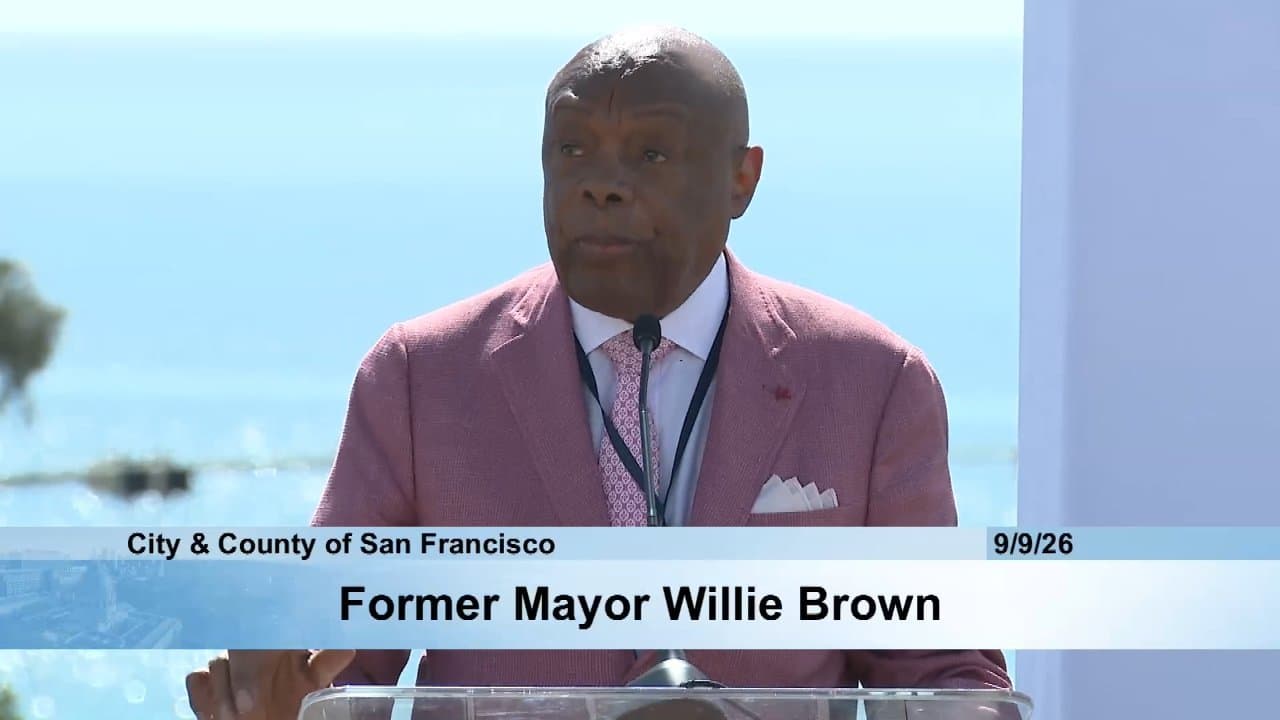
Former Mayor Willie Brown, who traced the project's lineage back to Congressman Phil Burton's vision and the World War II era, placed it alongside Mission Bay and Treasure Island as transformational waterfront developments.
"It's been so damn long," Brown said. "However, it's been worth every step of it."
Supervisor Shamann Walton, District 10, who has represented the neighborhood through years of stalled progress, was blunt about the frustration.
"The biggest thorn in my side since I have been in office has been Candlestick, because we've built so much housing here in this district, so much affordable housing here in this district," Walton said.
He noted that District 10 already leads San Francisco in affordable housing construction and pledged continued accountability as the project moves forward.
$116 Million Before a Single Home Goes Up
The basics: Before construction began, developer FivePoint committed more than $116 million to community investments in Bayview — a figure detailed by Dr. Veronica Hunnicutt, Chair of Hunters Point Shipyard Citizens Advisory Committee (CAC), who has served as one of the project's most persistent community watchdogs.
Where things stand: The investments include $42 million for affordable housing infrastructure, $15 million for the Eclectic Cookery (a cultural and culinary facility supporting local food entrepreneurs), $2.25 million in early capital for the Southeast Family Health Center on Keith Street, $1.5 million for education and scholarships, approximately $2 million for workforce development and local contractor support, and over $3 million for community organization property acquisitions — including 5000 3rd Street, now home to Rafiki health, wellness and food security programs, and a recovery clinic at 1676 Newcomb Ave. An additional $400,000 went to Working Solutions to administer the District 10 Small Business Revolving Loan Fund.
"Over more than 16 years, the developer has contributed more than $116 million towards housing, education, health and wellness, workforce development, job creation and infrastructure in this community," Hunnicutt said.
She emphasized these were commitments the community helped shape and fought to protect. Hunnicutt also paused to honor deceased CAC members who spent decades envisioning this day — Scott Madison (27 years of service), Saul Bloom (23 years), Frank O'Neill (18 years), Ollie Mixon (14 years) and Mary Booker (12 years). Their collective tenure underscores just how long Bayview residents have been at the table, pushing for this project.
"A groundbreaking is not the finish line," Hunnicutt said. "The true measure of this project will be whether families move into homes, businesses open their doors, parks welcome our children."
Later in the press conference, Speaker Emerita Nancy Pelosi singled out Hunnicutt's advocacy, calling her "relentless, persistent, dissatisfied. Effective." She described Hunnicutt's work as an embodiment of democratic participation — making sure people's views are heard.
Lurie's Speed Question: Can San Francisco Build Faster?
Why it matters: Mayor Daniel Lurie used the ceremony to connect Candlestick to his broader housing agenda, framing the project as proof of concept for a city trying to accelerate construction across every neighborhood and price point.
"For years, San Franciscans have heard about what would someday rise at Candlestick. They heard about new homes and parks and shops and jobs. But year after year, it remained empty," Lurie said.
His central question — "how do we go faster?" — pointed to the administration's Family Opportunity agenda, the family zoning plan designed to make room for more homes, and the Permit SF initiative to cut red tape and reduce construction costs.
"San Francisco must build more homes at every level of affordability. We need more affordable housing. We need more senior housing. We need more market rate housing," Lurie said.
He also announced $5 million in investments for the neighboring Alice Griffith public housing community, funding repairs, improved security and upgraded play areas for children and families.
Lurie's emphasis on speed reflects a real tension: the Candlestick project has been in planning and entitlement phases for well over a decade, buffeted by recessions, a pandemic and the sheer complexity of government processes. Whether the Lurie administration can compress timelines on this and other large-scale projects will be closely watched as the city faces state housing-element compliance pressures.
Federal Dollars and the Political Coalition Behind the Project
FivePoint President and CEO Dan Hedigan framed Candlestick as a once-in-a-generation development opportunity.
"The opportunity to create an entire neighborhood of this scale from the ground up in a city as iconic as San Francisco is extraordinarily rare," Hedigan said.
He outlined plans for the 2.8 million square feet of approved commercial space to become an innovation district, aligning with the mayor's economic recovery priorities.
Speaker Emerita Nancy Pelosi highlighted the federal investment that helped make the project viable, including a competitive $30 million PROMISE grant and funding for the Third Street rail extension connecting the site to the rest of the city. "All over the country, people wanted promise grants. We got $30 million," Pelosi said, emphasizing that Congress funds projects when it sees strong community backing.
Rev. Dr. Carolyn Ransom Scott, Chair, Commission on Community Investment and Infrastructure, offered opening remarks, and Suhail Toda, Senior Vice President, FivePoint, who has worked on the project for 15 years, emceed the ceremony — recalling attending 16 consecutive Giants opening days at the old ballpark.
What's Next
Infrastructure work — roads, utilities and grading — is now underway, with housing construction to follow. The first buildings on site will be residential, with 40% of Phase 1 designated affordable. The project's long-term trajectory — delivering more than 7,200 homes across multiple phases, along with commercial space, parks and waterfront access — will unfold over years, making sustained community oversight and government accountability essential at every milestone.