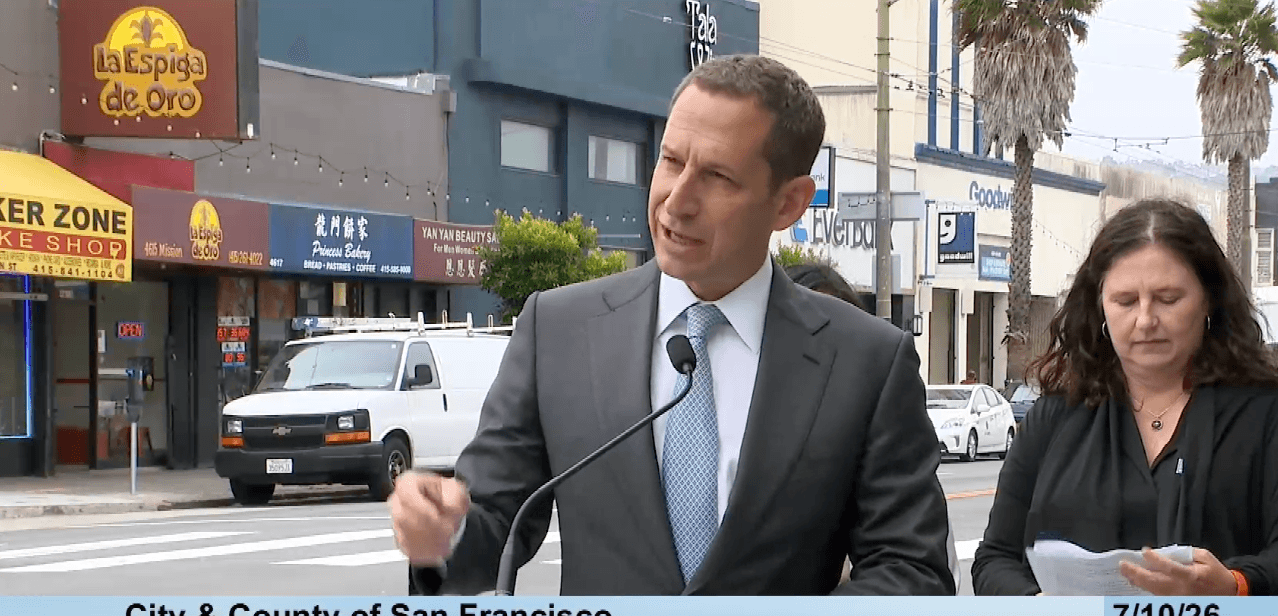
Mayor's Press Conference - Jul 10, 2026 - Meeting
Mayor's Press Conference • San FranciscoJuly 10, 2026
Locunity is a independent informational service and is not an official government page for this commission.We use AI-assisted analysis and human editorial review to publish information.
City Celebrates $31M Excelsior Safety Overhaul as Crash Numbers Hit Decade Low
Five deaths, more than 300 injuries, and seven years of dangerous conditions on one of San Francisco's busiest corridors led to a $31 million infrastructure transformation that city leaders say is already saving lives. Mayor Daniel Lurie and a lineup of agency heads and community advocates gathered Thursday in the Excelsior to cut the ribbon on the completed Mission Street and Geneva Avenue Infrastructure Improvement Project — and to announce it had just won a national engineering award.
- $31 million Mission-Geneva project completed with 87 new curb ramps, 70 signal poles, 34 bulb-outs, raised crosswalks, sewer rehabilitation, and Highway 280 overpass upgrades
- Injury crashes on Geneva hit their lowest level in more than a decade, city reports, crediting signal timing, safety upgrades, and speed cameras
- Citywide pedestrian collisions down 32%, vehicle near-misses cut nearly in half, and speed cameras reducing speeding by almost 80%
- Project wins 2026 ASCE Outstanding Sustainable Engineering Award from the American Society of Civil Engineers, Golden Gate Branch
- Excelsior's 300+ small businesses and immigrant community celebrated as direct beneficiaries of safer streets and better curb management
Safer Streets, Stronger Neighborhood: The Excelsior Gets Its $31M Makeover
The Excelsior, one of San Francisco's most commercially dense and diverse neighborhoods, has been one of the city's most dangerous places to cross the street. The Mission Street and Geneva Avenue corridor sits on the city's High Injury Network — the 13% of streets where 75% of all severe and fatal collisions happen.
Why it matters: Over seven years, five people were killed and more than 300 were injured in car collisions along this corridor. The $31 million project, a collaboration between SF Public Works, SFMTA, SFPUC, and the SF County Transportation Authority, was designed to fundamentally change those odds with a comprehensive rebuild of the street environment.
Where things stand: The scope of the project is enormous for a neighborhood-scale investment. Director Carla Short, Director, San Francisco Public Works, rattled off the numbers: "87 new curb ramps, 70 new traffic signal poles, 34 bulb-outs, 22 street light replacements, 17 concrete bus pads, three bus bulbs, two raised crosswalks, tens of thousands of square feet of new concrete base, and thousands of tons of fresh asphalt." Beyond the surface, the project included sewer mainline rehabilitation and improvements to the overpass across Highway 280.
Mayor Daniel Lurie framed the project as a moral imperative. "Over seven years, five community members have been killed and more than 300 people have been injured in car collisions. That is why today we are delivering practical improvements," he said, calling the corridor "a model for what every neighborhood in San Francisco deserves — infrastructure that works for the people who live here."
The early returns are striking. SFMTA Director Coruspan reported that on Geneva Avenue between Mission and Carter, "the signal timing, safety upgrades and speed camera helped to contribute to the lowest number of injury crashes recorded on the corridor in more than a decade."
Director Short also announced that the project was selected by the American Society of Civil Engineers, Golden Gate Branch, as the 2026 Outstanding Sustainable Engineering Project Award winner — national recognition for a neighborhood-level infrastructure investment.
Vision Zero by the Numbers: Citywide Safety Gains Accelerate
The Excelsior project is part of a broader push, and the SFMTA director used the ribbon cutting to present aggregate citywide results that suggest San Francisco's sustained investment in street safety is producing measurable returns.
The basics: Vision Zero is the city's policy goal of eliminating traffic deaths. The High Injury Network strategy concentrates capital spending on the relatively small share of streets — 13% — that generate the overwhelming majority of severe and fatal crashes.
Where things stand: "Across the city, safety improvements are helping to reduce pedestrian collisions by 32%," SFMTA Director Coruspan reported. "Vehicle near-misses have dropped by almost half. Bike trips have increased by 30%. And our speed cameras have helped to reduce speeding by almost 80%."
The speed camera statistic is particularly notable. San Francisco was among the first California cities to deploy automated speed enforcement after the state authorized a pilot program, and the nearly 80% reduction in speeding on equipped corridors provides early evidence that the technology is changing driver behavior at scale.
Why it matters: These are among the first aggregate results demonstrating that sustained, corridor-by-corridor investment in the High Injury Network — combined with newer tools like speed cameras — is bending the curve on traffic violence citywide. For advocates who have pushed for years to redirect transportation dollars toward safety over vehicle throughput, the data offers significant political validation.
Excelsior Economy: Safer Streets, Stronger Small Business
Community leaders made clear the project isn't just about crash statistics — it's about the economic survival of one of the city's most vibrant immigrant business corridors.
Why it matters: The Excelsior is home to more than 300 small businesses, many immigrant-owned, lining Mission Street and Geneva Avenue. Infrastructure that makes deliveries smoother and foot traffic safer has a direct impact on whether those shops and restaurants can compete.
Supervisor Cheyenne Chen, Supervisor, District 11, pointed to the practical: "Better curb management means deliveries are safer and more efficient, making it easier for more than 300 small businesses along Mission and Geneva to serve our community and continue to thrive." She also credited inter-agency coordination and the Mayor's office for helping push the project through bottlenecks.
Laura Padilla, Executive Director, Excelsior Action Group, connected the infrastructure to the neighborhood's identity and culture. "This investment helps showcase Excelsior as one of San Francisco's most diverse neighborhoods, home to more than 300 small businesses, incredible restaurants, rich cultural traditions, and generations of immigrant families," she said. She argued that the link between street safety and local commerce is direct: "When streets are safer and easier to navigate, people spend more time walking, shopping locally and supporting neighborhood businesses."
Padilla tied the improvements to community programming — night markets, cultural celebrations, and everyday commerce — that depends on streets people feel safe using after dark and on weekends.
What's next: The completion of the Mission-Geneva corridor is expected to serve as a template for future High Injury Network investments across San Francisco. Whether the city can replicate this level of multi-agency coordination and funding — $31 million is a significant sum for a single corridor — in other underserved neighborhoods will be the next test of the Vision Zero strategy's staying power.