Mayor's Press Conference - May 26, 2026 - Meeting
Mayor's Press Conference • San FranciscoMay 26, 2026
Locunity is a independent informational service and is not an official government page for this commission.We use AI-assisted analysis and human editorial review to publish information.
Mayor Lurie Honors Eritrean Community at Third Annual City Hall Celebration
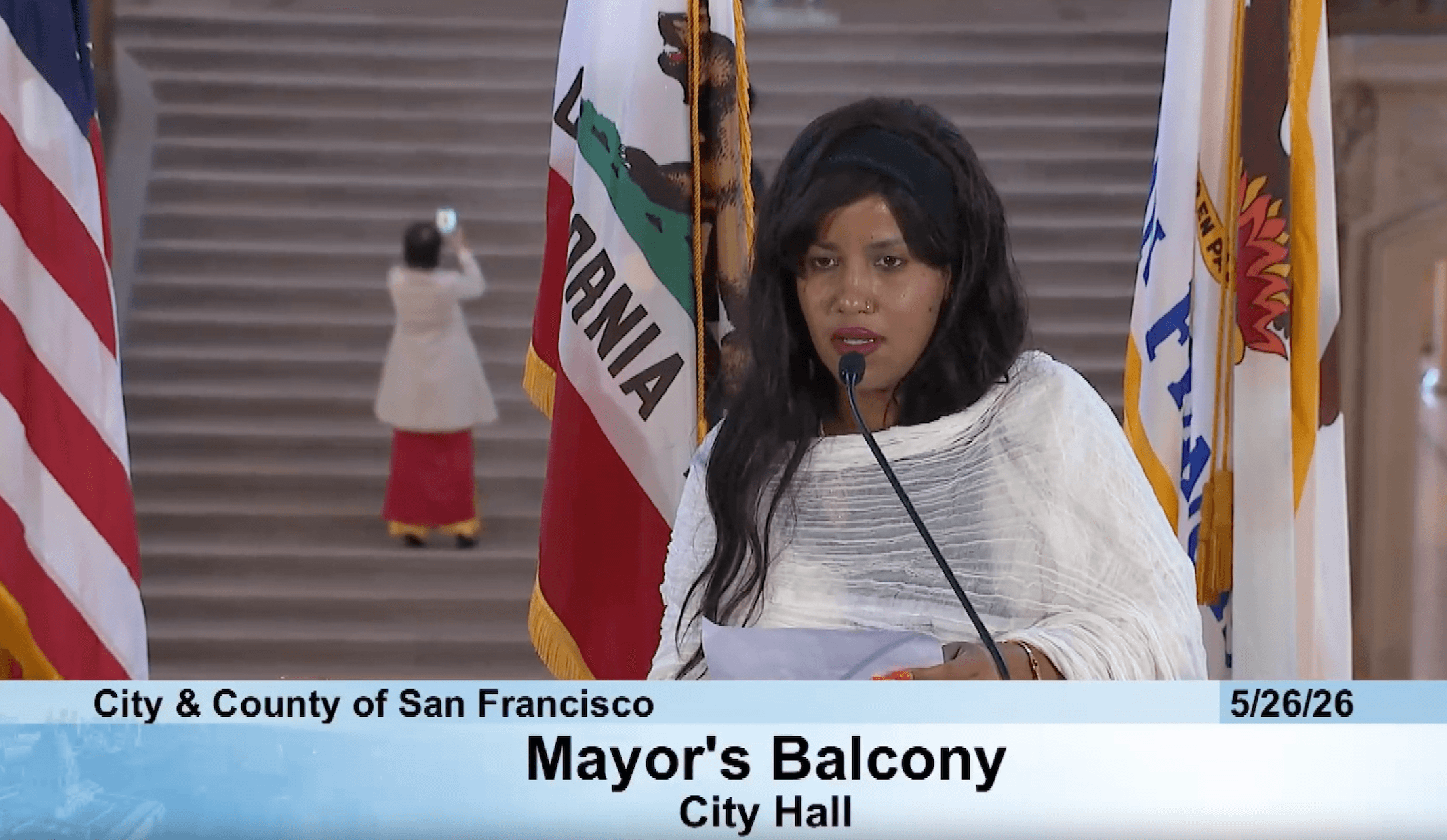
San Francisco marked its third annual Eritrean Independence Day celebration at City Hall on May 26, with Mayor Daniel Lurie joining community leaders to honor the Bay Area's deep Eritrean roots — one of the largest diaspora communities in the United States. The ceremony blended cultural pride with a memorial for a late scholar and an unexpected call to harness the city's AI industry for East African cultural research.
Mayor Lurie celebrates Eritrean Independence Day, reaffirms San Francisco as a welcoming city
Community leaders honor 170,000 lives lost in Eritrea's independence struggle
Speaker calls on SF's AI ecosystem to continue late scholar's research linking Egyptian hieroglyphs to Eritrean language
Poet Aram Walda Baraya performs original work celebrating Eritrean American identity
Identity, Resilience and a City's Embrace
Why it matters: The Bay Area's Eritrean community is among the oldest and largest in the country, and civic recognition at City Hall affirms San Francisco's relationship with a diaspora that has shaped neighborhoods, businesses and culture across the region for decades.
Lydia Haile, founder of Kibri, a San Francisco-based arts organization, opened the ceremony — which she has organized each of the three years — with a direct answer to skeptics who question the annual tradition.
"Recently, someone asked me, why do you continue organizing this event every year? And the answer is simple. Because identity matters. Representation matters. Belonging matters. Purpose matters," said Haile.
Mayor Daniel Lurie followed with keynote remarks praising the Eritrean community's spirit and its contributions to the city.
"We are incredibly fortunate that the Bay Area is home to one of the largest and earliest Eritrean communities in the United States," Lurie said.
He drew laughs describing Eritrean hospitality:
"You think you're stopping by for a quick five minute greeting, but three hours later, you've been fed twice, you've had three cups of coffee."
The mayor struck a more serious tone in closing, pledging the city's continued openness.
"San Francisco will always be a place where you are welcome, no matter your background, ethnicity, or culture," Lurie said.
A Nation's Price: History, Loss and Global Achievement
Dawit Gedle provided the ceremony's most emotional moments, weaving Eritrea's deep archaeological heritage — including some of the oldest human remains on record and what he described as the world's oldest oyster bar — with the devastating human cost of independence.
"We paid about over 170,000 lives to restore Eritrea. And for instance, I lost two brothers in the past independence," Gedle said.
He then asked audience members to raise their hands if they, too, had lost someone. Nearly every hand went up.
Gedle pivoted from loss to pride, citing modern Eritrean excellence on the global stage — cyclist Binyam Gurmail's historic Tour de France stage victories as the first Black African winner and Swedish-Eritrean soccer star Alexander Isak's record $170 million transfer.
"For Eritreans, the most important value is perseverance. That's the power to overcome challenge and never give," he said, before urging the mayor directly: "Please make sure these kind of events and this communication and cooperation continues."
A Scholar's Legacy and a Call for AI
One speaker delivered a tribute to the late Isaias Gebrhin, a researcher who died unexpectedly in his early 40s roughly a month before the celebration. Gebrhin had spent 15 years — entirely self-funded — studying connections between ancient Egyptian hieroglyphs and the Eritrean Tigrinya language.
"Over 15 years of time, Sas dedicated his life and his own money, without any institutional funding, without any sponsorship, to studying ancient Egyptian hieroglyphs and their possible connection to Eritrean language, in particular," the speaker said.
His research reportedly began with the observation that a ceremonial stick still carried by Eritrean men at weddings appeared carved on ancient Egyptian temple walls. The speaker argued that Gebrhin believed standard phonetic decodings of hieroglyphs were correct but that deeper cultural interpretations had been misunderstood.
The tribute then turned into a call to action aimed squarely at San Francisco's tech sector:
"I want to provoke the Eritrean community, our academic community, our funders and our scholars to use the power of San Francisco in this incredible moment of artificial intelligence to solve mysteries that are yet to be even claimed in terms of what they can do to bring unity to this world."
Why it matters: The proposal represents a novel intersection of San Francisco's dominant AI industry and East African cultural scholarship — a use case that could establish a model for tech-civic-academic collaboration if funders or institutions take up the call.
'I Am an Eritrean American'
Aram Walda Baraya — an artist, writer, poet, filmmaker and mental health advocate — closed the ceremony with an original poem titled "I Am an Eritrean American."
"I am an Eritrean American from a lineage of patriot people who violently fought and won the battle of army struggle against colonizers," Walda Baraya read, celebrating identity, resilience and the Eritrean spirit before the City Hall audience.