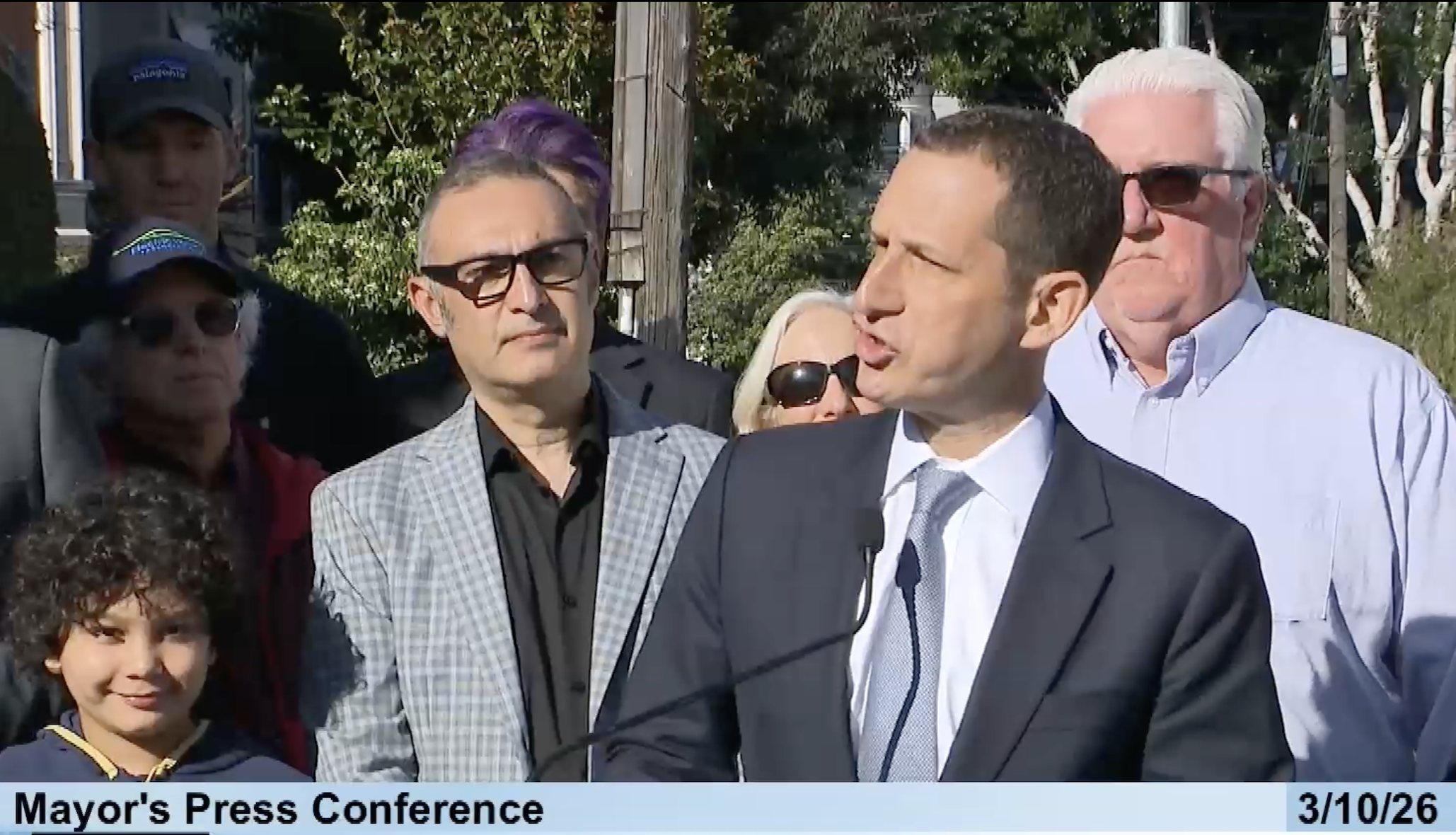
Mayor's Press Conference - Mar 10, 2026 - Meeting

Mayor's Press Conference - Mar 10, 2026 - Meeting

Mayor's Press ConferenceSan FranciscoMarch 10, 2026

Sources:

Locunity is a independent informational service and is not an official government page for this commission.We use AI-assisted analysis and human editorial review to publish information.

SF Unveils Citywide Framework for Curbside EV Chargers

Mayor Daniel Lurie and Board of Supervisors President Rafael Mandelman introduced legislation to create a permanent permitting pathway for curbside electric vehicle charging — a move aimed at the roughly 70% of San Francisco residents who rent and lack garages. At a press conference outside IBEW Local 6's union hall, where the city's first curbside chargers were installed last spring, the two leaders framed the effort as the next step in making EV ownership realistic for a renter-majority city.

  • New legislation creates a permanent citywide permitting framework for curbside EV chargers, moving beyond a two-charger pilot launched in April 2025

  • Permit SF reform push now tops 20 ordinances cutting red tape, with an online portal launched in February 2026

  • IBEW Local 6 says 700+ members certified through EV infrastructure training, positioning union labor for the buildout

  • Lurie vows to keep walking San Francisco's streets after a Tenderloin confrontation, with Mandelman offering public backing


Charging the Curb: From Pilot to Citywide Program

The legislation introduced jointly by Mayor Daniel Lurie and Board of Supervisors President Rafael Mandelman would establish a long-term permitting pathway for curbside electric vehicle chargers across San Francisco. The framework moves beyond the existing pilot — two chargers installed outside IBEW Local 6's union hall in April 2025, the first curbside units west of the Mississippi — to enable installations at scale in neighborhoods with high renter populations and apartment density.

Why it matters: In a city where most residents rent without access to a garage, public curbside charging is the primary path to making EV ownership feasible. Without it, the city's climate goals and equity commitments around clean transportation remain largely theoretical for the majority of San Franciscans.

Where things stand: The legislation sits within the broader Permit SF initiative, which has produced more than 20 ordinances aimed at reducing bureaucratic barriers. An online permit portal launched in February 2026. The SFMTA's Taxi Access and Mobility Services division will house the new permitting program, with the city pursuing public-private partnerships for installation and operation. Lurie noted that 250 EV chargers have opened citywide since he took office.

"Through our permit reforms, we have already introduced more than 20 ordinances to cut red tape — common sense changes that make life easier for residents and our small businesses," said Lurie.

SFMTA Director of Transportation Julie Kirschbaum described the agency's approach as focused on making the program workable across different neighborhoods.

"We are excited to make efficient and easy public-private partnerships to deliver this work. Our priority is simple. We're trying to create a feasible, equitable and responsive pathway to meet this important community need," she said.

Mandelman, who described years of advocacy for curbside charging before his current role, framed the legislation as the culmination of that push.

"The intention has always been to get beyond a pilot and actually to be able to have EV chargers on the sidewalk at scale," he said. "What is significant about the legislation that you're introducing and that I'm co-sponsoring at the Board of Supervisors today is that it actually creates that framework."

Mandelman also noted the chargers appear to be well-used, noting that they are in use nearly 70% of the time.

He acknowledged that reducing car dependency remains the top priority but argued the city must also serve residents who need vehicles.

"Of course, the first and most environmentally friendly thing we need to do is make it possible for as many people as possible to live and commute and live their lives without cars. But there will be people who need to have cars. And when they have those cars in San Francisco, we need those cars to be electric vehicles."

Union Workforce Ready for the Buildout

John Doherty of IBEW Local 6 made clear that the labor side of the equation is already in place. The union has certified over 700 members though the Electrical Vehicle Infrastructure training program.

Doherty framed the expansion as a virtuous cycle for the workforce:

"The more everything runs on the grid, the more work opportunities my members have, the more apprenticeship opportunities we can open up for the next generation of electrical worker, making it a win-win situation for all involved."

A Renter's Testimony

Ashkan Javaherian, a San Francisco resident, offered a personal account that underscored the stakes of the program.

"I was actually close to selling my EV when I discovered the curbside pilot program run by the city," he said. "And because of that, I decided to keep my car."

Javaherian pointed to a structural gap in the city's EV landscape:

"In practice, owning an EV... is realistic mostly for people who own their own home and have a garage. In a city where so many residents are renters, that's just not an equitable solution."

Expansion Plans

Kirschbaum said the next pilot installations are planned for Dogpatch and Treasure Island, with chargers already opened in Bayview and the Mission District.

"We do anticipate that this will be a citywide program focusing on where we have apartment buildings and other residential density that would really benefit from this work," she said.

What's next: The legislation heads to the Board of Supervisors for consideration.


Lurie Defends Street Walks After Tenderloin Confrontation

When reporters asked about a recent confrontation the mayor experienced in the Tenderloin, Mayor Daniel Lurie declined to discuss specifics, citing an ongoing investigation. But he made clear the incident will not change his approach.

"I've probably gone out and talked to people on the street a few hundred times and I'm not going to stop doing that," he said. "There are people struggling on our streets with addiction, struggling with homelessness."

Lurie said he walks the streets regularly, had positive interactions that morning, and will consult with his security detail and the police chief to ensure safety going forward.

Why it matters: The exchange underscored a defining feature of the Lurie administration — a mayor who physically shows up in neighborhoods grappling with drug use, mental health crises, and homelessness. The incident has raised questions about personal safety and the limits of hands-on governance, but also about what residents expect from their elected leaders.

Board of Supervisors President Rafael Mandelman offered an unsolicited defense, saying his constituents are frustrated by scenes of open drug use and mental illness and by police sometimes driving past without intervening.

"We do not want our city hiding from this problem," he said.

The public backing from Mandelman signals a political alignment between the mayor and the new Board president on public-safety messaging — one that could carry weight as the administration navigates ongoing debates over street conditions and enforcement.