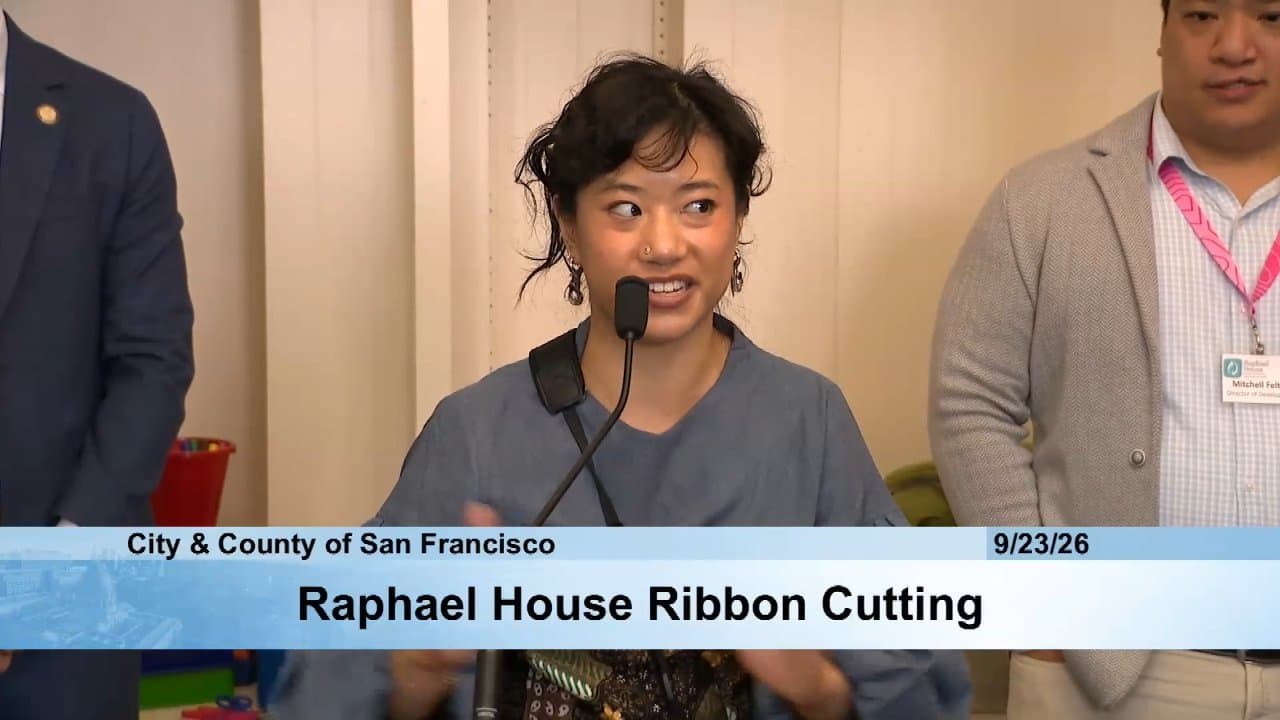
Raphael House Secures First City Funding, Expands Family Shelter by 50%
Mayor's Press Conference • San FranciscoSeptember 23, 2026
Locunity is an independent informational service and is not an official government page for this commission. All information is sourced from public footage and an analysis of official agendas with the aid of responsible, fact-checked AI. to report an error or omission.
San Francisco's oldest family homelessness shelter celebrated a milestone it waited more than five decades to reach: its first-ever public operational funding. Mayor Daniel Lurie joined Raphael House leaders and District 3 Supervisor Danny Sauter for a ribbon cutting marking eight new residential units and a landmark contract with the city, part of a $140 million push to address rising family homelessness even as overall unsheltered numbers hit a 15-year low.
- Raphael House opens 8 new family shelter units, its first expansion in years, increasing capacity by 50%
- 54-year-old nonprofit lands its first public operational grant from the Department of Homelessness and Supportive Housing
- Mayor Lurie announces $140 million family homelessness investment, the largest in city history, including a $27 million rent relief package
- Family homelessness rising even as citywide unsheltered homelessness drops to lowest level in 15 years
- Former shelter resident returns 52 years later as a doctor, mother, and bestselling author to mark the occasion
A First-of-Its-Kind Partnership
The basics: Raphael House, a family homelessness shelter in District 3, has operated for 54 years entirely on private funding. The new contract with the city's Department of Homelessness and Supportive Housing marks the first time the organization has received public money for its day-to-day operations — not just capital projects.
Why it matters: The organization reports an 88% stable housing exit rate for families in its residential program and a 1-to-8 case manager ratio, outcomes that far exceed national benchmarks. Securing city funding allows Raphael House to serve 50% more families while maintaining the intensive, wraparound model that produces those results. For the city, the contract represents a bet that partnering with a high-performing private operator can stretch public dollars further at a moment when family homelessness is climbing.
Where things stand: Board Chair Charlie opened the ceremony by highlighting the shelter's track record: "In our most recent fiscal year, 95% of families participating in our Raphael House Bridge Program have maintained stable housing. And because of the city's investment and the extraordinary work of our dedicated Raphael House staff, we've been able to increase the number of families that we can house in this shelter by 50%."
Executive Director Tina Bergamo underscored the historic nature of the moment. "This is a huge milestone for Raphael House. It's the first time we have received public funding for our operational work in the history of our organization," she said, adding that "in our residential program, we see families successfully exiting into stable housing at a rate of 88%, which is well beyond the benchmarks that we see nationally."
Bergamo painted a picture of the shelter's culture to illustrate why outcomes are strong: "Just the other week, we heard clapping downstairs. And we went to go see what was going on, and a little one had taken their first steps. And all of the other families and the staff came out to celebrate this little cutie."
Supervisor, District 3 Danny Sauter praised the organization's quiet decades of service but urged its leaders to step into a larger role now that public funding brings a broader platform. "For more than 50 years, you've been doing this work, and you've been doing this work pretty quietly. You've been really focused inside these walls on serving families and taking care of each other. And I think it's time you get loud. It's time you share all of your secrets, all of your success," he said.
$140 Million and a Rising Crisis
Why it matters: Overall unsheltered homelessness in San Francisco is at a 15-year low — but family homelessness is moving in the opposite direction. The tension between those two trendlines is driving the Lurie administration's most aggressive spending push on family services to date.
Where things stand: Mayor Daniel Lurie arrived at the ceremony and connected the Raphael House expansion to a broader strategy. "Our city is now seeing the lowest levels of unsheltered homelessness in 15 years," he said, before acknowledging the gap: "But as homelessness rates decline citywide, you all know this here, family homelessness has increased. And that, as we all know, is unacceptable."
The mayor outlined the scope of the city's response: "This year, we made the largest investment in San Francisco's history to fight family homelessness, $140 million to move families and young people out of homelessness faster and prevent it from happening in the first place."
Deal math: The $140 million package includes nearly doubled rental subsidies for at-risk families, relocation of 237 RV-dwelling households into stable housing, a $27 million rent relief package announced the prior week for households about to lose federal housing vouchers, expanded legal representation for families facing eviction, and a Family Opportunity Agenda expanding childcare access.
Lurie detailed the rent relief component: "Just last week, we announced a rent relief package to help families stay in the homes they already have. That includes $27 million in rental subsidies for households about to lose federal housing vouchers and expanded legal representation for families facing eviction."
He also framed the effort as a defense against federal retrenchment: "Through our Family Opportunity Agenda, we are taking on some of the biggest costs families face. We are expanding access to childcare. When federal cuts threatened to support families, the support that the families depend on, we stepped up to protect access to food, healthcare, and housing."
Standing in the expanded shelter, Lurie said the eight new units represent something tangible: "The 8 new units built here means 8 more families will have a roof over their heads, 8 more families who can have their children stay in their own room, 8 more families who can take the next step to build a better future for themselves."
52 Years Later: A Doctor Returns
Dr. Theresa Van Woy, an Executive Leadership Council member at Raphael House, delivered the ceremony's most personal testimony — and the clearest argument for why family shelter investment pays generational dividends.
"My story starts 52 years ago in 1974 when I was 7. My mother, my 8 siblings, and I arrived in San Francisco with nowhere to live," she told the audience, describing how her family traveled across the country in a small camper before police officers directed them to Raphael House, where she finally felt safe.
"So now here I am, 52 years later, standing in Raphael House as a doctor, a mother, a bestselling author, and a member of Raphael House's Executive Leadership Council," Dr. Van Woy said.
Her story puts a face on the data: if the shelter's 88% stable housing exit rate holds for the eight additional families it can now serve, the compounding effects — on children's education, health, and economic mobility — extend well beyond any single budget cycle.
What's next: The new units are open and accepting families. The city's $27 million rent relief package and expanded legal representation program are in early implementation. The broader $140 million family homelessness investment will continue to roll out through the current fiscal year, with the Family Opportunity Agenda expanding childcare and shielding families from federal funding cuts.