
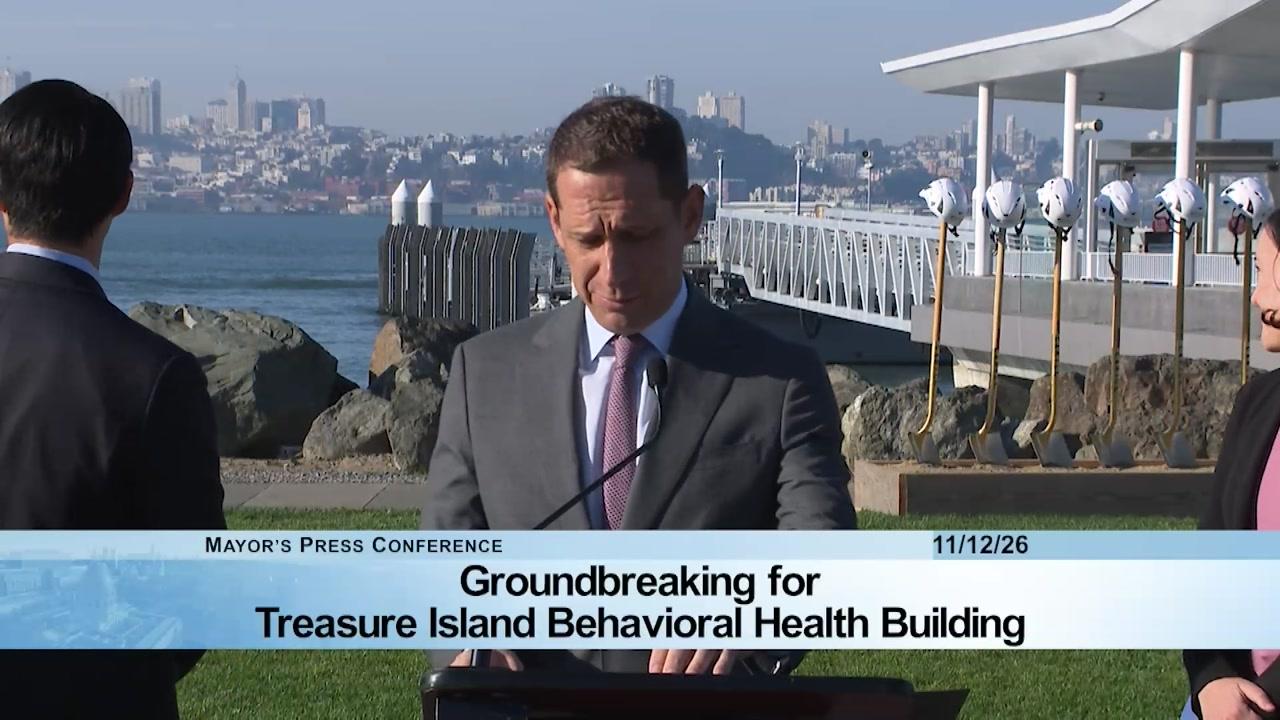
Lurie Breaks Ground on $72M, 300-Bed Treasure Island Recovery Hub
Mayor's Press Conference • San FranciscoNovember 12, 2026
Locunity is an independent informational service and is not an official government page for this commission. All information is sourced from public footage and an analysis of official agendas with the aid of responsible, fact-checked AI. to report an error or omission.
San Francisco is betting $72 million that recovery holds better when people have a stable place to live after treatment. Mayor Daniel Lurie and partners broke ground Nov. 12, 2026, on the Treasure Island Behavioral Health Building, scheduled to open in 2028. It will put 300 treatment and recovery beds under one roof. This was a press event, and no votes were taken.
- 300 beds by 2028: 44 treatment, 84 new recovery, 172 relocated beds
- Layered financing: 2020 Prop A bond, state grants and Treasure Island Development Authority funds
- Nearly $9.9M from the state's Community Care Expansion Program
- Treasure Island milestone: first building in Stage 2, which will include about 1,300 homes
- HealthRight 360 will operate the building; Mercy Housing is developer
Closing the Gap Between Treatment and Housing
Why it matters: Relapse risk is high when people finish residential treatment and have no stable housing. This building is designed to close that gap by combining treatment and longer-term recovery housing on one site.
The basics: Dan Tsai, Director, San Francisco Department of Public Health, described "residential step-down" housing. It provides 12 to 18 months of stable housing after about 90 days of residential treatment. The model gives people a structured bridge between intensive care and independent living.
Where things stand: The mayor laid out the bed mix:
- 44 residential treatment beds
- 84 new recovery housing beds
- 172 relocated beds
Mayor Lurie said residents will be able to stay up to two years. That is longer than the 12- to 18-month range Tsai gave for step-down stays, and officials did not reconcile the two figures at the event. Planned on-site services include employment coaching, primary care and case management.
Mayor Lurie placed the project within his broader push to add treatment beds. He said fewer people are sleeping on the streets than at any point in 15 years.
"Overdose deaths are down nearly 25% this year compared to the same time last year," said Daniel Lurie, Mayor.
A client's view: Janille Miller, a client of HealthRight 360, described her own recovery at the site. Her remarks gave the event its human center.
"In a short time, this place has become home," said Janille Miller, HealthRight 360 client.
Decisions and stakeholder impacts: Construction is now underway. People leaving residential treatment stand to gain the most because they will have a defined housing pathway instead of an uncertain discharge. Neelab Khan, Chief Engagement and Strategy Officer, HealthRight 360, also spoke for the nonprofit that will run the building. The project expands HealthRight 360's role in the city's recovery system. Because 172 of the 300 beds are relocated rather than new, the net gain in recovery and treatment capacity is smaller than the headline number. The 84 step-down beds and 44 treatment beds are the new additions.
What's next: Officials expect the building to be completed in 2028.
How the $72M Got Assembled
Why it matters: The financing combines voter-approved local bond money, state infrastructure dollars and redevelopment commitments. The project shows how San Francisco is pairing local and state money to build behavioral health capacity.
Where things stand: The project draws on four funding sources:
- The 2020 Prop A health and recovery bond
- The Treasure Island Development Authority (TIDA)
- A California Department of Health Care Services behavioral health infrastructure grant
- Nearly $9.9M from the California Department of Social Services' Community Care Expansion Program
Hana Azamati, Deputy Director, Housing and Homelessness Division, California Department of Social Services, spoke for the state's role in the project.
The Treasure Island angle: Sheila Jeevan, Executive Director, Treasure Island Development Authority, said the building fulfills transition commitments the city made in 2011. It is also the first building in Stage 2 of the island's development, which will include around 1,300 housing units. For Treasure Island, the groundbreaking is both a social services milestone and a marker of progress on the island's long-running redevelopment.
Decisions and stakeholder impacts:
- Voters: Prop A bond dollars are turning into physical capacity.
- State agencies: Two state departments have a stake in whether the project delivers on schedule.
- Treasure Island residents and stakeholders: The building settles a commitment made more than a decade ago and opens the next phase of development.
- Mercy Housing California: The nonprofit, as developer, carries responsibility for delivery through 2028.
What's next: The officials did not announce a timeline for the rest of the Stage 2 housing.
Looking Ahead
Officials target completion in 2028. Readers tracking the project should watch three things: how the 172 relocated beds are transitioned, how stay lengths are set in practice (12 to 18 months versus up to two years), and when the remaining Stage 2 Treasure Island housing breaks ground.