Mayor's Press Conference - Jul 07, 2026 - Meeting
Mayor's Press Conference • San FranciscoJuly 7, 2026
Locunity is a independent informational service and is not an official government page for this commission.We use AI-assisted analysis and human editorial review to publish information.
SF Breaks Ground on $71M Renovation of Chinatown Public Health Center
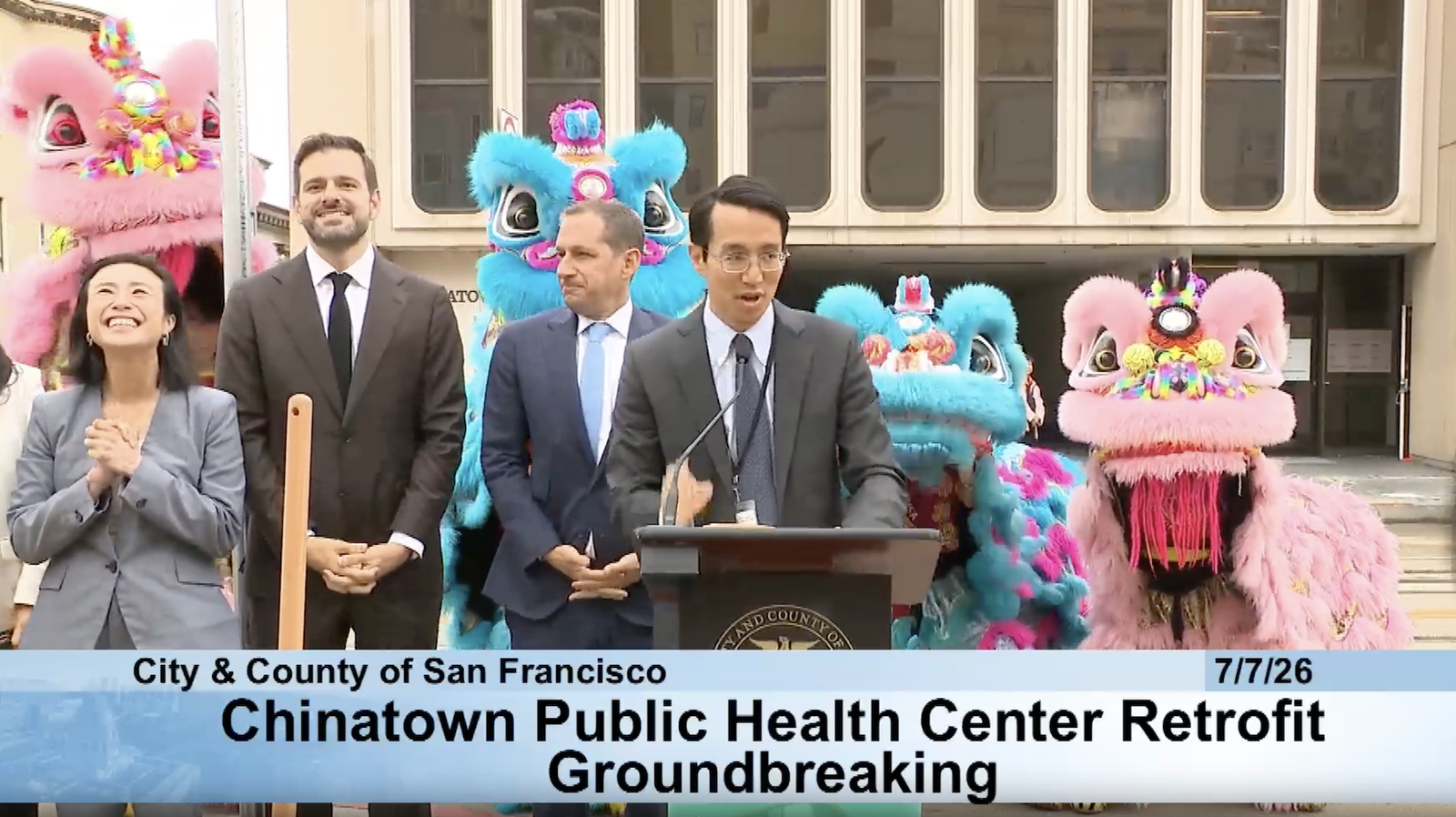
Mayor Daniel Lurie and city leaders gathered in Chinatown on Monday to launch the first major renovation of the neighborhood's public health center in 55 years — a $71 million project that will seismically retrofit the city's most structurally vulnerable clinic while modernizing care for 20,000 annual patient visits, 80% of which are delivered in languages other than English. The investment, drawn from the voter-approved 2024 health bond, lands as federal healthcare funding faces deep cuts, and as Chinatown braces for years of overlapping construction from multiple capital projects.
$71M renovation begins at the Chinatown Public Health Center, the first major upgrade since the building opened, funded by the 2024 Healthy, Safe and Vibrant San Francisco bond
City doubles annual capital spending from a pandemic-era low of ~$50M back to over $100M, signaling a broader push to address deferred maintenance across city facilities
Patients will continue care at Chinese Hospital's fourth floor during an approximately two-year construction period, with the same providers
Chinatown faces overlapping construction from the health center, library renovation, and Portsmouth Square renovation, with officials pledging bilingual outreach and coordinated street closures
A Clinic Built by Immigrants Gets Its First Real Overhaul
The basics: The Chinatown Public Health Center was created by Chinese immigrants who were once excluded from San Francisco's hospitals. It now serves as the primary point of entry to Western healthcare for one of the city's most linguistically and culturally distinct immigrant communities, providing primary care, behavioral health, dental, and acupuncture services. About 400 children at the adjacent Chinatown Child Development Center also receive behavioral health services through the facility.
Why it matters: The building is the Department of Public Health's most seismically unstable clinic, with failing HVAC and ventilation systems. The $71 million project — the single largest healthcare infrastructure investment in Chinatown's history — will deliver a full seismic retrofit, top-to-bottom modernization of building systems, improved ADA accessibility, and a reconfigured layout to expand patient care capacity, including behavioral health.
"This health center was built out of necessity by the Chinese immigrants who were once shut out of San Francisco's hospitals and clinics. They responded by creating a place where people could get care from doctors and nurses who spoke their language, understood their culture, and treated them with dignity," said Mayor Daniel Lurie.
DPH Director Dan Tsai drove home the urgency of the physical upgrade:
"The current building is deeply, seismically unsafe. It is the most seismically unstable anywhere of our DPH clinics. The HVAC and ventilation doesn't work appropriately."
Supervisor Danny Sauter, who represents the district, placed the investment in neighborhood context:
"We are two blocks from our fire station. We are two blocks from our police station. We are half a block from Gene Parker, our elementary school. It's just an example of these community serving institutions that make our communities strong."
The Bond Behind the Build
The project is funded through the 2024 Healthy, Safe and Vibrant San Francisco bond, which voters approved with more than $200 million for healthcare infrastructure. Lurie framed the investment against a stark federal backdrop:
"As the federal government cuts health care for our families, we are continuing to step up. Because no matter what happens elsewhere in this country, San Franciscans should know they can count on their city."
Tsai echoed that theme, describing the significance of standing at a groundbreaking:
"In the face of all sorts of cuts to healthcare across the country and the state, [we are] able to stand here and talk about how we're making sure that the people we serve here in Chinatown and across the city that need culturally competent and congruent services and care get the best possible modern healthcare facility."
Personal Stakes, Deep Roots
Several speakers drew on personal connections to underscore what the center means to the community.
Supervisor Connie Chan, who grew up in Chinatown and chairs the Board of Supervisors' budget committee, recalled the center's role in her own childhood:
"That's where we get our vaccination for Chinatown kids and that's where we get our TB testing as new immigrants."
Supervisor Cheyenne Chen, who represents District 11, shared a similar story as someone who used the clinic after arriving in the country:
"25 years ago when I came here, this building in the back exists for the last 50 plus years. I am one of the beneficiary that I'm able to access with vaccination, bilingual cultural competency, access care."
Health Commissioner Dr. Ed Chow, who has served on the commission for 36 years, recalled fighting to keep the center open during past budget crises:
"There have been times in which we were talking about closing the health center because of budget issues. And I had the privilege of being able to say this was an important center and the face of public health here in our community, and we cannot lose it."
He described the facility as "often the entrance to Western health care".
Anni Chung, CEO of Self Help for the Elderly, offered a piece of neighborhood lore. She recounted how the nearby Lady Shaw Senior Center was inspired by the health center's unusual engineering — both buildings sit atop the Broadway Tunnel.
"Supervisor Jack Molinari and our Mayor Dianne Feinstein were driving through the tunnel and they looked up and said, oh, health center number four was built on thin air. So why can't we put the senior housing also on thin air? And that's how we built."
A Bigger Infrastructure Bet
City Administrator Carmen Chu used the event to highlight a broader policy shift. Before the pandemic, San Francisco invested more than $100 million annually in capital improvements — HVAC, windows, water systems, roofs. The pandemic slashed that figure to roughly $50 million per year, accelerating deterioration of city buildings.
"This year, through the mayor's priority, we have doubled that amount. And this is not an easy thing to do in a tough budget year like this, but we have doubled our capital investments to over $100 million," City Administrator Chu said.
The restored spending level, supported by Chan and the Board of Supervisors, enables projects like the Chinatown renovation that had been deferred for years.
Construction Impacts: Broadway Tunnel and Beyond
The building's location atop the Broadway Tunnel — which has connected Chinatown and North Beach with Russian Hill and Van Ness Avenue since 1952 — creates unique engineering challenges and traffic implications for the surrounding neighborhood.
Director of San Francisco Public Works Carla Short acknowledged the complexity:
"The Chinatown Public Health Center sits above the Broadway Tunnel. In a neighborhood where every square foot matters, building above the tunnel made it possible to create space for an essential public facility."
She pledged that her department is committed to working with Suffolk Contruction, and the contractor to provide "timely, bilingual updates" for the community and residents.
Lurie pledged that street closure timelines would be coordinated across the health center renovation, the Chinatown Library renovation, and the Portsmouth Square renovation — three concurrent capital projects bearing down on the dense neighborhood.
Chan struck a note of practical realism, urging patience from residents and accountability from city departments:
"Please be patient. Please also be considerate to our community. As I ask the city departments who's going to do this work, work to coordinate and provide language and cultural competency and access to our community so that the next two years, truly we can end in a very celebration two years from now."
What's next: Construction is now underway with an approximately two-year timeline. Patients will continue seeing their same providers at Chinese Hospital's fourth floor for the duration. Residents and businesses should expect rolling street impacts, with the city committed to bilingual community updates throughout.