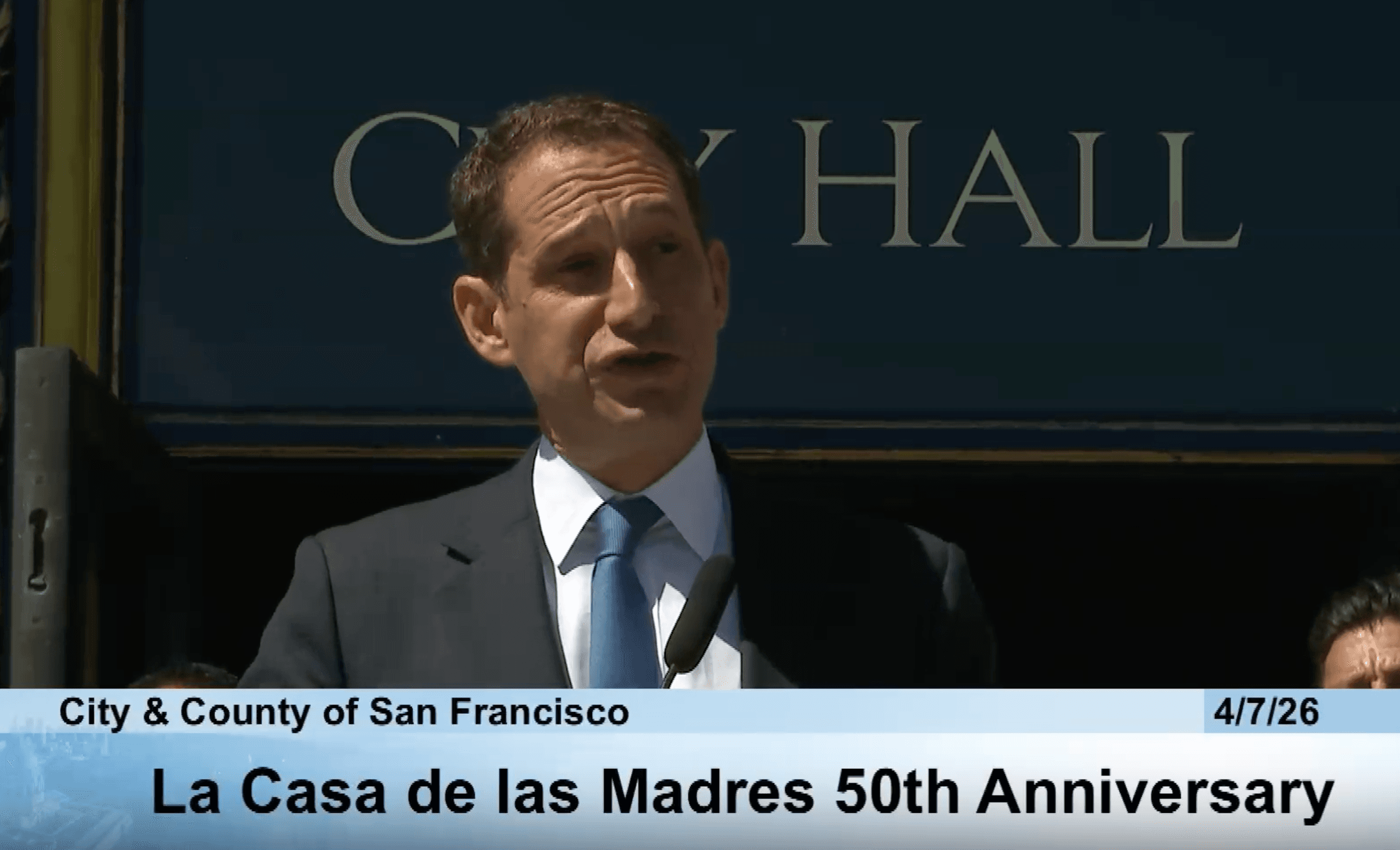
Mayor's Press Conference - Apr 07, 2026 - Meeting
Mayor's Press Conference • San FranciscoApril 7, 2026
Locunity is a independent informational service and is not an official government page for this commission.We use AI-assisted analysis and human editorial review to publish information.
La Casa de las Madres Marks 50 Years of Saving Lives in San Francisco
Mayor Daniel Lurie, Board of Supervisors leaders, and survivors gathered at City Hall to celebrate five decades of one of the Bay Area's first full-service domestic violence (DV) shelters — and to send a clear signal that the city intends to protect more than $10 million in annual gender-based violence funding even as San Francisco navigates a budget crisis.
La Casa de las Madres celebrates 50 years as one of the Bay Area's earliest domestic violence shelters, with City Hall ceremony drawing the mayor, supervisors, SFPD chief and state AG representative
Lurie reaffirms $10M+ annual investment in gender-based violence prevention and announces pending state legislation to strengthen survivor protections
Supervisor Myrna Melgar discloses her own DV survivor story, adding personal weight to the Board's support for continued services
Survivor's dramatic 1976 rescue — wheeled out of a hospital hidden in a laundry bin — illustrates La Casa's life-saving origins
State data underscores lethal stakes: DV incidents involving a firearm are 12 times more likely to result in death
Fifty Years From a Secret Shelter to a Citywide Safety Net
The basics: La Casa de las Madres was founded in 1976 by a group of women who believed no one should have to choose between staying in a violent home and having nowhere to go. It has since grown into a citywide network providing shelter, legal aid, job access and advocacy to thousands of domestic violence (DV) survivors annually.
Why it matters: The anniversary is more than ceremonial. With San Francisco facing fiscal pressure, the press conference served as a public commitment from the mayor, the Board of Supervisors and city agencies that DV services will not be on the chopping block — a message aimed squarely at budget stakeholders and frontline providers.
Executive Director Lucero Arias opened the ceremony by invoking La Casa's origins:
"Fifty years ago, a group of women came together with a simple but urgent belief that no one should have to choose between staying in violence and having nowhere to go."
Board of Supervisors President Rafael Mandelman praised the organization's evolution from emergency shelter to prevention engine, calling out "not just responding to domestic violence, but the work that you do to actually prevent domestic violence from happening in the first place."
Supervisor Myrna Melgar, District 7, delivered some of the most powerful remarks of the day, disclosing her own history as a survivor.
"I am a survivor. I grew up in a house that was dominated by domestic violence with a teenage mom who left that relationship and took us with her, attempted to take us with her," she said.
Melgar emphasized that La Casa offers pathways far beyond a bed for the night — "to thrive, to have legal representation, to be able to get access to a job and opportunities, to be able to control their lives and set up success for themselves and their children."
What's next: The ceremony signals that La Casa and the broader DV service network — including partners across the city — can expect continued city contracts and political cover as budget deliberations proceed.
The Founding Story: Born From Tragedy, Built by Mothers
Co-founder Sonia Melara brought the room back to 1976 — and to the grief that sparked the organization. She recounted the story of fellow co-founder Marta Segovia Ashley, whose mother was murdered by domestic violence in 1947:
"Just three weeks into my 10th grade, it happened. Beset by jealousy and rage, my stepfather attacked my mother with a knife. She died on the kitchen floor while I was away."
That trauma, Melara said, became the fuel for action. She explained the organization's name and founding mission:
"We called it La Casa de las Madres. Why? Because it's the house of mothers. Because we believe that the primary reason women left a violent situation, did not leave the violent situation, was because they could not go anywhere."
Survivor Cynthia Glinka, who was among the earliest people sheltered by La Casa, gave harrowing testimony of a 1976 rescue from St. Luke's Hospital after a near-fatal beating.
"Two weeks later, a group of women rescued me. They wheeled me out of the hospital, hidden in a laundry bin, covered in blankets so he couldn't see me if he was lurking around," she recalled. "Without La Casa, I would not be here today. They gave me safety, hope, and a future."
Glinka went on to build a career in dance and the performing arts — a trajectory she credited entirely to the organization's intervention.
City Budget and Policy: $10M+ Commitment Amid Fiscal Pressure
Mayor Daniel Lurie framed DV services as central to his public safety agenda:
"As mayor, keeping San Franciscans safe is my top priority. And that includes survivors of domestic violence through our Women's Agenda launch."
He cited the city's annual investment of more than $10 million in gender-based violence prevention and response, the Breaking the Cycle program that helps DV families access housing, and pending state legislation with Assemblymember Catherine Stephany to strengthen protections for survivors.
Dr. Diana Aroche, Director of the Department on the Status of Women, issued the day's starkest warning — and the most direct call for budget protection.
"In San Francisco, the most dangerous time for a woman is right when she leaves an abuser. As any domestic violence provider will tell you, this work is a matter of life and death."
She noted that women are 75% more likely to experience violence in the two years after leaving an abusive partner and pushed back against the notion that policy alone can protect survivors:
"Policies don't create safety, people do. Trusted organizations do. Community rooted people do."
Why it matters: Aroche's remarks were a pointed message to city budget negotiators: cutting contracts to community-rooted DV organizations would directly endanger lives, regardless of what policies remain on the books.
Ivy Lee, Director of the Mayor's Office of Victims and Witness Rights, pledged to mobilize resources for providers and characterized the organization's work in movement terms:
"La Casa is so much more than a shelter. It is resistance. And it is a part of a movement to say that violence is never going to be accepted as normal."
State Spotlight: Firearms and Domestic Violence
A representative from California Attorney General Rob Bonta's office, connected DV policy to gun violence prevention.
"The data is clear. When a domestic violence incident involves a firearm, it is 12 times more likely to result in death," he said.
The basics: In 2022, the California Department of Justice created the Office of Gun Violence Prevention — the first such office within any state attorney general's office — along with the Office of Community Awareness, Response and Engagement (CARE), which includes a Victim Services Unit connecting DV survivors to resources. The AG's office enforces domestic violence restraining orders that can remove firearms from dangerous individuals.
Why it matters: The state's enforcement infrastructure gives local DV providers like La Casa an additional layer of protection for survivors, particularly in cases where an abuser has access to weapons. The data Tao cited underscores the lethal escalation that firearms introduce into already dangerous situations.
Minor Items
SFPD Chief Liu highlighted a 23-year partnership embedding La Casa advocates directly in the Police Department's Special Victims Unit to support survivors after DV calls.
Assessor-Recorder Joaquin Torres spoke as a male ally, emphasizing men's responsibility to help break cycles of violence: "It's a reminder of the responsibility that we as men have to join with you in ensuring that we are creating spaces of safety."