Mayor's Press Conference - Apr 14, 2026 - Meeting
Mayor's Press Conference • San FranciscoApril 14, 2026
Locunity is a independent informational service and is not an official government page for this commission.We use AI-assisted analysis and human editorial review to publish information.
SF Showcases Nationally Unique Firefighting Water System Ahead of 1906 Anniversary
Two weeks after a 4.6 magnitude earthquake rattled San Francisco, city leaders gathered at Fire Station 35 to demonstrate the emergency water infrastructure built to prevent a repeat of the catastrophic fires that followed the 1906 quake. The press conference doubled as a call to action: with a major west-side expansion of the system set to begin construction in 2027, officials urged residents to take their own preparedness steps before the next big one hits.
City demonstrates emergency firefighting water system using fireboat pumping 16,000 gallons per minute through bay-side manifold
$200 million in voter-approved bonds invested since 2010 to upgrade and expand the nation's only dedicated firefighting water system
New west-side expansion from Lake Merced through the Sunset and Richmond scheduled to begin construction in 2027
Mayor Lurie and emergency officials urge residents to update plans, visit ReadySF, and join neighborhood response training
The System That Exists Because of 1906
The basics: San Francisco is the only city in the United States with a dedicated firefighting water system entirely separate from its drinking water supply. The Emergency Firefighting Water System (EFWS) was born from the worst urban fire disaster in American history — when the 1906 earthquake ruptured the city's water mains and fires burned unchecked for three days.
Why it matters: The demonstration at Station 35 — the same base from which Fireboat Phoenix responded during the 1989 Loma Prieta earthquake — was designed to show the public that the city can draw directly on bay water to fight large-scale post-earthquake fires, a capability that saved the Marina district 37 years ago.
Where things stand: Fire Chief Dean Crispen walked observers through a live demonstration of Fireboat St. Francis pumping bay water into a shore-side manifold connected to the high-pressure system.
"This manifold is one of five strategically located along the bay," said Crispen. "This fireboat can pump 16,000 gallons per minute and can operate for 72 hours without refueling."
The pumped water supplied both an aerial ladder nozzle — used to attack upper-floor fires — and a ground-based multiversal nozzle for lower floors. Crispen called the capability "a culmination of the vision of Chief Engineer Dennis Sullivan, who perished in the great earthquake and fire."
Dennis Herrera, the General Manager of the San Francisco Public Utilities Commission, provided the historical stakes.
"Fires raged for three days after the quake because San Francisco's water system, run by the private Spring Valley Water Company, was not able to provide enough water to fight the fires," he said.
The city's response, over the following decades, was to build a parallel system from scratch.
Today that system consists of 135 miles of resilient pipelines, an independent reservoir, hilltop tanks, waterfront intakes, two bay water pump stations, and more than 200 underground cisterns located throughout the city.
"Since the PUC took over management of this system in 2010, we've invested about $200 million from voter-approved earthquake safety and emergency response bonds to upgrade and expand it," Herrera said.
What's next: Herrera announced that a new west-side expansion is scheduled to begin construction in 2027. The project will bring a dedicated firefighting water loop from Lake Merced through the Sunset and into the Richmond — two of the city's densest and most seismically vulnerable neighborhoods. The Fire Department has also installed 20 new cisterns in the Sunset and Richmond and put three new hose tenders into service for high-pressure, high-volume water delivery across the city.
'Emergency Management Super Bowl': Officials Press Residents to Prepare
Mayor Daniel Lurie connected the recent tremor directly to the infrastructure on display.
"Two weeks ago, a 4.6 magnitude earthquake shook our city. This Saturday, we will mark the 120th anniversary of the 1906 earthquake. Earthquakes and natural disasters are part of our city's past, and we know they will be part of our future," he said.
Lurie urged residents to update their emergency plans, visit ReadySF — the city's preparedness website — and join Neighborhood Emergency Response Team (NERT) training. He also highlighted the recently upgraded Pump Station No. 2 as part of the broader EFWS improvements.
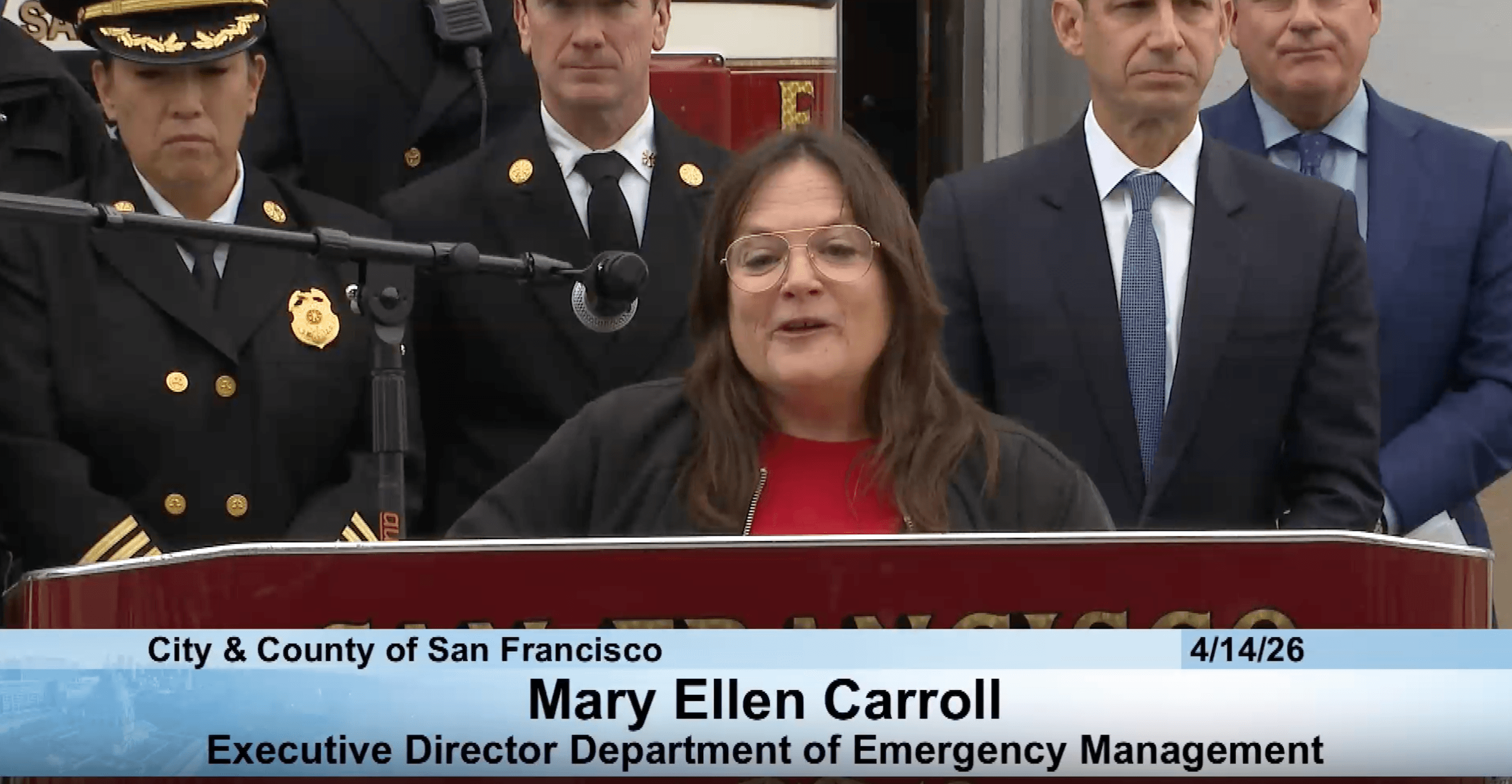
Mary Ellen Carroll, Executive Director of the Department of Emergency Management — who spent eight years at the PUC as their emergency manager before her current role — framed the week in unusually direct terms.
"This week, the commemoration of the 1906 earthquake is sort of like emergency management Super Bowl," she said. "The fact of the matter is, a lot of the people who are working on this weren't even born for Loma Prieta."
Carroll called the 1906 legacy central to the city's identity:
"We all in San Francisco have 1906 in our DNA. It makes us who we are. In a lot of ways, it creates that resilience."
She invited residents to the traditional gathering at Lotta's Fountain at 5 a.m. on the anniversary Saturday, calling it "a rite of passage for San Francisco."