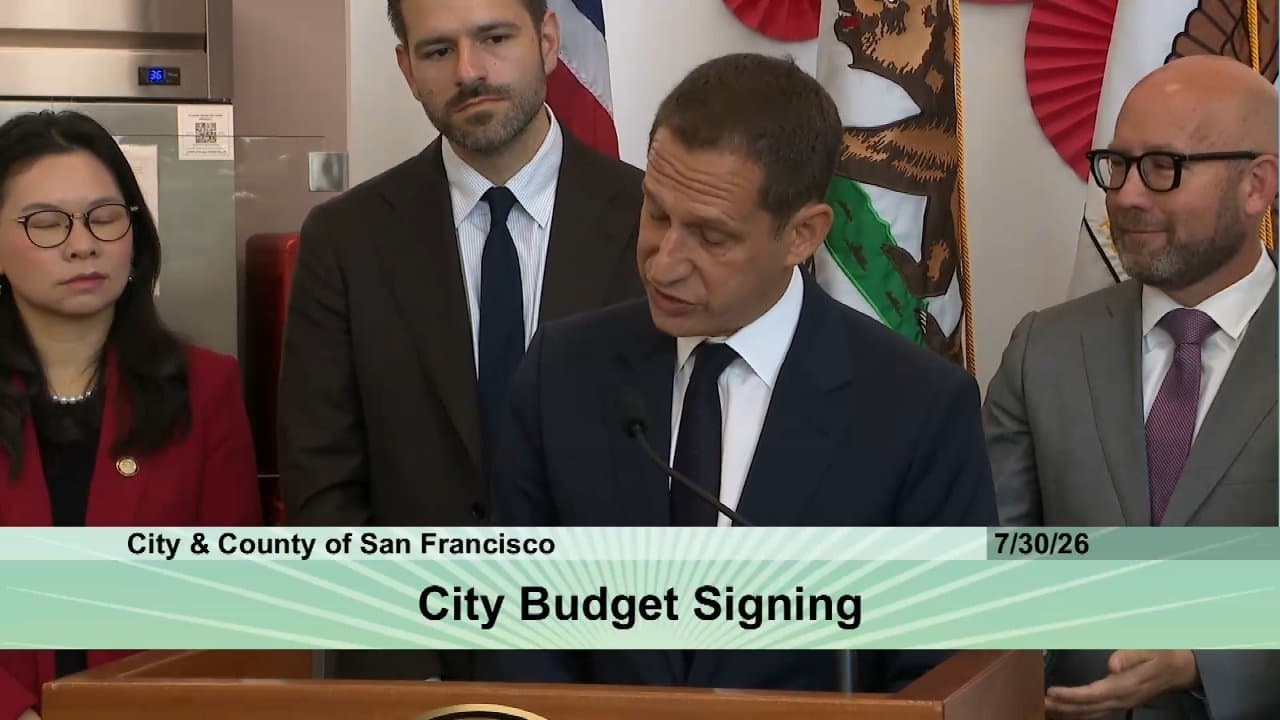
Mayor's Press Conference - Jul 30, 2026 - Meeting
Mayor's Press Conference • San FranciscoJuly 30, 2026
Locunity is a independent informational service and is not an official government page for this commission.We use AI-assisted analysis and human editorial review to publish information.
SF Signs Balanced Budget, Closing $642M Deficit With First Unanimous Board Vote in Six Years
Mayor Daniel Lurie signed San Francisco's FY2026–2027 budget at a ceremonial event at the Geneva Community Center, capping a process that produced the first unanimous Board of Supervisors vote on a city budget in six years. The spending plan closes a $642 million deficit, creates a $100 million reserve to absorb anticipated federal funding cuts, and preserves safety-net programs for health care, food assistance, and immigrant legal defense.
- $642 million deficit closed with structural cuts and no additional layoffs beyond 127 already-planned positions
- First unanimous Board of Supervisors budget vote in six years signals rare political unity at City Hall
- $100 million reserve created — part of $1.3 billion set aside — to guard against federal health care and social service cuts
- HIV prevention funding restored after federal government abandoned its commitment to ending AIDS
- Crime down 20% this year after a 30% decline in 2025; unsheltered homelessness at a 15-year low
- Housing milestones continue with 160 affordable homes opened, 94 artist units breaking ground, and an Affordable Housing Trust Fund expansion heading to the November ballot
Closing a $642M Gap — Without Gutting the Safety Net
Mayor Daniel Lurie framed the budget as a direct response to a fiscal and political squeeze: a $642 million local deficit colliding with hundreds of millions in threatened federal funding cuts.
"In a few moments, I will sign a balanced budget that closes a $642 million deficit and strengthens our social safety net. As Washington cuts hundreds of millions of dollars for health care and families face rising rents, we are stepping up for hardworking San Franciscans," said Mayor Daniel Lurie.
Why it matters: The budget preserves Medi-Cal and CalFresh enrollment assistance, restores HIV prevention funding, maintains $12 million annually for immigrant legal defense, continues Free City College funding, stabilizes SRO funding, and invests in the fire department — including new fire trucks and cancer-free uniforms. The mayor confirmed no further layoffs beyond the 127 positions already announced.
Where things stand: The Budget and Appropriations Committee passed the budget at 6:25 p.m. — in what Lurie called record time — and the full Board of Supervisors voted unanimously, 11-0. Board President Rafael Mandelman praised the administration's budget director, Sophia Kittler, and her team for fiscal discipline, noting the administration stopped relying on the one-time funding sources that previous budgets used to push problems into future years.
"The last two years, that has not been possible, nor has it been the inclination of the mayor. And that is a good thing," Board President Mandelman said of the shift away from easy spending from flush coffers.
Decisions: The 11-0 vote — the first unanimous budget approval since six years ago — represents a notable consensus between the mayor's office and a Board of Supervisors that has historically sparred over fiscal priorities. Budget Chair Connie Chan called Lurie the most cooperative mayor she has worked with on budget negotiations.
Defying Washington: A $1.3 Billion Shield Against Federal Cuts
A defining thread of the signing ceremony was San Francisco's posture toward the federal government. Multiple speakers framed the budget as an act of defiance against funding cuts under the Trump administration.
The basics: The budget creates a new $100 million reserve specifically to buffer against federal funding losses. Budget Chair Connie Chan cited a total of $1.3 billion placed on reserve to safeguard against health care cuts.
"This budget is saying no to Donald Trump," said Budget Chair Connie Chan.
Chan outlined the specific commitments the budget protects: "We understand that we want to put $1.3 billion on reserve to safeguard for health care cuts. We understand that we want to push back, we don't have to have layoff and that every city workers can be on the front line serving San Franciscans. We understand that we need to spend at least $12 million every year investing in our immigrant community for immigrant legal defense fund."
Board President Mandelman characterized the federal threat more bluntly: "Even with the federal government throwing banana peels in our path at every opportunity, the city has been able to continue to invest in the priorities that are most important to San Franciscans."
Why it matters: The budget restored HIV prevention funding after the federal government pulled back on its commitment to ending AIDS. It preserved Medi-Cal and CalFresh enrollment support services and fully funded Ryan White programs. It also continued food security programming — services that directly affect residents like Daviel Byrd, a San Francisco mother who testified at the ceremony.
"If it wasn't for these essential services like CalFresh, CalWorks and even WIC, my son and I wouldn't be able to have food on a table at times," Byrd said. "As a mother, knowing these services will continue gives me hope and sense of security for my family's future."
What's next: The $100 million reserve and broader $1.3 billion in set-asides will be drawn upon if and when federal funding cuts to Medicaid, food assistance, or other programs materialize. The city's ability to sustain these services independently will depend on whether the deficit remains manageable in future fiscal years.
Crime, Homelessness and the Recovery Narrative
Mayor Lurie used the ceremony to highlight public safety and homelessness metrics as evidence the city's recovery strategy is producing results.
"We made public safety our top priority. And crime is down 20% this year after being down 30% last year," Mayor Lurie said.
Unsheltered homelessness has fallen to its lowest level in 15 years. The number of RVs on city streets dropped 53% in one year, with nearly 200 households that had been living in RVs moving into stable housing.
Board President Mandelman praised the approach to spending homelessness, mental health, and substance abuse dollars "in the most intelligent way possible" to bring support to the greatest number of people while ensuring public spaces become usable for everyone.
Why it matters: The continued declines in crime and visible homelessness are central to the administration's argument that fiscal discipline and targeted spending can coexist. These metrics will be closely watched as the city absorbs budget cuts and federal uncertainty.
Housing Milestones Stack Up
The city notched several housing wins that the mayor highlighted alongside the budget signing.
The city opened 160 affordable homes at 730 Stanyan and broke ground on 94 affordable homes for artists. Office-to-housing conversions are moving forward, and projects are utilizing the family zoning plan. The Board of Supervisors unanimously approved placing an expansion of the Affordable Housing Trust Fund on the November ballot. The Permit SF initiative continues to cut red tape for small businesses and housing development.
Budget Chair Chan also highlighted stabilized SRO funding to ensure continued pathways to affordable housing.
Why it matters: After decades of insufficient housing production, San Francisco is now seeing results across multiple fronts — streamlined permitting, conversions, and new affordable construction. The November ballot measure on the Affordable Housing Trust Fund will test whether voters are willing to deepen the city's commitment.
Four Years of Line-by-Line Oversight
Budget Chair Connie Chan used the ceremony to detail the fiscal oversight work that made the unanimous vote possible.
Chan described combing through contracts, grant agreements, and lease agreements across her four years leading the Budget Committee, guided by a single principle: "Is this in the best interest of San Franciscans."
She highlighted reining in overtime spending that had ballooned to $20–30 million, working with the Controller's office to establish quarterly reporting. "When there were overtime spending that we just weren't sure how to rein it in, we make sure that we work with the controller to ring it in to have a quarterly report," Budget Chair Chan said.
The committee also placed nonprofit organizations' funding on reserve pending audit completion when financial mismanagement was discovered, pushed back against over-hiring of managers in favor of frontline workers, and scrutinized fee waivers and tax giveaways sought by special interest groups.
Why it matters: The oversight record reflects a broader shift from pandemic-era spending to structural fiscal accountability. The Budget Committee's willingness to hold contracts, question fee waivers, and audit nonprofits created the fiscal conditions that allowed both the mayor and the full board to agree on a balanced budget without deeper service cuts.
What's next: Board President Mandelman expressed hope that the collaborative dynamic between the mayor's office and the Board of Supervisors would continue, noting: "We've seen this last year and a half. The good things that can happen when people who may not agree about everything operate in a spirit of goodwill and shared commitment to our constituents."
Minor Items
- Board President Mandelman praised continued investment in Free City College, calling it "an amazing program."
- Mandelman highlighted that essential organizations like Self Help for the Elderly, which hosted the signing ceremony at the Geneva Community Center, were protected despite the fiscal constraints.
- The budget includes investment in the fire department, including new fire trucks and cancer-free uniforms for firefighters.