
Lurie Touts $12M Mission Investment, Native Wellness Center at City Hall Celebration
Mayor's Press Conference • San FranciscoNovember 18, 2026
Locunity is an independent informational service and is not an official government page for this commission. All information is sourced from public footage and an analysis of official agendas with the aid of responsible, fact-checked AI. to report an error or omission.
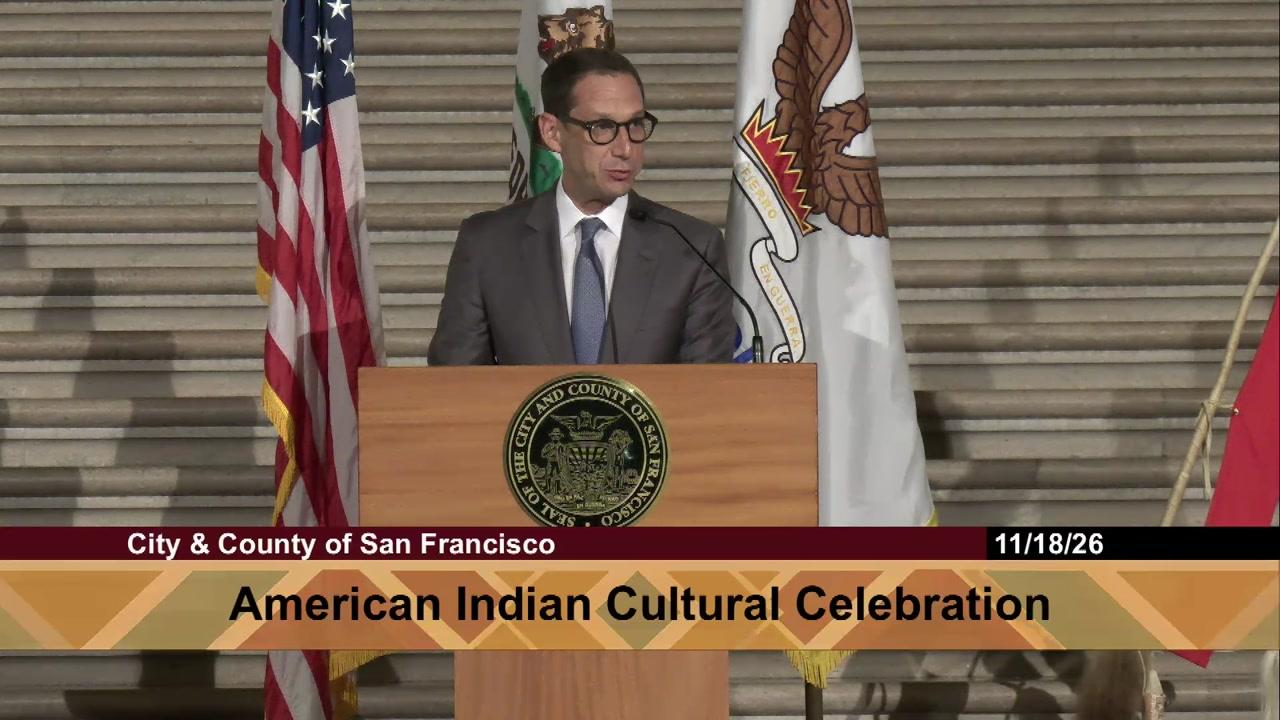
Mayor Daniel Lurie used San Francisco's annual American Indian cultural celebration on Nov. 18, 2026, to promote a $12M push to clean up the Mission Corridor and 16th Street BART plazas, along with a planned six-story Native-led wellness center in the American Indian Cultural District. No votes were taken at the ceremonial event. The program focused on two neighborhood institutions, Friendship House and the Native American Health Center, and on a recovery workforce that says culture is the treatment.
- $12M Mission Corridor and BART plaza investment highlighted by Lurie alongside Supervisor Jackie Fielder
- Village SF Wellness Center, a six-story treatment, housing and cultural hub, targets groundbreaking in 2027
- Native American Heritage Month proclamation announced for Friendship House and Native American Health Center
- Eight frontline recovery and health workers honored, many crediting the organizations with their own sobriety
- Fielder recognized as the city's first American Indian supervisor as elders closed the program
Lurie Ties Mission Safety Money to Native Services
The basics: The American Indian Cultural District is a city-recognized Mission neighborhood zone. It serves as the anchor for San Francisco's urban Native community and the service providers based there.
Why it matters: The mayor framed two priorities as one strategy: street conditions around the 16th Street BART plazas and Native-led behavioral health services. Linking them signals that City Hall sees culturally specific treatment as part of its Mission public safety approach.
Where things stand: Lurie described a "$12 million investment to make the Mission Corridor and the BART plazas safer, cleaner, and more welcoming," which he had announced earlier with Supervisor Jackie Fielder. He cited partnerships with Crankstart and the state, as well as coordination with BART.
He also promoted Friendship House's planned project, "the Village SF Wellness Center, a new 6-story center in the Mission within the American Indian Cultural District," said Mayor Daniel Lurie. The facility would combine treatment, supportive housing and cultural space. The mayor said groundbreaking is expected next year, in 2027.
Lurie then invited the directors of Friendship House and the Native American Health Center to receive a Native American Heritage Month proclamation.
Fielder's history lesson: Fielder grounded the moment in federal policy. She walked through the Indian Relocation Act, which moved Native families from reservations into cities, and the occupation of Alcatraz. "Today, 90% of Native people live in urban areas like San Francisco," said Supervisor Jackie Fielder. She pointed to the American Indian Cultural District and a reparations advisory committee as city actions responding to that history.
Decisions and stakeholder impacts: No vote occurred. Funding specifics, including how the $12M is split between cleaning, safety and services, were not detailed. Friendship House and the Native American Health Center gain a mayoral endorsement of their work. Crankstart and state partners are positioned as co-investors. Mission residents and BART riders are the intended beneficiaries of the plaza work.
What's next: Watch for the Village SF Wellness Center to move toward groundbreaking. Ask how the $12M is allocated and which department administers it.
Culture as Treatment: Providers Make Their Case
Why it matters: The speakers argued that recovery for urban Native residents depends on reconnecting with identity. That argument shapes how the city funds behavioral health in the Mission.
Where things stand: Wayne Grigsby, clinical director, Friendship House Association of American Indians, traced the organization's work back to 1963 and spoke about his own sobriety. "I am living proof that Friendship House does work," said Grigsby.
Aurora Mamea, representative, Native American Health Center, described the center's whole-person care model.
Decisions and stakeholder impacts: Eight staff members were recognized:
- Wayne Grigsby
- Chelsea Smith
- Catherine Collins
- Erin Needham, senior substance use disorder counselor at Friendship House
- Laura Cedillo, program manager of the Native American Health Center's Living in Balance Program
- Sandino Wapipa, cultural health practitioner
- Emery Tahy, educator, who also gave the opening prayer
- Marvin Paddock
Several honorees said the two organizations helped them recover before they went to work for them. Catherine Collins, substance abuse counselor, Friendship House Association of American Indians, explained why cultural connection is central to her work: "I know firsthand what it feels like to not belong," said Collins.
The pattern matters for policymakers. These programs draw their workforce partly from their own alumni, which links staffing pipelines directly to program outcomes.
From Family Gathering to City Hall Tradition
Where things stand: Karen Wakazu and family members recounted how gatherings organized by Helen Wakazu moved into City Hall at the invitation of then-Mayor Gavin Newsom. That move turned a community event into a civic ritual.
Martin Wakazu said bars were once the only gathering places for Native people in the Bay Area. He credited Friendship House and the Native American Health Center with changing that. He also honored elders and Fielder: "I want to acknowledge Jackie, the first American Indian supervisor for the City and County of San Francisco," said Wakazu.
Why it matters: Fielder's presence gives the Native community a direct voice on the Board of Supervisors. That matters as the cultural district, the reparations advisory committee and the wellness center move forward.
Minor Items
- Tom Phillips received a city certificate of honor in his memory.
- Emery Tahy opened with a land acknowledgment recognizing the Ramaytush Ohlone as San Francisco's original stewards.
- Emcee Nona Claypool led the program on behalf of Friendship House and the Native American Health Center.
- The program closed with a song and a reception in City Hall's Northern Light Court.
Looking ahead: The key follow-up items are the Village SF Wellness Center's 2027 groundbreaking timeline and how the $12M Mission Corridor investment is spent.