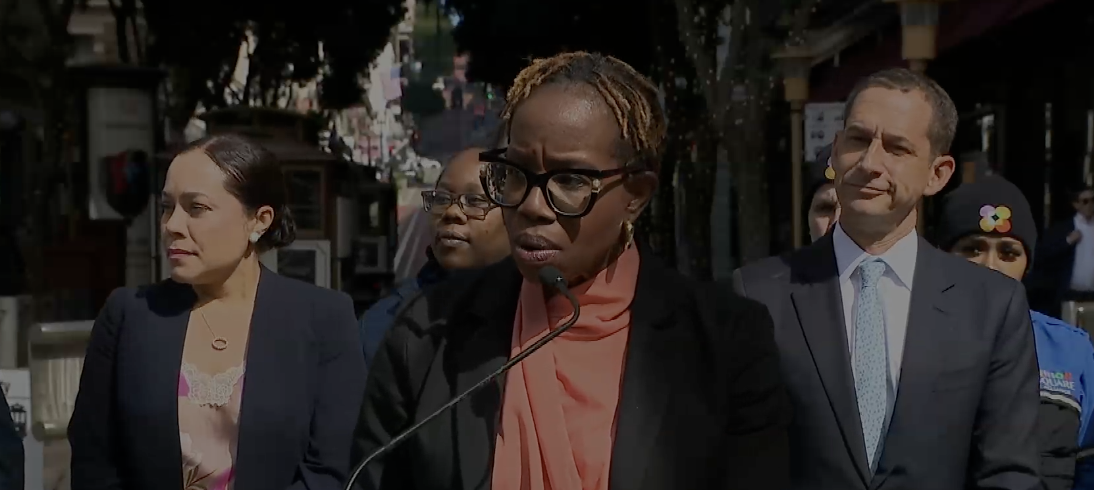
Mayor's Press Conference - Mar 25, 2026 - Meeting
Mayor's Press Conference • San FranciscoMarch 25, 2026
Locunity is a independent informational service and is not an official government page for this commission.We use AI-assisted analysis and human editorial review to publish information.
SF Expands Safety Ambassador Program to Powell Street, Backed by $5M in Private Capital
Mayor Daniel Lurie announced the expansion of the Market Street Safe Corridor Program to Powell Street Station — one of San Francisco's busiest transit hubs — doubling down on a public-private safety model that has cut 911 calls by more than half. Separately, Lurie used the press conference to deliver an unequivocal reaffirmation of the city's sanctuary policies amid heightened federal immigration enforcement.
DDC commits nearly $5 million to expand the Safe Corridor to Powell Street and keep HART Ambassador programs running in Union Square and Yerba Buena
911 calls down 53%, crime down 40% in Union Square and the Financial District since program launch
150,000 visitors flooded Union Square for a tulip event — triple last year's turnout
30 new office leases signed in Yerba Buena as foot traffic surges 20–25%
Lurie reaffirms sanctuary policies, says SFPD will not assist federal immigration enforcement "for as long as I am mayor"
$5M Private Bet on Downtown Safety
The basics: The Market Street Safe Corridor Program, first launched last summer at Embarcadero and Montgomery BART stations, deploys trained ambassadors who serve as a visible safety presence — connecting with visitors, supporting small businesses, and coordinating with police, fire, and crisis response teams. The program is now expanding to Powell Street Station, with the Downtown Development Corporation funding both the expansion and a full-year continuation of HART Ambassador programs in Union Square and Yerba Buena that were set to expire at the end of March.
Why it matters: The nearly $5 million DDC investment represents a significant injection of private capital into a function — street-level public safety — traditionally funded by city government. With downtown generating tax revenue that underwrites citywide services including Muni, parks, and first responders, the business community is effectively betting that visible safety improvements will accelerate the economic recovery that pays for everything else.
Where things stand: The numbers from the program's first phase are striking. "This program has driven safety-related 911 calls down by 53%. It's also driven SFPD response times down by 58% and SF Fire Department response times by 23%. More than 82% of commuters report feeling safer during their commute," said Shola Olatoye, CEO of the San Francisco Downtown Development Corporation. In 2025 alone, HART ambassadors conducted over 54,000 safety checks, coordinated more than 250 emergency calls, and filed over 1,300 service requests.
Olatoye noted the DDC has raised more than $60 million in under a year for downtown revitalization. "The DDC is investing close to $5 million to support both the extension of the HART program to Powell Street as well as the continuation of the Safety Ambassador program," she said.
Robbie Silver, President and CEO of the Downtown SF Partnership, described how the original program came together at speed. "When we were approached by the Mayor's office in July of last year about how do we bring more safety, more vibrancy, cleanliness to Market Street, we stood up this program in less than two weeks," he said. Silver also credited Amazon, Google, and Visa for providing initial seed funding.
Mayor Lurie framed the effort as central to the city's trajectory. "Crime is down 40% in Union Square. In the Financial District. We are leading major U.S. cities in return-to-office rates and confidence is returning," he said.
What's next: The DDC is also fundraising for a broader physical redesign of the Powell Street area — including sidewalk and lighting improvements near the cable car turnaround. Olatoye said the organization is "committed to raising the funds to support that project" and that city approvals are anticipated later this year.
Downtown Recovery by the Numbers
The press conference doubled as a progress report on downtown San Francisco's broader economic rebound, with community benefit district leaders presenting data that paints a picture of accelerating momentum.
Marissa Rodriguez, CEO of the Union Square Alliance, pointed to a recent tulip event as a barometer of public confidence. "We welcomed over 150,000 people to just this district alone with tulips. Last year, 50,000 people came. 150,000 came today … because it feels clean and safe," she said. Rodriguez described Powell Street as "the gateway to San Francisco" and "where we show everyone the health of our city."
Scott Rowitz, Executive Director of the Yerba Buena Partnership, reported that 70% of survey respondents say they feel safer in the neighborhood than a year ago. The commercial picture is equally encouraging: 30 new office leases have been signed, foot traffic on key streets is up 20–25% year over year, and new ground-floor tenants are increasingly local, community-oriented businesses. "We've seen 30 new office leases in the neighborhood. And they're changing. They're becoming San Francisco businesses, small businesses, vibrant community businesses," Rowitz said. He noted that 30 ambassadors were supporting the RSA Conference at Moscone Center this week, serving 45,000 visitors — calling it a direct example of economic development.
The partnership structure — linking the DDC, Downtown SF Partnership, Union Square Alliance, Yerba Buena Partnership, and SFPD — represents a coordinated public-private model that other cities dealing with post-pandemic downtown challenges may be watching closely.
Lurie Draws a Line on Sanctuary Policy
In a brief but pointed exchange during the Q&A, Mayor Lurie responded to a reporter's question about whether SFPD's recent actions were appropriate in the context of federal immigration enforcement.
"I want everybody to know that our sanctuary policies are here. They are in place. They are not going anywhere. As long as I am mayor, we are going to continue those policies. SFPD and any local law enforcement will not assist federal immigration enforcement, and we will continue that policy for as long as I am mayor," he said.
Why it matters: The declaration comes amid increased federal pressure on sanctuary jurisdictions across the country. Lurie's unequivocal language — repeating "as long as I am mayor" twice — was clearly designed to leave no ambiguity for immigrant communities, city employees, or federal officials. The commitment may reassure residents while inviting further scrutiny or potential funding conflicts with federal agencies.