Mayor's Press Conference - Jun 02, 2026 - Meeting
Mayor's Press Conference • San FranciscoJune 2, 2026
Locunity is a independent informational service and is not an official government page for this commission.We use AI-assisted analysis and human editorial review to publish information.
SF Celebrates 145 Senior Homes Built 30% Faster at Nearly Half Typical Cost
San Francisco marked the grand opening of 1633 Valencia, a 145-unit permanent supportive housing development for formerly homeless seniors in the Mission District — a project completed in 28 months at roughly half the per-unit cost of comparable developments. The ribbon cutting brought together Mayor Daniel Lurie, state and city officials, housing finance innovators, and residents to showcase a model its backers say is already scaling across the Bay Area.
145 affordable senior housing units open at 97% occupancy in the Mission District, built 30% faster and at ~$525,000 per unit — roughly $300,000 below industry average
$44 million in estimated savings compared to typical per-unit costs, enough to fund an entire additional building of comparable size
Innovative financing and design-build model already replicating in San Jose and Santa Cruz through the Bay Area Housing Innovation Fund
Mayor Lurie calls for wraparound services alongside housing, stressing that homelessness among seniors is driven by compounding crises a roof alone cannot solve
State Sen. Wiener highlights SB 35's impact, noting the streamlined permitting law has now enabled nearly 5,000 below-market-rate homes in San Francisco
A New Blueprint for Building Affordable Housing Faster and Cheaper
The grand opening of 1633 Valencia, at the intersection of Cesar Chavez, Mission Street, and Valencia Street, is being positioned as a turning point for affordable housing delivery in California. The 145-unit building for seniors aged 55 and older who have experienced or are at risk of homelessness was developed by Mercy Housing California in partnership with the San Francisco Housing Accelerator Fund, which provided early, flexible financing that enabled a progressive design-build approach with Cahill Contractors and David Baker Architects.
Why it matters: The project came in at approximately $520,000–$525,000 per unit, compared to an industry average approaching $1 million per home. That gap — roughly $300,000 per door — translates to an estimated $44 million in savings across the 145 units.
Where things stand: The building is already 97% occupied, with 140 of 145 units filled. Financing included more than $41 million from the city's Health and Recovery General Obligation Bond via the Department of Homelessness and Supportive Housing, a $42 million tax-exempt construction loan from California Bank and Trust, and more than $27 million in Low-Income Housing Tax Credit equity syndicated by National Equity Fund from over 10 investors. The project was entitled under SB 35, the state streamlined permitting law.
"Building these homes faster means 145 seniors get home sooner, and by realizing $44 million in savings, that is another building — that's dozens of additional homes for many others still in need," said Rebecca Foster, CEO of the San Francisco Housing Accelerator Fund. Foster cast the project as proof that the accelerated model can move beyond a single success story: "A few years ago at Tehanin, we proved that this approach could work. Today, standing here at 1633 Valencia, we've proven it can scale."
Todd Fabian of the National Equity Fund described assembling the tax credit equity: "It's about $30 million and we were able to cobble together over 10 different investors that contributed to this project."
What's next: HAF broke ground on another Bay Area Housing Innovation Fund project in San Jose in the prior week and has another completing construction in Santa Cruz. If the model holds at those sites, it could fundamentally reset cost and timeline expectations for supportive housing across the state.
Housing Alone Isn't Enough: The Services Model Behind 1633 Valencia
Multiple speakers emphasized that the building's real test lies not in construction speed, but in whether the formerly homeless seniors living there can achieve lasting stability. Mayor Daniel Lurie framed the challenge in stark terms.
"For many of the seniors moving into this building, homelessness didn't happen in isolation. It happened alongside struggles with mental health, with substance abuse, with the kind of compounding crises that a roof alone cannot solve," Mayor Lurie said.
Why it matters: The project uses a first-of-its-kind resident referral pilot developed with HSH. Approximately half of residents are channeled through the city's Housing Ladder program — which supports permanent supportive housing residents who no longer need intensive services to transition to more independent living — and the other half through Mission Action Access Points, a neighborhood-based entry to the coordinated entry system. Tiffany Bohe of Mercy Housing California described the pilot as seeking to center culturally specific, age-tailored supportive housing services within new permanent supportive housing communities.
On-site services are delivered by the Felton Institute, a 136-year-old organization providing case management, clinical support, digital literacy, employment assistance, and community wellness programs. CEO Al Gilbert underscored what aging residents face beyond the housing itself: "Those seniors who have the blessing of living a long life get to see more death, more illness, more isolation than anybody else, because that's what happens in the aging process."
Mayor Lurie said the city is building a system where care follows the person: "We are working to build that system where the care follows the person, where housing is paired with health, and where we measure success not just by whether someone has a unit, but by whether their life is actually getting better."
SB 35: The State Law That Made It Possible
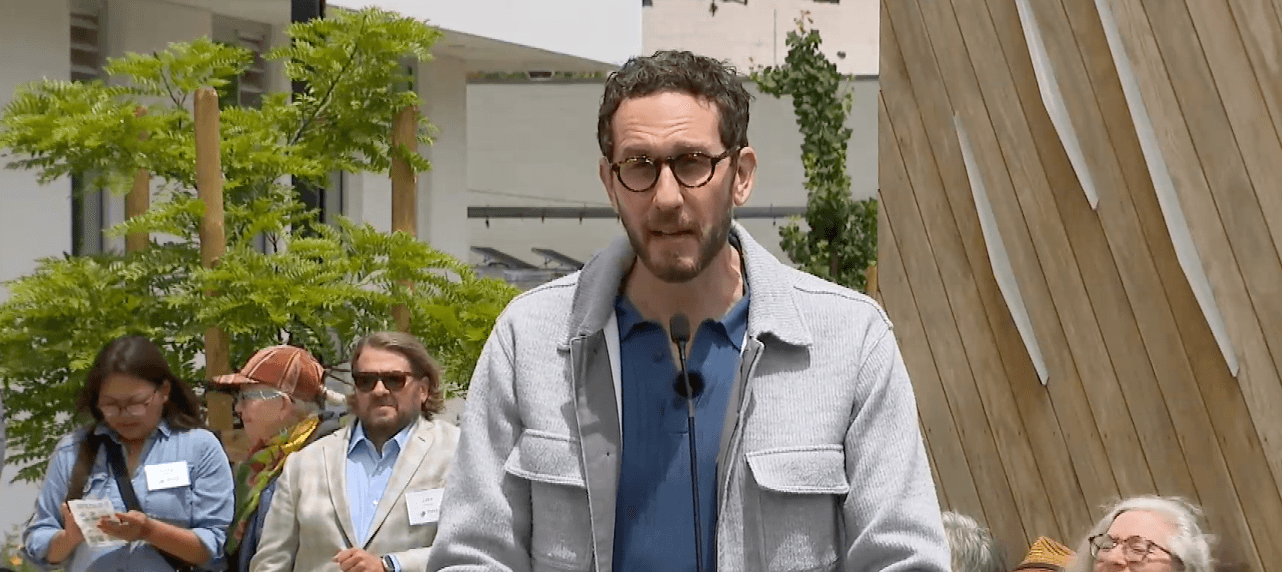
State Sen. Scott Wiener (D-San Francisco) spoke about the role of SB 35, the landmark 2016 bill he authored that streamlines housing permitting by requiring jurisdictions to approve projects ministerially when they meet pre-established zoning rules. The law was used to entitle 1633 Valencia.
Sen. Wiener recalled the skepticism that greeted the bill: "We were told there's no way this bill will ever pass. This is impossible. It's not how we do things in California. And we said, you know what? How we've been doing things in California for housing doesn't work."
The law has now enabled nearly 5,000 below-market-rate affordable homes in San Francisco alone — a striking figure for a single city. Sen. Wiener brought the policy conversation back to its human stakes: "Fundamentally, when it comes to housing, it's about people and we always need to center people. And so here we have our lowest income seniors who have helped build this community and deserve to be able to age with dignity."
1633 Valencia is the latest proof point that predictable permitting — combined with creative financing — can dramatically cut housing delivery timelines in a state notorious for slow, expensive development.
A Resident's Story: From Sleeping in a Van to a Place to Call Home
Nestor Luis Ramirez, a resident of 1633 Valencia, shared his journey from working as a construction foreman to becoming homeless after a workplace injury and COVID-related displacement. He described years of sleeping in his van before moving into the building.
Ramirez said the move has been transformative, describing his new home as amazing and wonderful, and that he feels like he has a better life now.
A 30-Year Career Comes Full Circle
The event also served as an unofficial send-off for Shireen McSpadden, Executive Director of the Department of Homelessness and Supportive Housing, who is retiring at the end of June after more than 30 years of public service focused on seniors and people with disabilities. McSpadden has also served on the Governor's Stakeholder Committee shaping California's Master Plan for Aging.
"I spent 30 years of my career working to serve older adults in San Francisco and the last five years working with people experiencing homelessness. And it's really wonderful to be able to bring those things together in this amazing building that is 1633 Valencia," Executive Director McSpadden said.
Her departure creates a leadership vacancy at the agency overseeing San Francisco's permanent supportive housing system during a period of active innovation and scaling.