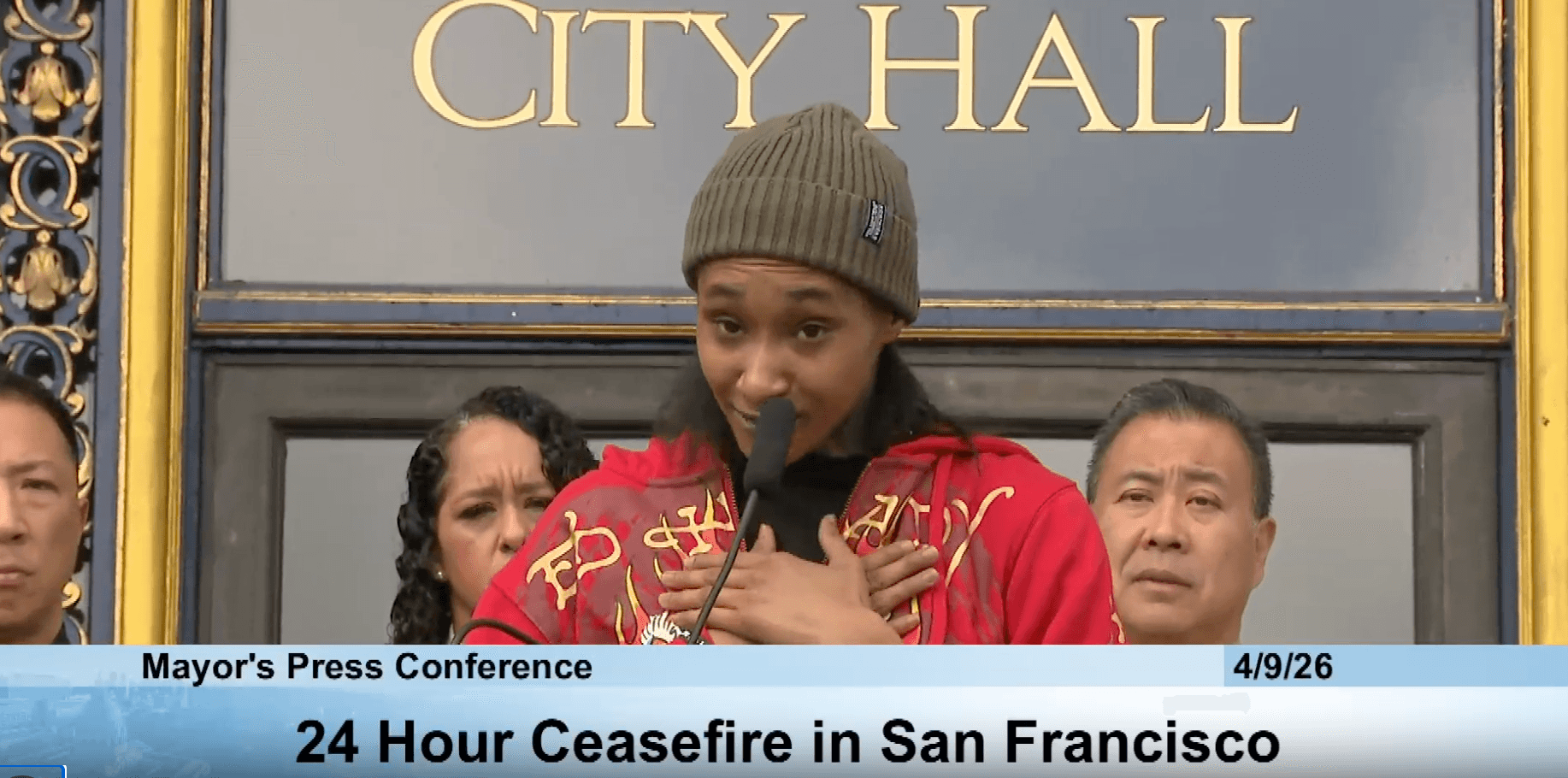
Mayor's Press Conference - Apr 09, 2026 - Meeting
Mayor's Press Conference • San FranciscoApril 9, 2026
Locunity is a independent informational service and is not an official government page for this commission.We use AI-assisted analysis and human editorial review to publish information.
City Officials, Community Leaders Rally for 24-Hour Ceasefire as SF Homicides Triple
San Francisco's mayor, district attorney, police chief, and a coalition of community organizations gathered Wednesday to announce a 24-hour citywide ceasefire on April 10, 2026 — a direct response to a surge in homicides that has more than tripled the count from this time last year. The call to action was initiated not from City Hall but from inside Solano State Prison, where a man serving a life sentence urged the community group United Players to mobilize the city around one question: Can San Francisco go one day without gun violence?
Homicides spike from 4 to 14 year-over-year, reversing the city's lowest homicide rate in 70 years
24-hour ceasefire set for April 10, organized by United Players with backing from the Mayor's Office, DA, SFPD, and DCYF
Youth speak from personal loss — a friend shot at Burton High School in December brought young speakers to tears and to the microphone
Mayor Lurie reaffirms public safety as top priority, pointing to the largest SFPD academy class since 2017 and new city-community coordination
Incarcerated organizer Demetrius Dixon calls in from prison to urge the city to protect its children
A Ceasefire Born Behind Bars
The basics: The press conference, held at the initiative of United Players, announced a 24-hour ceasefire beginning April 10 across San Francisco, with organizers hoping to expand the model to Oakland, Richmond, Vallejo, and all of Northern California if the day is successful.
Why it matters: Gun violence is now the leading cause of death for Americans 18 and under. In San Francisco, the crisis has arrived with force — homicides have jumped from 4 at this point in 2025 to 14 in 2026, erasing the gains of a year that saw the city's lowest homicide rate in seven decades.
Where things stand: The ceasefire concept came from Demetrius Dixon, known as Big Meech, who has been incarcerated at Solano State Prison for 31 years. Dixon called Rudy, the founder of United Players, and told him something had to be done.
"He called me, say, Rudy, there's so much gun violence that's happening here on the streets that something, somebody has to do something. We have to stand up," said Rudy, founder of United Players.
Rudy framed the initiative as an effort to unify every sector of the city — government, community organizations, and what he called "the hood sector" — around a single cause: protecting children. He cited the shooting death of 15-year-old Jada and violence across neighborhoods from Hunters Point to Chinatown to Nob Hill.
"A 24-hour ceasefire. Can we sit on our hands for one day? For the youth?" Rudy asked the crowd.
Dixon himself called into the press conference from prison, delivering a message of accountability and compassion.
"Speak up and remember to do so from a place of respect, of acknowledgment and consideration. A place of trust, a place of love, a place of understanding," said Demetrius Dixon.
A 'Crisis Point': The Numbers Behind the Urgency
District Attorney Brooke Jenkins put the stakes in blunt numerical terms: the city has recorded 14 homicides so far in 2026, compared to 4 at the same point last year.
"We were at four homicides last year. At this time. We are at 14 in San Francisco. This is a crisis point," said DA Brooke Jenkins.
Jenkins committed her office's Victim Services division and its intervention and prevention resources to the effort, framing her role as proactive rather than solely prosecutorial.
"My job is to get in front of it. My job is to make sure that our city comes together to invest in intervention and prevention of these types of tragedies from happening," she said.
The other side of the ledger: The SFPD Chief of Police acknowledged the sharp increase but emphasized that last year's progress was real — a 16% reduction in shootings drove the city's lowest homicide rate in 70 years. He also noted that investigators have made arrests in nearly every 2026 case.
"Last year, San Francisco saw the lowest homicide rate in 70 years, driven by a 16% reduction in shootings. This work is not over. We have seen an increase in homicides in the first part of this year. But thanks to our diligent investigators, patrol officers and the community, we have made arrests in nearly every case," the Chief of Police said.
He issued a pointed warning against vigilante justice: "Street justice only brings retaliation and more violence to our communities."
The contrast is stark. The city's 2025 safety gains — built on partnerships between SFPD, United Players, DCYF, SF Unified, the DA's Office, and Probation — now face a test of durability. Whether the cross-sector coalition that produced those results can reverse a sudden spike will shape the public safety debate in San Francisco for the rest of the year.
'A Bullet's Name Is Destruction': Youth Demand Action
The most emotionally powerful moments of the press conference came from young people connected to United Players who spoke from direct experience with gun violence.
Tony Bedford, who has been involved with United Players for more than 12 years, told the crowd that her brother Keenan was shot at Burton High School in December.
"This movement also means a lot to me, as my brother was shot at Burton High School last year in December," Tony Bedford said.
Ziggy Flash delivered an impassioned redefinition of what a bullet really is — not a nameless object, but a force of ruin.
"They do actually have a name. Their name is destruction. A bullet's name is destruction. Because any hand that that bullet or that gun, that weapon is in, it will cause destruction to either the person holding it, the person behind it, or in general, just anybody around," Ziggy Flash said.
Tarani, also known as Flash, described the emotional toll of losing peers to gun violence.
DCYF Director Cherise Dorsey Smith catalogued the organizations that showed up to stand behind the ceasefire: United Players, Us For Us, Operation Genesis, Instituto Familia de la Raza, SCDC, YCD, CYC, SVIP, UCS Wraparound, and the School Crisis Support Initiative. She framed the challenge as requiring collective responsibility.
"It takes a community to raise a child, and it takes a community to protect one, too," said DCYF Director Cherise Dorsey Smith.
Smith broadened the call beyond guns: "We could call it into all violence, not just gun violence, but all violence across the city. We can make a call to choose community over conflict. We can choose accountability over silence."
Chewy Gomez, a local radio personality, echoed calls to support the dreams of young people and backed the ceasefire effort.
Lurie Arrives, Pledges Sustained Commitment
Mayor Daniel Lurie arrived at the press conference and reaffirmed his administration's stance.
"I want to remind everyone public safety is my top priority as mayor. Not just today, not just tomorrow, but each and every day going forward," Mayor Lurie said.
Lurie pointed to concrete steps his administration has taken: the 287th graduating class of the SFPD — the largest academy class since 2017 — recently entered the force, and the mayor described a shift toward proactive community policing.
"We are making sure officers are not just responding to calls, but are present in the community, building relationships, earning trust, and working alongside residents to prevent violence," the Mayor said.
He also described a recent visit to the United Players Tenderloin Youth Clubhouse with Supervisor Mahmoud, where young people gave him a list of requests that he said is now on his desk. The mayor framed the work as a new model of coordination between city departments — SFPD, DCYF, and others — and community groups to connect youth with resources before violence intervenes.
What's next: The 24-hour ceasefire begins April 10. Organizers envision it as a proof of concept: if San Francisco can pull it off, the model could expand to Oakland, Richmond, Vallejo, and across Northern California. Whether the coalition assembled Wednesday — spanning City Hall, the criminal justice system, community organizations, and a voice calling from prison — can translate a single day of peace into sustained safety gains is the question that will define the months ahead.