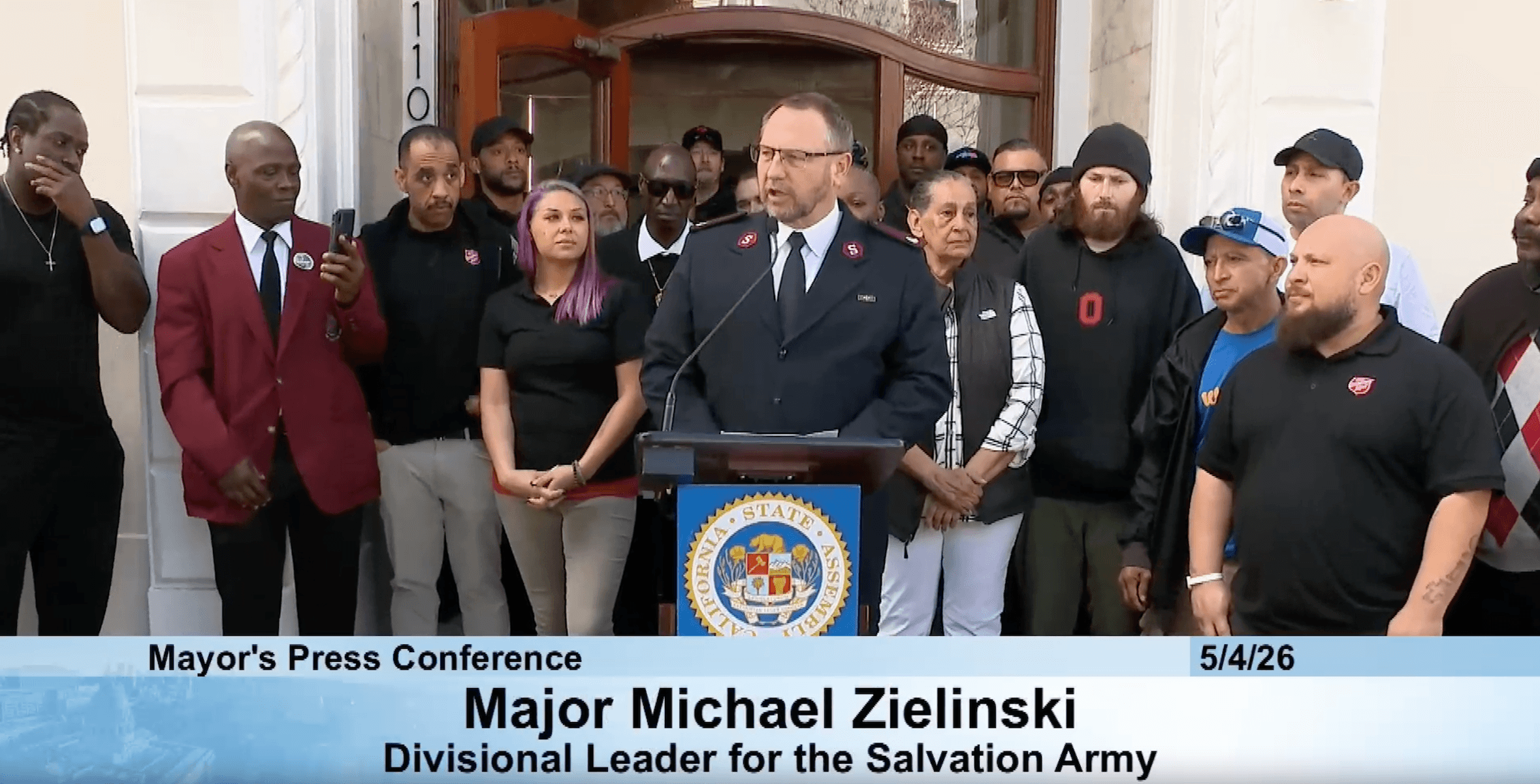
Mayor's Press Conference - May 04, 2026 - Meeting
Mayor's Press Conference • San FranciscoMay 4, 2026
Locunity is a independent informational service and is not an official government page for this commission.We use AI-assisted analysis and human editorial review to publish information.
SF Leaders Rally Behind State Bill to Unlock Funding for Sober Recovery Housing
Mayor Daniel Lurie and Assemblymember Matt Haney stood outside a Marina District recovery residence Monday to build support for AB 1556, a bill that would allow California to fund drug-free supportive housing for the first time. The press conference doubled as a milestone moment for the city's broader addiction strategy, with Lurie announcing the simultaneous opening of a new facility where police can bring people engaged in public drug use for health-focused stabilization.
AB 1556 would end California's ban on funding abstinence-based recovery housing, unlocking dollars for programs like the Salvation Army's Wells Place
Lurie announces Reset Center opening, a new facility connecting people arrested for public drug use to treatment under the city's Breaking the Cycle plan
Wells Place reports 79% success rate — residents exiting employed, sober, and housed — bolstering the case for statewide replication
Recovery advocates push back on critics, clarifying that the bill protects people who relapse by transferring them to different care rather than discharging them to the streets
Medical community backs the bill, with San Francisco Marin Medical Society endorsing recovery housing as essential to the full treatment spectrum
Closing the Funding Gap for Sober Housing
The basics: California law currently prohibits state funds from supporting permanent supportive housing that requires abstinence. AB 1556, authored by Assemblymember Matt Haney and now in its fourth year, would create a legal framework to change that. Mayor Daniel Lurie, the Bay Area Council, and the Salvation Army are co-sponsors.
Why it matters: San Francisco operates no permanent supportive housing that requires abstinence. That means people in recovery who want a sober living environment have limited publicly funded options — a gap advocates say contributes to relapse and overdose deaths in the very facilities meant to help.
Where things stand: The Salvation Army's Wells Place recovery residence, which opened in September in the Marina District, has become the bill's showcase. Steve Adami, Salvation Army/Wells Place, provided the numbers:
"We currently have 60 people living in the facility. We've enrolled a little over 80 since we have opened. And our mid-year impact reports showed that we had a 79% success rate, meaning people exited this recovery housing program employed, sober, and housed."
Major Michael Zielinski, Salvation Army Divisional Commander, framed the problem starkly:
"When we look at the number of permanent supportive housing facilities in San Francisco, none of them currently require abstinence as a part of their program."
He contrasted Wells Place's results with the Salvation Army's Railton Place facility on Turk Street, which must accept all referrals regardless of substance use status under current rules — limiting its effectiveness as a recovery program.
Haney called the state's current policy dangerous:
"The state has had out of date misguided rules that prohibit any state funding from going to recovery permanent supportive housing like this. It is wrong. It's misguided, and frankly, it's dangerous."
He emphasized a key provision: the bill requires recovery residences to adopt a "return to use" policy focused on warm handoffs to alternative housing or treatment — not punitive discharge to homelessness.
The other side: Critics have argued the bill could harm people who relapse by pushing them out of housing. Cedric Akbar, Positive Directions Equals Change, addressed those concerns directly:
"To all the people that have been calling me and asking me that this bill is going against people who relapse — it does not. Because as long as I'm a part of this, anyone who relapses will go to a different level of care and we will maintain their housing."
Akbar also acknowledged the local politics of siting recovery programs, thanking Marina District residents for accepting Wells Place in their neighborhood:
"It was a real fight to get this program here in the Marina District. And right now I want to thank everyone in the Marina District for coming and coexisting with us and helping individuals to get their lives together."
Dr. Joseph Wu, San Francisco Marin Medical Society, offered the medical establishment's endorsement:
"Your doctors believe we need to use every tool in our tool belt to help those struggling with substance use disorders and addiction, from harm reduction to abstinence and everything in between."
Dr. Manisha Bhatia, San Francisco Marin Medical Society, also spoke in support.
Decisions: No legislative vote was taken — this was a rally to build momentum. A similar version of AB 1556 was vetoed by the governor last year. Haney said he believes the revised bill can succeed:
"A similar version of this bill was vetoed last year. We believe this version, if we can get it to the governor, will be signed into law."
What's next: The bill must clear the state Legislature before reaching the governor's desk. Supporters are betting that Wells Place's data and a broadening coalition — spanning business, labor, medicine, and the recovery community — will be enough to overcome last year's veto.
Reset Center Opens as Part of City's Addiction Strategy
Mayor Daniel Lurie used the press conference to announce a parallel development: the opening of the Reset Center, a new facility under the city's Breaking the Cycle plan.
"Today, actually, at this very minute, we are opening the Reset Center, a new model that allows police officers to quickly arrest those engaged in public drug use and bring them to a health-focused facility where they can sober up and have a chance to get connected to treatment," Lurie said.
The mayor also pointed to Hope House, a sober shelter he recently visited, as further evidence that abstinence-oriented programs produce results:
"We've already seen the impact of this approach in San Francisco with projects like Hope House, a sober shelter that has a 78% success rate of moving residents into long-term recovery options."
Supervisor Matt Dorsey, who has spoken publicly about his own recovery, argued the bill's greatest value lies in empowering a community that costs taxpayers nothing.
"The importance of this legislation is that it puts into the game the most important ally we could have in the struggle against drug overdoses. It's the recovery community itself."
He noted that San Francisco's recovery-first approach had drawn national attention, citing a New York Times profile recognizing the city as a model.
Libby Schaaf, CEO, Bay Area Council, highlighted the business community's sustained commitment:
"This team has been working nonstop for four years to make sure that people who are choosing drug-free recovery housing options are not punished by California law."