Mayor's Press Conference - Jun 30, 2026 - Meeting
Mayor's Press Conference • San FranciscoJune 30, 2026
Locunity is a independent informational service and is not an official government page for this commission.We use AI-assisted analysis and human editorial review to publish information.
SF Opens 64-Unit Affordable Complex With Half Its Homes for Formerly Homeless Youth
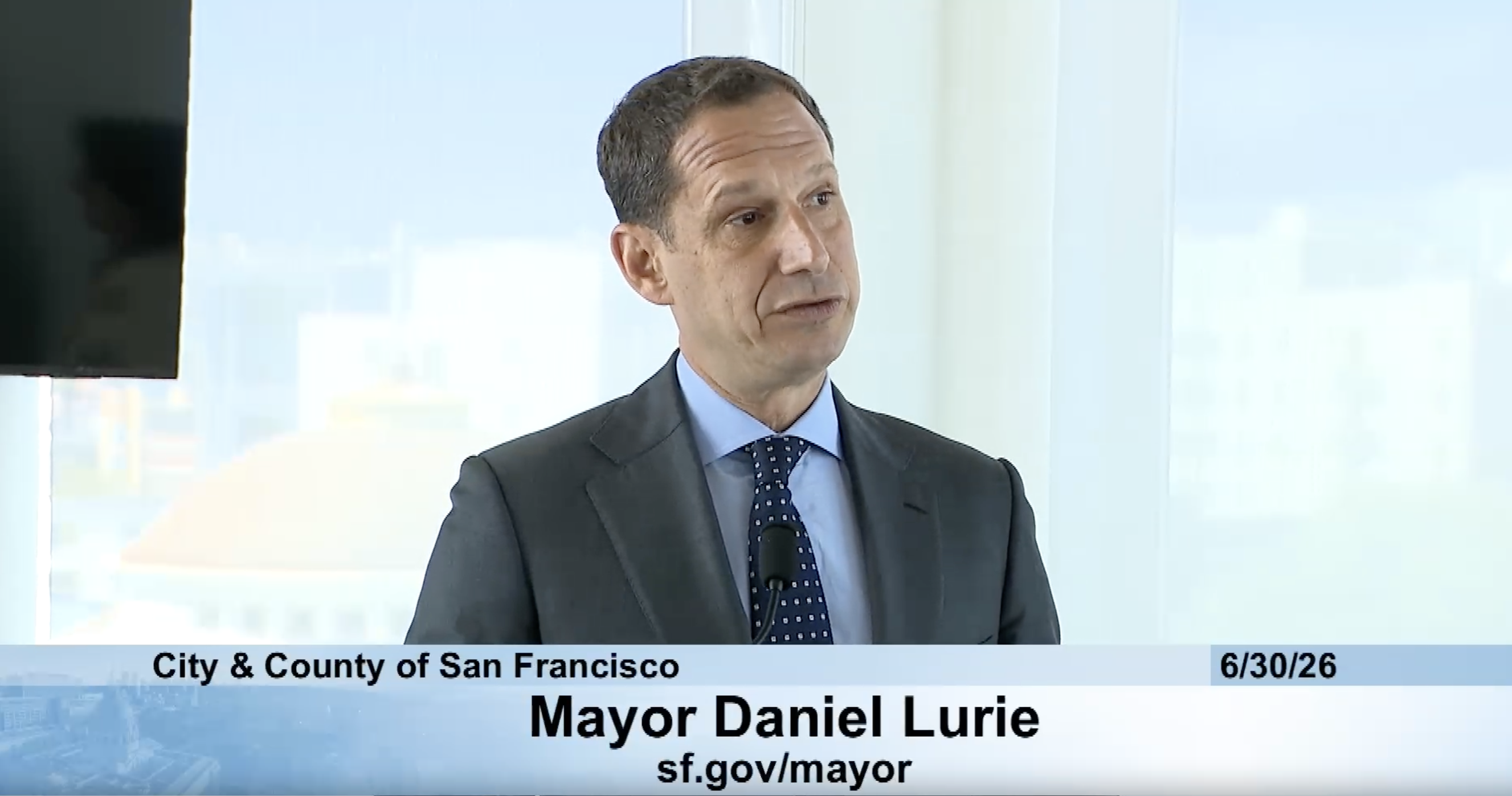
Mayor Daniel Lurie joined housing developers, service providers, and financial partners at 78 Haight Street to celebrate the grand opening of a 64-unit affordable housing project in Hayes Valley — 32 of those units dedicated to transitional-age youth who have experienced homelessness. The press conference also marked a leadership transition at the city's homelessness department and a broad outline of the Lurie administration's housing agenda.
64 affordable homes open at 78 Haight, with 32 reserved for formerly homeless young adults ages 18–24
$46M+ in private financing from First Citizens Bank anchored the project alongside nonprofit lender Merritt Community Capital
Outgoing HSH Director Shireen McSpadden departs, introduces successor Mike Levine on her final day
Mayor Lurie connects project to citywide housing push, citing Family Zoning, permitting reform, and a historic Housing Trust Fund investment
78 Haight: A Decade in the Making
San Francisco's newest affordable housing project sits in one of the city's most resource-rich neighborhoods — and it was designed that way. The 64-unit building at 78 Haight Street, developed and managed by the Tenderloin Neighborhood Development Corporation (TNDC), dedicates half its units to transitional-age youth who have experienced homelessness, with wraparound social services provided on-site by Larkin Street Youth Services. The building also includes community spaces, a rooftop garden, and a ground-floor family daycare.
Why it matters: The project traces its roots to a 2006 TAY housing plan that deliberately placed supportive housing outside the Tenderloin and Mission — neighborhoods where such housing is already concentrated — to give young residents access to different economic opportunities and community networks.
Where things stand: The building opened roughly six months ago and is now fully operational, but the road to get here was not smooth. David Dologite, a representative of Merritt Community Capital, the project's nonprofit investor and lender, was frank about what it took:
"This is a project that encountered some delays during construction and some really knotty problems. And we would not be here today if all the people involved in this project, including the city, weren't dedicated to seeing this thing through."
Dologite described Merritt's broader mission:
"For more than 35 years, Merritt Community Capital has been California's nonprofit investor and lender in affordable housing. We've invested 1.7 billion statewide, creating nearly 13,000 homes and housing more than 30,000 of our neighbors."
The financing package was substantial. Tony, a representative of First Citizens Bank, described the bank's commitment:
"We were very grateful to offer both an $18 million loan as well as a $28 million equity investment into this project."
He credited the bank's family-ownership structure for enabling values-driven decisions over short-term profit pressures. The Weinberg Foundation also provided a critical gift during a period of particular project difficulty.
Jen, a TNDC executive who emceed the event, framed the building as a model:
"This is deeply affordable housing. It's dedicated homes for transitional age youth. It's strong on-site supportive services, and through our partnership with Larkin Street Youth Services, it's really the access to one of the most resource-rich neighborhoods here in San Francisco."
Sherilyn Adams, Executive Director of Larkin Street Youth Services, offered perhaps the most vivid description of what the building means to its residents:
"Imagine getting to live in this building and do all the things right after experiencing homelessness, after experiencing trauma, after not thinking you will ever have a safe place to be."
Adams also credited a figure not present at the event — retired MOHCD official Anne Romero — with making the entire TAY housing pipeline possible:
"There would be no TAY housing projects in San Francisco without Ann Romero. Every single one of them that has opened since 2010 is because of Ann's leadership," Adams said, noting Romero helped draft the original 2006 TAY housing plan.
Lurie's Housing Playbook: Zoning, Permitting, and the Trust Fund
Mayor Daniel Lurie used the ribbon-cutting to outline his administration's broader housing strategy, connecting the 78 Haight project to several policy initiatives.
The basics: The mayor referenced four pillars: the Family Zoning plan adopted in 2025 to increase housing density near transit and commercial corridors; efforts to streamline permitting to reduce wait times and costs; programs to convert vacant office buildings to residential use; and what he called the largest affordable housing investment in San Francisco history through the Housing Trust Fund, announced earlier in 2026.
"Last year, we passed the Family Zoning plan to make room for more housing near transit and along commercial corridors so the next generation of San Franciscans can afford to raise their children," Lurie said.
He was also pointed about what comes after a building opens — arguing that permanent supportive housing alone is not enough.
"As we stand up more of it, we must pay attention to what comes next. That means greater investment in health care services, treatment access, high quality case management, and workforce development," he said, framing the goal as helping residents eventually graduate to independent living.
HSH Leadership Change on Sherene's Final Day
The press conference doubled as a farewell for Shireen McSpadden, the outgoing Director of the Department of Homelessness and Supportive Housing (HSH), who was making her final public appearance in the role.
McSpadden used her remarks to reflect on the philosophy behind projects like 78 Haight:
"When you bring all of the services together for folks, that's what helps people get beyond their identity as a person experiencing homelessness and allows them to be part of the community."
She then introduced her successor, Mike Levine, who comes to San Francisco from Massachusetts, where he ran the state's Medicaid program.
"The city is in super capable hands with Mike," McSpadden said, adding that HSH staff were "already falling in love with him" after about a week of overlap.
Sherilyn Adams, Executive Director of Larkin Street Youth Services offered a personal tribute to McSpadden and a warm welcome to Levine. The transition comes as San Francisco scales up its TAY housing pipeline and supportive housing investments — making continuity at HSH a closely watched question for providers and policymakers alike.
What's next: Levine takes the helm at HSH as the city expands its supportive housing portfolio. The 78 Haight project stands as a proof-of-concept for the TAY housing model the administration hopes to replicate across San Francisco.