Mayor's Press Conference - Apr 15, 2026 - Meeting
Mayor's Press Conference • San FranciscoApril 15, 2026
Locunity is a independent informational service and is not an official government page for this commission.We use AI-assisted analysis and human editorial review to publish information.
SF Celebrates Songkran at City Hall, Affirming Southeast Asian Heritage
San Francisco marked its second annual Songkran New Year celebration on the Mayor's balcony at City Hall on April 15, with elected officials and community leaders casting the event as a statement of civic inclusion for the city's Thai, Cambodian, Lao and Myanmar communities. The ceremony — part cultural ritual, part political signal — came as the holiday continues to gain formal recognition, from UNESCO's 2023 designation to California's first official acknowledgment in 2024.
- City Hall hosts second Songkran celebration with Mayor, Board President and community organizations
- Southeast Asian community leaders spotlight 50 years of service and the Tenderloin's role as an immigration hub
- SFO's first Thai American director connects Songkran's themes of renewal to the airport's global mission
Songkran Comes to City Hall — Again
The basics: Songkran is the traditional New Year observed across Thai, Lao, Cambodian and Myanmar communities, centered on water-based rituals symbolizing purification, renewal and community. UNESCO recognized it as intangible cultural heritage in 2023, and California officially recognized the Songkran New Year for the first time in 2024.
Why it matters: The ceremony institutionalizes Songkran as a recurring civic event at San Francisco's seat of government — a meaningful gesture of political visibility for Southeast Asian communities at a time of heightened national tension around immigration. It places Thai, Lao, Cambodian and Myanmar cultural traditions alongside more established Asian American civic celebrations in a city where those communities have deep but sometimes overlooked roots.
Where things stand: Montana Ratana Pakdi, founder of the Jasik Froicha Foundation, opened the event by connecting the celebration to the approaching 250th anniversary of the United States. "These moments remind us that America is strong and powerful because of the many culture, tradition and the community that help shape this country," she said. Ratana Pakdi also shared a personal reflection, describing how her family weathered difficult years and the values of resilience she has passed to her children.
Mayor Daniel Lurie framed the celebration within San Francisco's broader recovery narrative. "For us as a city to retake the mantle as the greatest city in the world, our recovery must include all neighborhoods, all communities," he said, adding that San Francisco will continue to be "a place where people from all backgrounds can honor their traditions, share their cultures and feel at home."
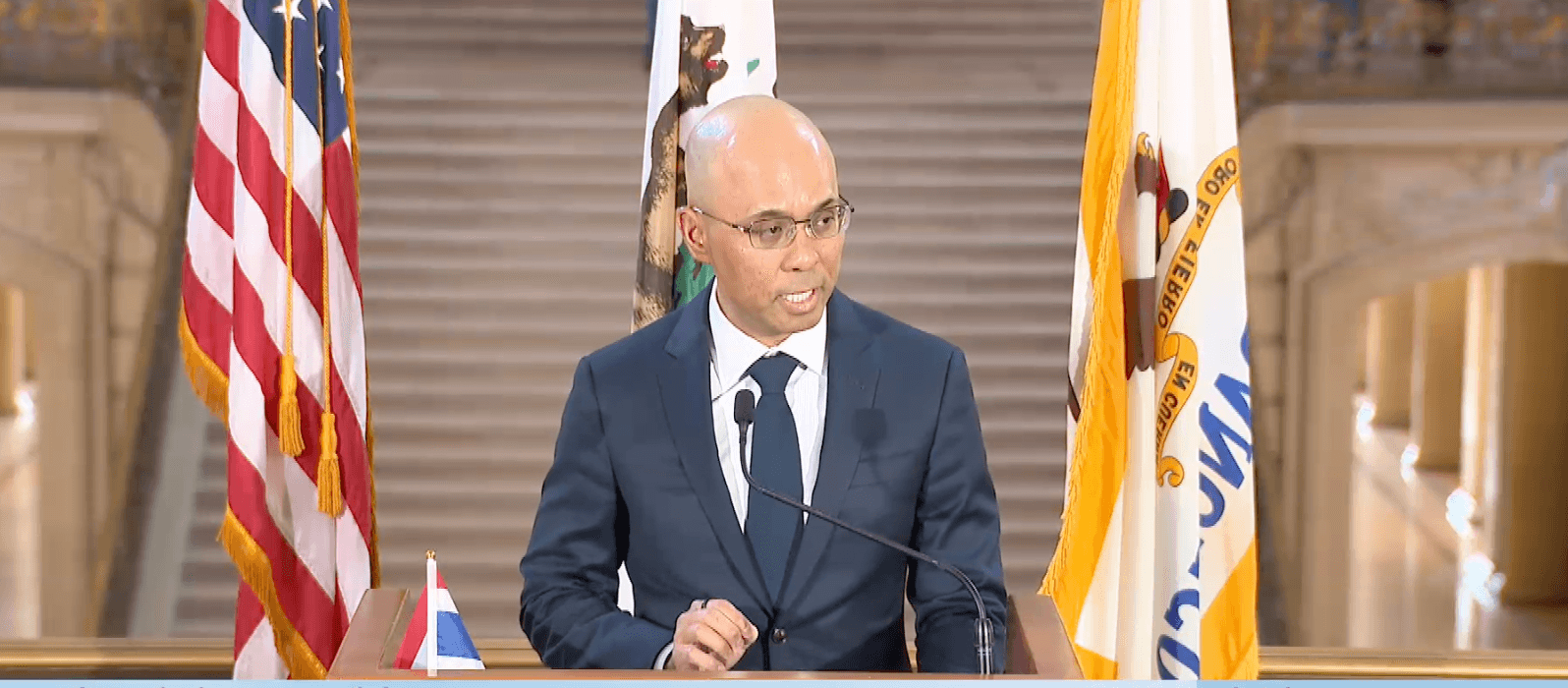
Board President Rafael Mandelman praised the Mayor's enthusiasm for the city's cultural diversity before introducing Mike Nikornket, director of San Francisco International Airport and the first Thai American to lead SFO. Nikornket drew a line between the holiday and his agency's mission: "Songkran reminds me of the importance of fresh starts and strong connections. Those values are at the heart of what we do at SFO — welcoming travelers from around the world."
Community Organizations Claim the Spotlight
Two longtime Southeast Asian service organizations used the platform to underscore decades of often under-recognized work in San Francisco's most underserved neighborhoods.
Diana Vuong, executive director of the Southeast Asian Community Center, highlighted the organization's half-century of service. "For over 50 years, SEACC has served immigrants, refugees and Southeast Asian families through culturally responsive programs, advocacy and small business support," she said, noting the center's role in hosting the Vietnamese New Year Festival and establishing the Little Saigon commercial and business district. Vuong also pointed to the center's decision to remain open in person during the pandemic as a reflection of its commitment.
Supervisor Mahmoud, District 5, emphasized that the Tenderloin — often defined by its challenges in public discourse — is a hub for Southeast Asian immigration stories. "That's really the Tenderloin that people don't see. It's the Little Saigon that people don't see," she said, thanking community leaders for sustaining that neighborhood identity.
Judy Young, executive director of the Southeast Asian Development Center, closed the event with the most direct articulation of what the celebration means for civic belonging. "It affirms that the culture and traditions of our Thai and Southeast Asian communities are not only welcome, but valued, honored and woven into the civic life of the city," she said. "Your presence today sends a clear message that San Francisco's strength comes from its diversity and that our stories belong here at City Hall."
What's next: The Southeast Asian Development Center will mark its 49th anniversary with a gala on May 15. Community organizations recognized at the event included the Thai Association of Northern California, First Thai Christian Church, TUC Thai Unity Community, Thai Culture Council of Berkeley and World Team USA Muay Thai, signaling a broad coalition of groups invested in sustaining Songkran's civic presence in San Francisco.