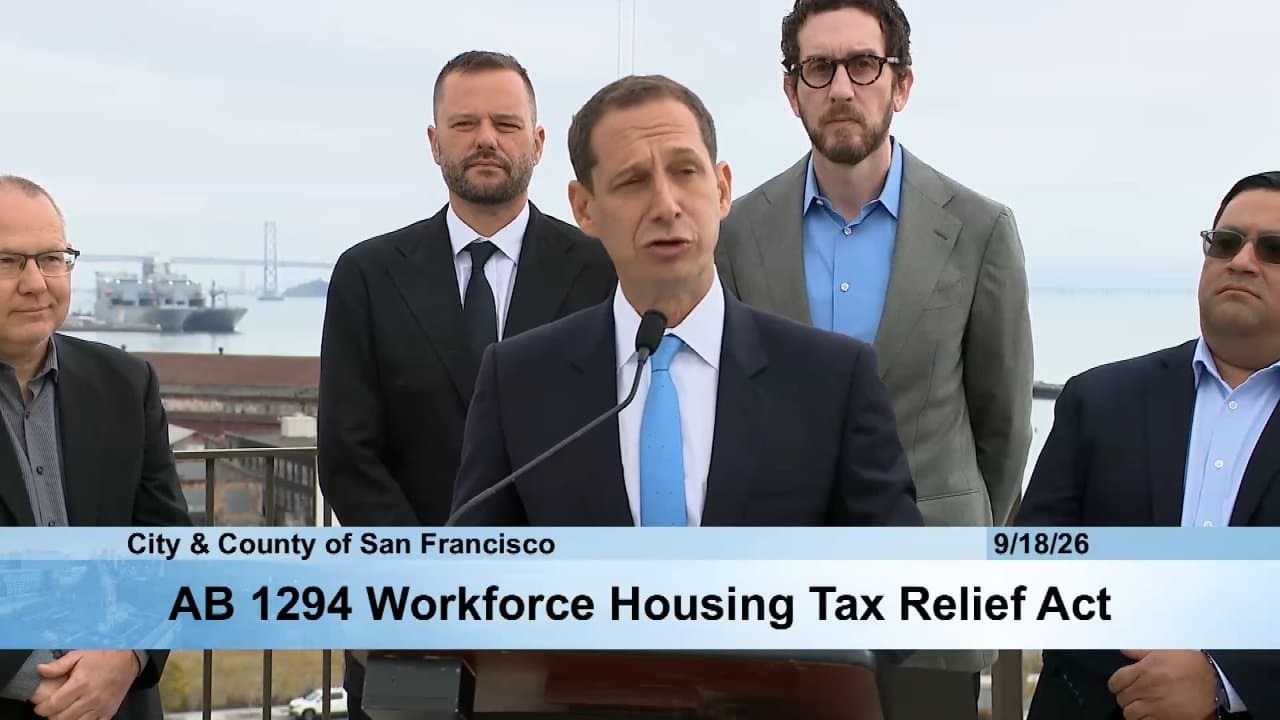
Mayor's Press Conference - Sep 18, 2026 - Meeting
Mayor's Press Conference • San FranciscoSeptember 18, 2026
Locunity is an independent informational service and is not an official government page for this commission. All information is sourced from public footage and an analysis of official agendas with the aid of responsible, fact-checked AI. to report an error or omission.
SF Leaders Rally Behind Workforce Housing Tax Break Awaiting Governor's Signature
Mayor Daniel Lurie and a coalition of state legislators gathered at the Sophie Maxwell Building on Sept. 18 to urge Gov. Gavin Newsom to sign AB 1294, a bill that would create a property tax exemption pilot program to make workforce housing financially viable in three of California's most expensive regions. The press conference capped an eight-year legislative effort that has passed through four authors and now sits on the governor's desk.
- Tax exemption pilot for workforce housing in San Francisco, Alameda County and Sacramento County heads to governor's desk
- Bay Area rents surge — up 8% in Alameda County and 15% in Oakland in the past year, fueling urgency behind the bill
- Eight-year legislative relay concludes as Assemblymember Haney carries the bill across the finish line after versions by City Attorney Chiu, Sen. Wiener and Sen. Arreguín
Closing the 'Missing Middle' Gap
The basics: AB 1294 would extend an existing property tax exemption for low-income housing to cover workforce and middle-income housing built by nonprofits. The pilot applies to San Francisco, Alameda County and Sacramento County. Units would carry long-term deed restrictions to keep rents affordable for decades, with the tax savings passed through directly to lower rents.
Why it matters: The bill targets a structural gap in California housing policy: workers who earn too much to qualify for traditional affordable housing programs but too little to afford market-rate rents. Assemblymember Matt Haney, the bill's author, opened the press conference by naming the people caught in that gap.
"Teachers, nurses, firefighters, construction workers, public employees, people who work in our restaurants, small businesses, schools and hospitals. These are people who can earn a decent salary and still be completely priced out of the communities where they work," said Assemblymember Matt Haney.
He explained the bill's core mechanism: "Right now, there is a tax exemption, a tax credit that goes to support low-income housing when it's built. This will extend that to provide that same level of support for workforce housing for the missing middle."
Where things stand: The bill has cleared the legislature and awaits the governor's signature, which speakers said could come as soon as this week.
Mayor Daniel Lurie, who sponsored the bill, connected it to a broader suite of city housing initiatives. "We passed family zoning to allow more homes in more neighborhoods. We're making it faster and easier to get permits through Permit SF. And we're also getting long stalled projects moving, from thousands of new homes at Candlestick Point to more affordable housing across the city," he said, calling AB 1294 "another important tool to build more housing for workers."
Rent Shock Across the Bay
State Senator Jesse Arreguín, who chairs the Senate Housing Committee, grounded the urgency in numbers from his district. "I'm proud to represent Alameda County, which has also seen a housing crisis with rents increasing by over 8% in the last year. And in Oakland, where I live, they've seen rents increasing by 15% just in the last year," he said.
Arreguín noted that middle-income housing projects are typically ineligible for most state housing financing programs, making the tax exemption a potentially powerful catalyst. "With this tax exemption we can catalyze hopefully thousands of units of needed workforce housing here in the Bay Area and in Sacramento County," he said.
A New York Precedent and Builder Confirmation
State Senator Scott Wiener drew a historical parallel to bolster the case. "In New York City, they created a tax abatement program for workforce housing. And it was wildly successful for decades," he said, referencing a post-World War II program designed to address a national housing shortage.
Wiener said the bill is not theoretical — builders have already validated its impact. "I have talked to various folks who build housing who have been very, very clear that this will absolutely make a whole bunch of working class, middle class housing that's not currently viable, will make it financially viable," he said.
An Eight-Year Relay Race
City Attorney David Chiu, who introduced the first version of the bill eight years ago when he served in the state Assembly, described the legislative journey as a team effort spanning multiple sessions and authors. "I think sometimes it is a four-legged relay race. And as the person who eight years ago introduced the first and second versions of this bill and then handed it to Senator Wiener, who handed it to Senator Arreguín, I just want to say to Assemblymember Haney, thank you for being the end of this relay, getting it done, bringing it home to build homes for California," he said.
Chiu framed the stakes in personal, geographic terms: "We want our nurses to be near their hospitals, we want our teachers to be near their schools, we want our first responders to be near their emergencies."
He also acknowledged the advocates and staff who sustained the effort across its long arc, singling out housing advocate Michael Lane and mayoral staffer Eileen Mariano. Chiu noted that mayors from other major California cities — including Todd Gloria of San Diego, Sam Liccardo of San Jose and Kevin McCarty of Sacramento — have supported versions of the bill over the years.
What's next: The bill sits on Gov. Newsom's desk. Speakers expressed confidence the governor would sign it, potentially within days. If enacted, AB 1294 would create the first state-authorized tax exemption pilot specifically designed to make nonprofit-built workforce housing financially viable in three of California's highest-cost regions.