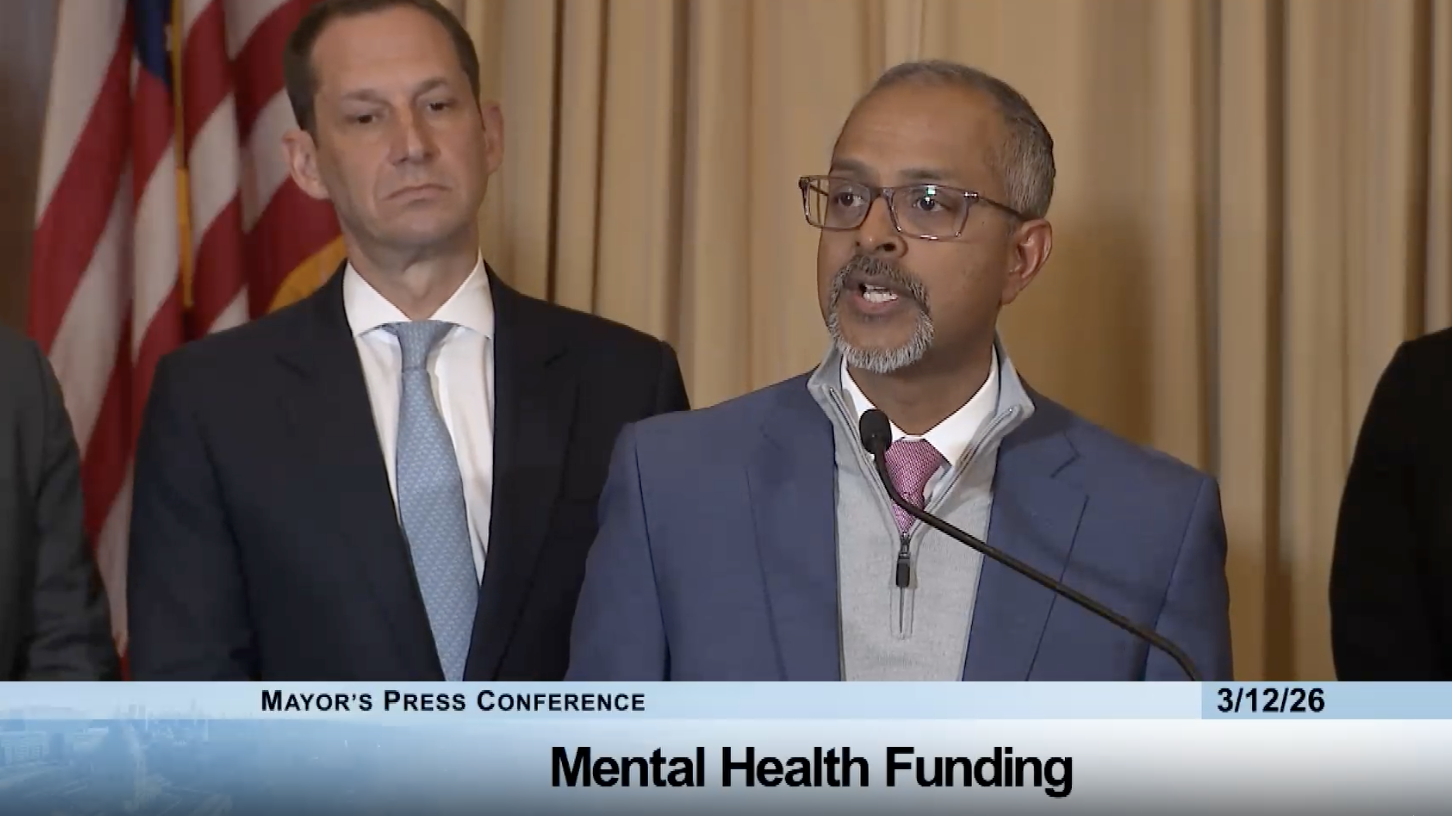
Mayor's Press Conference - Mar 13, 2026 - Meeting
Mayor's Press Conference • San FranciscoMarch 13, 2026
Locunity is a independent informational service and is not an official government page for this commission.We use AI-assisted analysis and human editorial review to publish information.
San Francisco Secures $100M in State Funds to Nearly Double Locked Psych Bed Capacity
Mayor Daniel Lurie announced that San Francisco has won approximately $100 million in state Proposition 1 funding for three behavioral health projects — the largest expansion of locked psychiatric and substance use treatment beds the city has seen in decades. The awards arrive as the city currently sends patients as far as Santa Barbara for care it cannot provide locally, and as officials report record-low tent encampment counts under the administration's Breaking the Cycle initiative.
Nearly $100M in Prop 1 funding awarded for three behavioral health projects that will add locked psychiatric beds, substance use treatment beds, and a new sobering center
City's locked psychiatric bed capacity will roughly double, reducing reliance on out-of-county transfers
Board President Mandelman says awards fulfill 2024 task force recommendations within a year of the report's release
Mayor Lurie reports lowest tent encampment numbers since 2022 and 40% increase in shelter placements under Breaking the Cycle
$100M Bet on Behavioral Health Beds
The basics: Proposition 1, approved by California voters, created a statewide funding stream — the Behavioral Health Continuum Infrastructure Program (BCHIP) — for local behavioral health capital projects. San Francisco applied for three and won all three.
Why it matters: San Francisco has for years lacked enough locked psychiatric beds and substance use treatment capacity to serve people in acute crisis. The shortage forces the city to transfer patients to facilities hundreds of miles away — or, more often, to leave people on the street with no appropriate placement at all.
Where things stand: The three funded projects are:
UCSF Health Hyde Hospital — 50 locked beds and 6 psychiatric beds
Treasure Island — 44 substance use residential treatment beds
1660 Mission Street — A sobering center that will serve as a centralized public health services hub
"We are sending people as far as Santa Barbara for this level of care out of county. And in many cases, folks are left on the street because there is no appropriate level of care," said DPH Director Dan Tsai (lightly edited for clarity).
Director Tsai said the 40 to 50 new locked beds will close to double the city's existing locked psychiatric bed capacity. The 44 substance use beds add meaningfully to the roughly 270 residential treatment beds currently available.
State Health and Human Services Secretary Kim Johnson framed the investment as part of a broader statewide push. "San Francisco city and county has received over $105 million alone just on the city county side for this behavioral health infrastructure, these places to support the treatment in recovery," she said.
UCSF's Expanding Footprint
UCSF Health President and CEO Suresh Gunasekaran described the Hyde Hospital expansion as part of a broader revitalization strategy. "The ability to expand this behavioral health capacity at our Hyde Hospital is really two parts — an ability to make this care accessible to patients in a timely manner, but also part of our revitalization at UCSF Health of expanding the number of sites that we have within the city," he said.
Dr. Gunasekaran emphasized that the work depends on partnership: "That partnership starts with city government, but it extends to all the health systems in the city as well as the community organizations."
From Task Force Report to Funded Projects in a Year
Board of Supervisors President Rafael Mandelman cast the announcement as the culmination of years of advocacy — including his early legislative efforts around housing conservatorships and his support for SB43, which expanded California's conservatorship criteria. In 2024, he convened the Behavioral Health Beds Working Group, which recommended 50 to 100 additional locked subacute beds and high-acuity residential care beds.
"Who could have imagined that a year later we would have a pathway to implementation of basically all of the important recommendations of that task force?" President Mandelman said.
He credited Gov. Gavin Newsom for what he called the most significant state effort on mental health since the closing of state hospitals decades ago — "reassert a role for the state of California in asking local governments and partnering with local governments to create this floor level of care, a floor beneath which we would not let people fall who have severe mental illness."
But President Mandelman also underscored the stakes: "The changes in law, as important as they are, are not worth very much if we don't have appropriate placements for the people who need this very high level of care."
The policy link is direct — expanded conservatorship powers under SB43 are only meaningful if cities have beds to place people in. Without capacity, the legal authority is hollow.
On the Ground in District 3
Supervisor Danny Souder, District 3, who represents the area that will house one of the funded sites, described the gap between outreach intent and available resources. "Inevitably on these walks, there's sometimes a moment where you reach a dead end. You have a conversation and there might be willingness to engage, but there's a dead end because there is simply not the space, there is not the room or the services," he said.
Paying for It
Director Tsai said operational costs for the new beds will be covered through Medicaid billing and by redirecting spending the city currently uses to send patients to out-of-county facilities. "Some of these beds are covered on an ongoing basis through Medicaid funding. But clearly you have to have the capacity to bill the state and federal government for Medicaid funding," he said.
Construction timelines were not specified. Officials said they would move as quickly as possible with the state capital funding.
What's next: The city will move into design and construction phases for all three projects. Operational funding will depend on the city's ability to bill Medicaid and shift dollars currently spent on out-of-county placements — a significant administrative lift during what officials acknowledged is a serious budget deficit.
Breaking the Cycle: Record-Low Tent Counts, 600+ Beds Added
Mayor Lurie used the press conference to highlight broader progress under his Breaking the Cycle initiative, which integrates health services, social services, law enforcement, and emergency responders into a unified homelessness response.
Key milestones he reported:
600+ beds added across the system
Nine neighborhood outreach teams consolidated into a single unified operation
40% increase in shelter placements
February 2026 recorded the lowest number of tent encampments and the most RV-to-housing placements and reconnections to family members in any single month since 2022
The mayor also referenced the 822 Geary 24/7 stabilization center and the forthcoming Reset center for drug users as part of the infrastructure buildout.
"It can't just be a shelter bed for many people. It's gotta be a recovery bed. It's gotta be a treatment bed," Mayor Lurie said, framing the Prop 1 awards as the next step in a continuum that starts with outreach and ends with clinical care.