
SFUSD to Open First Mandarin Immersion TK-8 School, Doubling Kindergarten Seats
Mayor's Press Conference • San FranciscoSeptember 24, 2026
Locunity is an independent informational service and is not an official government page for this commission. All information is sourced from public footage and an analysis of official agendas with the aid of responsible, fact-checked AI. to report an error or omission.
Mayor Daniel Lurie and SFUSD Superintendent Maria Su announced the district will open its first Mandarin immersion TK-8 school in fall 2027, doubling kindergarten-level Mandarin immersion capacity from 66 seats to approximately 132. The move responds to years of oversubscription and broad political backing, and signals a renewed city-district push to keep families in San Francisco public schools.
- SFUSD's first Mandarin immersion TK-8 school will open fall 2027 at Mission Education Center on Noe Street, starting with one transitional kindergarten and three kindergarten classrooms
- Kindergarten Mandarin immersion seats will double from 66 to roughly 132, addressing chronic oversubscription
- Mayor Lurie frames the school as part of a broader family retention strategy, connecting it to universal childcare, housing affordability, transit reliability, and high-impact tutoring
- Board of Education, teachers union, and 10 of 11 supervisors back the new school, along with a 900-family parent coalition
A School Years in the Making
The basics: San Francisco Unified School District currently offers just 66 Mandarin immersion kindergarten seats per year — at Alice Fong Yu Alternative School — while hundreds of families apply. The new school will temporarily share a campus with Mission Education Center at 1670 Noe Street, adding one TK classroom and three kindergarten classes in its first year and growing by one grade annually. Mission Education Center's existing programs and enrollment are unaffected.
Why it matters: The capacity gap has driven families toward private schools and out of the district entirely, compounding SFUSD's broader enrollment decline. Doubling kindergarten Mandarin immersion seats is the district's most concrete move in years to retain families who might otherwise leave the public system.
Where things stand: Superintendent Maria Su said the decision grew directly from listening to families. "When you ask San Francisco families what they want, they will tell you often and in full detail with multiple bullet points. One thing that we heard over and over again is that we at SFUSD need a Mandarin immersion," she said at the Sept. 24 press conference.
Su credited Leanna Sito, founding principal of Alice Fong Yu Alternative School — the nation's first Chinese immersion public school — for advising the new school's development.
Board of Education President Phil Kim underscored the historical weight of the moment, recalling that the first Mandarin school in San Francisco once faced opposition. "For those of us who've had the privilege of hearing her origin story of establishing the first Mandarin school in San Francisco, you know the stories are not always easy to hear because there was a time when there were people who were against opening that school," Kim said. "I cannot more clearly articulate for you how incredible it is, how big of a milestone it is that we are standing here today all united as labor leaders, community advocates, families saying yes to this school."
Kim also framed the expansion as an instructional strategy, not just a response to demand: "We know that complex language immersion programs such as Mandarin can have a positive impact on learning."
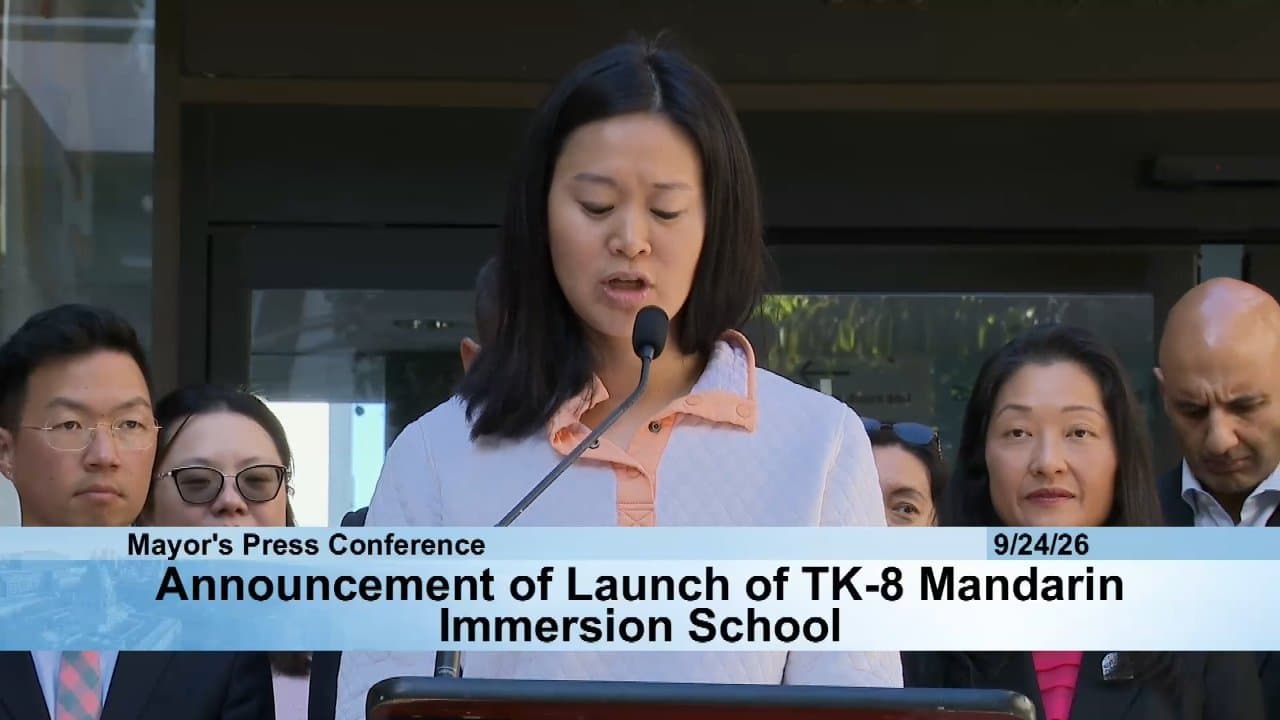
Abby Chow, representing Friends of SF Mandarin School — a coalition of more than 900 families — put the numbers plainly: "Currently, there are only 66 Mandarin immersion seats at the kindergarten level each year, and hundreds of families apply. This school will double the number of Mandarin seats that are available at kindergarten."
Chow described the personal stakes for families like hers: "For my family, this represents an amazing opportunity for my kids to potentially have the opportunity to connect to their heritage and connect with their Chinese-speaking family. For other families, it's about more bilingual education. It's about providing rigor. It's about becoming global citizens."
She also highlighted the breadth of political support, noting backing from all school board members, 10 of 11 supervisors, all school board candidates, and several supervisor candidates.
UESF President Cassandra Curiel praised the collaborative process and used the moment to push a broader vision: "Our goal is to make sure that every single school is fully funded, fully staffed, well-programmed, and fully enrolled. And that is truly the strong vision for San Francisco Unified."
What's next: SFUSD will work with the community to identify a permanent site for the school by January 2027. Families can visit sfusd.edu for updates on enrollment and development.
Lurie Ties School to Citywide Family Retention Push
Mayor Daniel Lurie positioned the Mandarin immersion announcement within his broader Family Opportunity Agenda, arguing that great public schools are only one piece of keeping families in San Francisco.
"That means our workers, small business owners, and public servants can raise their kids in the communities they love. That takes rents they can afford. Childcare they can count on, public transit that is safe and reliable, and most importantly, great public schools that give their children every opportunity to thrive," Lurie said.
He cited his goal of making San Francisco the first major U.S. city where every family with a child under 5 can access childcare, highlighted investments in after-school and summer programs through the Department of Children, Youth, and Their Families, and pointed to results from city-funded high-impact tutoring: "Students receiving this high-impact tutoring grew in their reading scores 2 times faster than their peers."
Lurie also referenced his rent emergency package and commitments to Muni service reliability as part of the same strategy — framing the school not as an isolated education win but as a component of a broader effort to stem family outmigration from the city.