Mayor's Press Conference - Jun 10, 2026 - Meeting
Mayor's Press Conference • San FranciscoJune 10, 2026
Locunity is a independent informational service and is not an official government page for this commission.We use AI-assisted analysis and human editorial review to publish information.
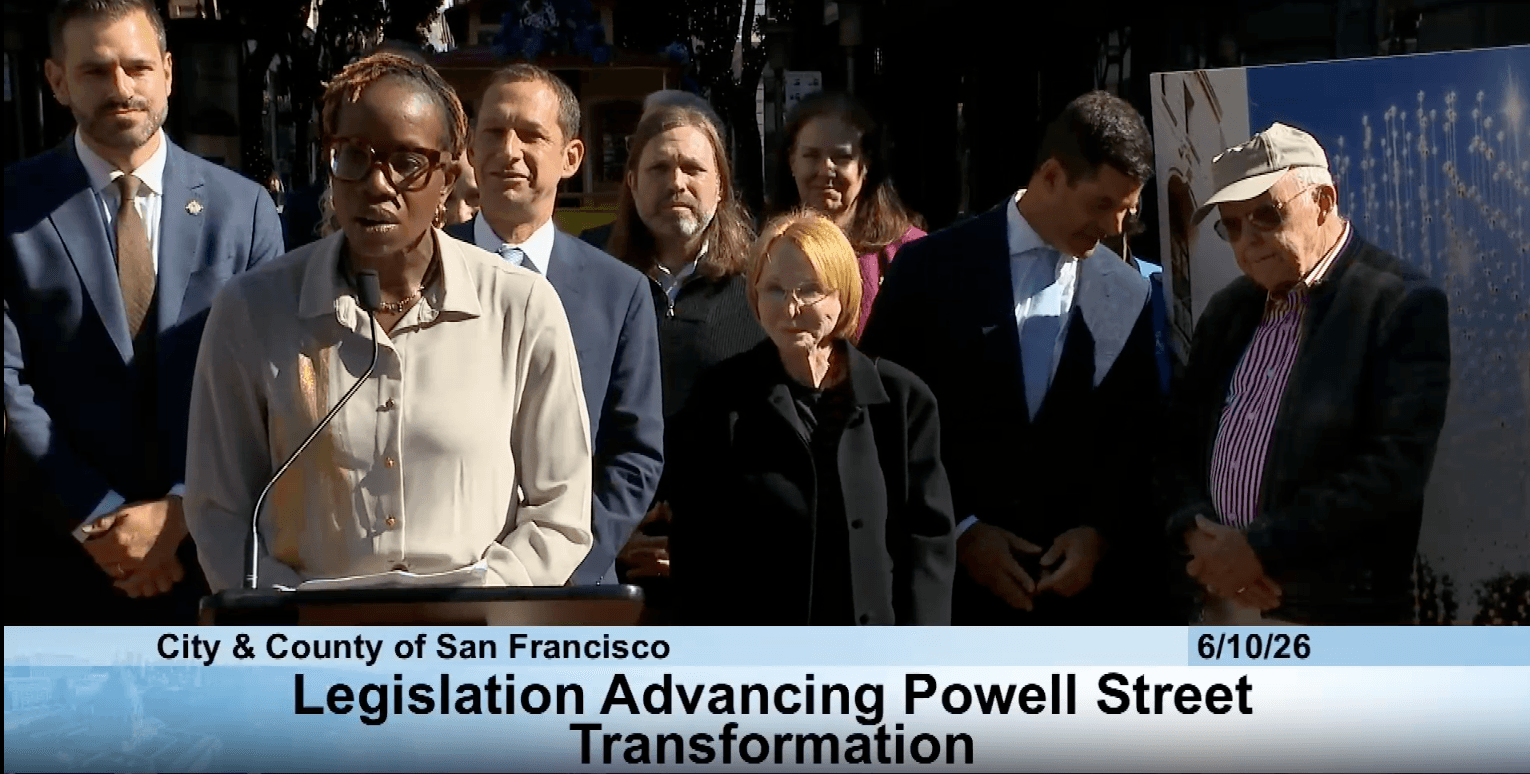
Mayor Signs $14.5M Grant Launching Powell Street Overhaul
San Francisco's most famous cable car turnaround is getting a makeover. Mayor Daniel Lurie signed legislation Wednesday accepting a $14.5 million grant from the Downtown Development Corporation to transform three blocks of Powell Street — the largest single private investment in the city's downtown streetscape recovery.
- $14.5M DDC grant unlocks Powell Street redesign spanning Market to Geary streets, with wider sidewalks, outdoor dining, upgraded cable car stops and heritage-inspired lighting
- Downtown recovery metrics accelerate: retail theft down 29%, foot traffic up 20%, and tourism projected to surpass pre-pandemic levels with 24 million visitors in 2026
- Dandelion Chocolate goes permanent on Powell, converting a skeptical pop-up trial into a full chocolate café — a concrete bet on the corridor's comeback
- Public-private funding model crystallizes, stacking the DDC grant with 2024 Prop B bond proceeds, $4 million from SFCTA and SFMTA contributions
Powell Street Gets Its Biggest Investment in a Generation
The basics: The Powell Street Improvement Project will redesign the three-block stretch between Market Street and Geary Street — the pedestrian spine connecting the cable car turnaround to Union Square. Improvements include widened sidewalks, new landscaping, outdoor dining areas, upgraded cable car stops and lighting designed to echo the neighborhood's architectural heritage. The project draws on multiple funding streams: the DDC's $14.5 million, 2024 Prop B voter-approved bond proceeds, a $4 million San Francisco County Transportation Authority contribution and SFMTA funds.
Why it matters: Powell Street is the literal front door of San Francisco tourism. Tens of thousands pass through daily — on cable cars, BART, Muni and on foot — and the corridor's condition shapes first impressions of the city for visitors and prospective tenants alike. The grant represents the DDC's largest single investment and a test case for the public-private model the Lurie administration is betting on to rebuild downtown.
Where things stand: Mayor Daniel Lurie framed the signing as part of his broader "Heart of the City" initiative, pointing to momentum across multiple indicators. "Crime is down, including retail theft, which is down 29% year over year. Union Square and Yerba Buena welcomed 44 new storefronts last year," he said, adding that San Francisco is projected to welcome more than 24 million visitors this year — surpassing 2019 pre-pandemic levels.
"Downtown's recovery is not going to be the work of any one sector," Mayor Lurie said. "It's going to take all of us. City government, community organizations, small businesses, major employers and civic leaders all pulling in the same direction."
District 3 Supervisor Danny Sauter underscored the convergence of public and private dollars, noting that voters backed Prop B in 2024 and are now seeing returns. "The 2024 Prop B is being put to good use here. And the voters said yes. And they're seeing their dollars delivered here," Supervisor Sauter said. He emphasized the stakes of the corridor's condition: "Tens of thousands of people pass through these streets every single day … and this is their first impression."
DDC Stakes Its Claim as Downtown's Catalytic Investor
DDC CEO Shola Olatoye positioned the grant as the centerpiece of a broader downtown strategic investment plan. "We are a nonprofit, public-private partnership that is built to raise catalytic capital — to invest in things that work, that drive the downtown recovery," Olatoye said.
She delivered a string of recovery metrics to justify the bet: foot traffic on the Powell corridor is up nearly 20% year over year, BART ridership is up 20% since the pandemic, hotel revenues are starting to exceed pre-pandemic levels, and Moscone Center is fully booked for the rest of 2026 and nearly booked for 2027. Olatoye credited the inaugural financial support of Catherine and David De Wilde and Hilton hotel partners in making the DDC's work possible.
"We recognize that we are a city of neighborhoods in a downtown of districts. But what has been missing is a comprehensive plan for investment for downtown," Olatoye said — framing the DDC's role as filling a strategic gap that no single city agency had addressed.
A Decade in the Making
Union Square Alliance CEO Marissa Rodriguez provided historical context, noting that the Powell Street project traces back more than a decade to original sidewalk-widening efforts and involves a dense web of city agencies — DPW, SFMTA, the County Transportation Authority, the Office of Economic and Workforce Development, property owners and community benefit districts.
"Today is about more than redesigning a street. It's about investing in the future of San Francisco. It's about ensuring that our front door to the world reflects the beauty, innovation and resilience that has always defined this city," Rodriguez said. She emphasized that no single organization can drive recovery alone: "It takes collaboration. And today's announcement is a powerful example of what can happen when we work together and think big."
From Skeptic to Permanent Tenant
The most tangible evidence of the corridor's turnaround came from Todd Masonis, founder of Dandelion Chocolate, who announced that the company has signed a permanent lease on its Powell Street pop-up location and will expand it into a chocolate café with outdoor seating.
Masonis was candid about his initial doubts. "A couple years ago we looked around for a location here and I'll be honest, we were a little hesitant about where the city was at. There weren't many people walking the streets, storefronts were empty, the charm was gone, and we weren't sure what the comeback strategy was," he said.
What changed his mind was seeing the public-private model in action. "It seems like what's happening here is a very San Francisco kind of innovation. You've got small businesses, the public sector, property owners and civic organizations all moving together and moving faster to make this happen," Masonis said.
120-Year-Old Building, Brand-New Optimism
Karen Flood of the historic Flood Building — which has stood on Powell Street for 120 years — described the long, uneven road to this moment. A previous bond measure failed before Prop B succeeded. "We had a failed bond measure. But then all of a sudden Prop B came through and the voters supported it and so we had funding from that. We still had to fight for it a little bit," Flood said.
The practical impact is already visible in her leasing conversations. "Finally have people to talk to that might want to come open businesses again in our building. And I can really point to the project and say, listen, this is going to be incredible. This is going to be a reimagined, reformed street," Flood said. She credited Mayor Lurie directly with shifting the narrative: "You've single-handedly turned around the narrative, which means that I actually have tenants to talk to."
Who gains, who watches: The immediate beneficiaries are Union Square property owners, retailers, restaurants and hospitality businesses who depend on foot traffic and a clean, safe streetscape. Tourism-dependent workers — hotel staff, food service, retail employees — stand to gain from the projected visitor surge. The DDC's donor-funded model gives private capital outsized influence over downtown priorities, a dynamic worth tracking as more investments follow. Neighborhood advocates outside downtown will watch whether this level of public-private investment gets replicated in commercial corridors citywide or remains concentrated in the tourism core.
What's next: Construction timelines and phasing details were not announced at the press conference. The project now moves into design and implementation with funding from the stacked public-private sources. The DDC signaled that additional strategic investments in other downtown districts are forthcoming.