
SF-Born Law Makes Serious Protective-Order Violations Chargeable as Felonies
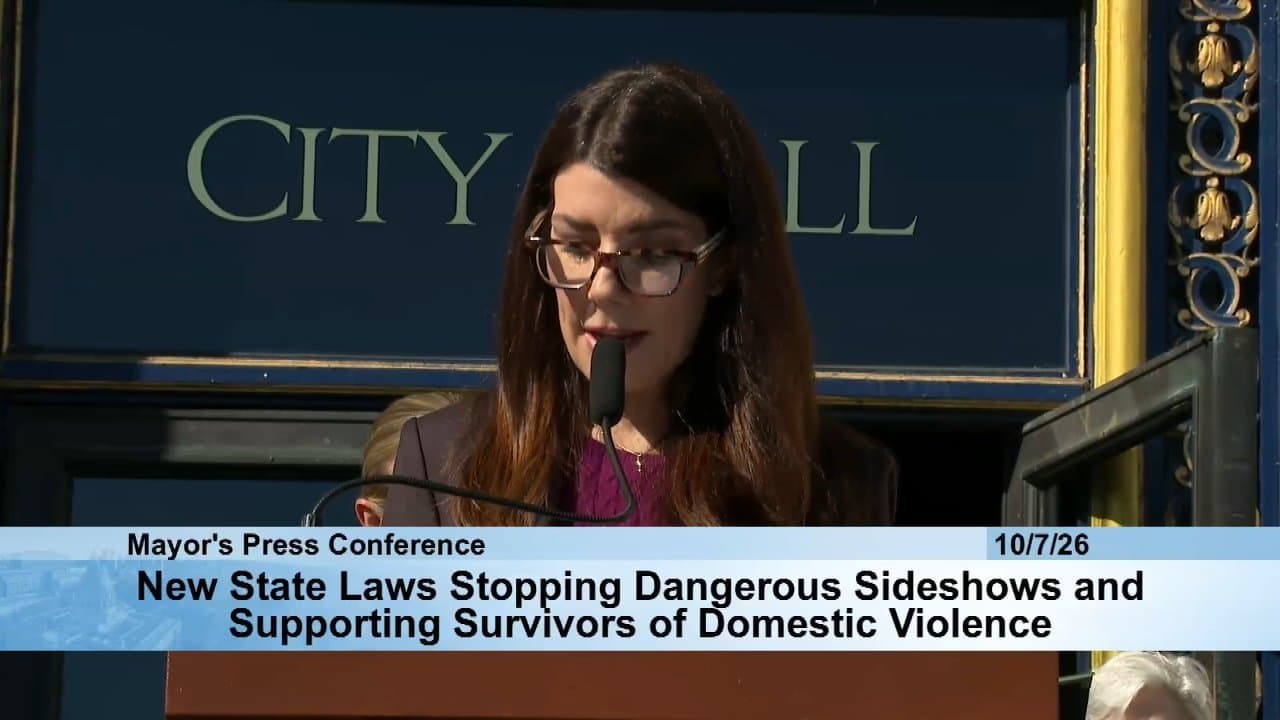
Mayor's Press Conference • San FranciscoOctober 7, 2026
Locunity is an independent informational service and is not an official government page for this commission. All information is sourced from public footage and an analysis of official agendas with the aid of responsible, fact-checked AI. to report an error or omission.
A gap that let abusers violate court stay-away orders with only misdemeanor consequences is closing statewide, and the fix started in a San Francisco City Hall office. At an Oct. 7, 2026, press conference, Mayor Daniel Lurie and Assemblymember Catherine Stefani celebrated two newly signed state laws: AB 1877, which allows felony charges for protective-order violations in high-risk cases, and AB 1588, a sideshow crackdown that adds escalating jail penalties and vehicle impounds.
- AB 1877 signed: Prosecutors can now charge serious or repeat protective-order violations as felonies
- The idea came from SF's Mayor's Office of Victims' Rights, which Stefani created as a supervisor
- AB 1588 signed: Dirt bikes and plateless vehicles now fall under the state's sideshow definition, and repeat offenders face jail
- Judges can impound sideshow vehicles for up to 30 days when registered to the offender
- SFPD pledges drones, license-plate readers and regional coordination against sideshows
Stay-Away Orders Get Felony Teeth
The basics: A criminal protective order is a court order barring someone charged with a crime from contacting or approaching the victim. A DVRO is a domestic violence restraining order.
Why it matters: Ivy Lee, Director of the Mayor's Office of Victims' Rights, said 10% of people with criminal protective orders issued on their behalf are still killed by their abusers or stalkers. Until now, violating those orders often carried only misdemeanor exposure.
Where things stand: Stefani authored AB 1877, and Lurie sponsored it. Stefani said that under existing law, "violations can be treated as misdemeanors even when the underlying conduct is charged as a felony." The new law lets prosecutors charge felonies when a violation involves a serious underlying charge or repeat violations, Lee said. Stefani stressed that prosecutors keep their discretion to choose the appropriate charge.
Lee said the bill's reach extends beyond domestic violence to sexual assault survivors, stalking victims and elder abuse victims. She added that it was designed and developed by survivors and the people who serve them.
A case that shaped the bill: Lee described a woman whose abuser violated an order twice at her workplace, then assaulted her at her child's school. Only the new assault was charged.
"The criminal protective order violations were never charged. When she asked why, she was told that it was because they were only misdemeanors. Not anymore," said Lee.
Personal and institutional roots: Stefani framed the bill as personal, saying she grew up watching her mother in a domestic violence situation and saw systems fail her repeatedly. As a supervisor, she created the victims' rights office that later identified the enforcement gap and brought forward the solution. It is a clear example of a city-created office turning frontline casework into state law.
"Today, we are making clear a court order to stay away is not a suggestion. It must be enforced," said Stefani.
Allied voices: Dr. Pamela Tate, Executive Director of Black Women Revolt Against Domestic Violence, said the signing sends a message across California, not just in San Francisco, where the bill started. She tied it to restraining-order enforcement more broadly, including gun violence restraining orders. SFPD Chief Derek Liu said officers have walked away from DVRO arrests wondering why they couldn't do more.
The money behind it: Lurie tied the law to city spending of more than $10M annually on gender-based violence prevention and intervention, plus nearly $30M for transitional housing and survivor services.
The other side: No opposition or debate was presented. The provision preserving prosecutorial discretion means outcomes will depend on how individual prosecutors use the new option.
Decisions and stakeholder impacts: This was a press event, and no vote was taken. Survivors of domestic violence, sexual assault, stalking and elder abuse gain a stronger enforcement backstop. Prosecutors gain a felony option. Police gain clearer consequences behind the arrests they make. Speakers credited Lee and Bobby Lopez of the victims' rights office, Tate, and Beverly Upton and the San Francisco Domestic Violence Consortium.
What's next: Watch how often prosecutors file felony charges under the new authority, and whether the victims' rights office tracks results.
Sideshow Crackdown Adds Jail Time, Impounds
Why it matters: Stefani said sideshows block intersections, strand residents, burden small businesses and obstruct police, fire and ambulances. She said they have shut down the Bay Bridge and that at least three people have been shot and killed at California sideshows, with more injured.
Where things stand: Lurie and Stefani introduced AB 1588 in January, and Gov. Gavin Newsom has signed it. The law:
- Adds motorcycles, unplated vehicles and organized street barricading to California's sideshow definition
- Escalates penalties for repeat offenders, including additional jail time
- Opens the door to potential felony charges when serious injury occurs
- Lets a judge impound the vehicle used for up to 30 days when registered to the offender
Stefani said the escalating penalties aim to stop offenders from treating citations as simply the cost of doing business. Lurie singled out motorbikes and dirt bikes and said the law allows SFPD to impound vehicles upon conviction.
Local fines were step one: The law builds on last year's city legislation doubling fines for misdemeanor sideshow offenses and on the city's Street Safety Initiative. Supervisor Danny Sauter, District 3, said much of the stronger response had to come from Sacramento.
"We were able to pass some legislation here locally to increase fines, and it was a start, but we wanted to do more," said Sauter.
Sauter recounted a neighbor's 88-year-old grandmother caught near a dirt bike pack on Lombard Street, and said he is starting to hear from neighbors that the activity is subsiding.
The police playbook: Liu called sideshows a regional problem. He said perpetrators move among Bay Area cities looking for gaps in enforcement or police presence, and that SFPD works with partners in other jurisdictions on investigations. He also said officers will be redeployed to areas where sideshows may be heading.
"We will continue to draw from a technology toolkit like drones and ALPR to disrupt these behaviors," said Liu, referring to automated license plate readers.
Sauter called the chief's enforcement "dogged" and "persistent."
The other side: No opposition was voiced. The chief's reliance on drones and ALPR is relevant to ongoing policing and privacy debates, but no one at the event addressed those concerns.
Decisions and stakeholder impacts: No vote was taken. Residents and small businesses in affected corridors gain stronger state penalties behind local fines. Emergency responders could see fewer blocked routes. Repeat offenders now face jail time and the loss of their vehicles. Lurie also thanked Streets Are for Everyone.
What's next: Liu asked residents to report illegal sideshows and share photos and video to support follow-up investigations.
Looking Ahead
Both laws now move from the press-conference stage to the courtroom. For civic watchers, the open questions are how often prosecutors use AB 1877's felony option, how frequently judges order AB 1588 impounds, and how SFPD's expanded use of drones and license-plate readers is overseen.