
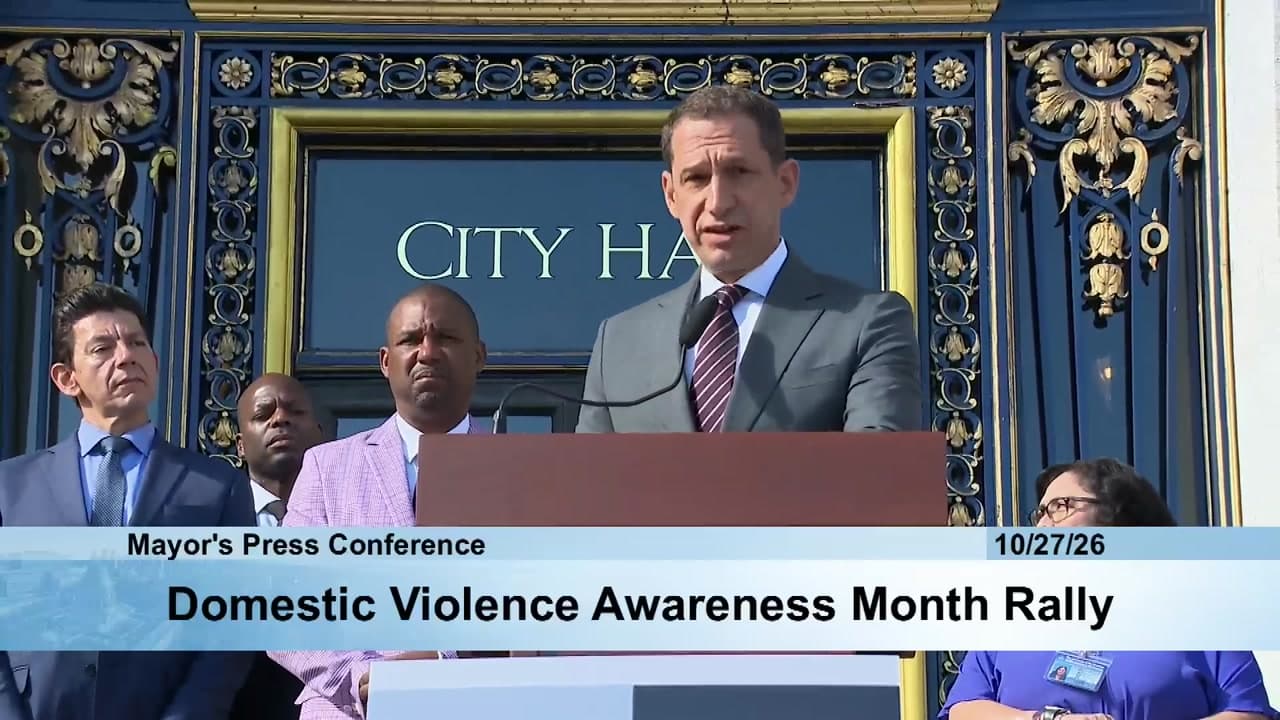
Advocates Press for Lasting Funding as City Leaders Rally for Survivors
Mayor's Press Conference • San FranciscoOctober 27, 2026
Locunity is an independent informational service and is not an official government page for this commission. All information is sourced from public footage and an analysis of official agendas with the aid of responsible, fact-checked AI. to report an error or omission.
At a Domestic Violence Awareness Month rally at City Hall on Oct. 27, 2026, Mayor Daniel Lurie listed millions in city spending on survivor housing and services. The head of his own Office of Victims' Rights then asked where the rest of the money is. No votes were taken, but the event showed where budget pressure is likely to come from: multi-year staffing for domestic violence services and city matching funds for a state right-to-counsel pilot.
- Advocates demand multi-year domestic violence funding, plus a city match for a $1.5M state right-to-counsel pilot
- Lurie cites $15M for the SafeHouse project, 400 rapid rehousing slots and 245 hotel vouchers
- New state law AB 1877 allows felony charges for protective order violations in high-risk cases
- Supervisors pledge language access, and the city attorney ties the sanctuary lawsuit to immigrant survivors
- A survivor and an SFPD commander share their stories, as speakers honor Beverly Upton and remember Ann Mannix
The Money Is Real. So Is the Gap.
Why it matters: City leaders agreed on the goal at the rally. The open question is whether services get stable, long-term budgets or stay on short funding cycles that advocates say leave programs understaffed.
Where things stand: Lurie said San Francisco dedicates more than $10M a year to gender-based violence prevention and intervention, and nearly $30M to transitional housing and services. He pointed to the SafeHouse project as a capital win.
“The city just awarded $15 million for this project,” said Lurie. He said the remaining funding gap was closed with help from Assemblymember Catherine Stefani and Speaker Emerita Nancy Pelosi.
He added that the city has funded 400 additional rapid rehousing slots and 245 emergency hotel vouchers over the past year. He also said the city is working with SFPD to strengthen investigations.
Supervisor Myrna Melgar framed the moment as a promise that needs renewing. “We must recommit to our promise to invest in prevention, in survivor support, in education, legal counsel, housing, housing protections,” said Melgar.
The other side: The sharpest push came from inside the administration. Ivy Lee, Director, Mayor's Office of Victims' Rights, argued the sector is chronically underfunded.
“This work, you've heard it over and over again, is valuable, but it is not valued,” said Lee.
She urged the city to fund and staff domestic violence services over the long term, as it does public safety positions, rather than on a two-year cycle. She then made a specific ask. “There's a right to counsel. We have $1.5 million from the state,” said Lee, before adding: “Where is the matching money? Let's do this today.” No official answered the question at the event.
Sheriff Miyamoto echoed her. “The only way we do this work is through funding and through support,” said Miyamoto. He noted that a retired volunteer works unpaid in the Sheriff's Survivor Restoration Project, a sign of how thin staffing can run.
Supervisor Stephen Sherrill, Supervisor, District 2, argued that prevention gets too little attention in public safety debates. “The care and the prevention resources that don't hit the front pages of the papers every day are what moves the needle,” said Sherrill. Board President Rafael Mandelman also tied the month's recognition to budgets and services.
Decisions and stakeholder impacts: No budget action was taken. Survivors gain from the housing capacity Lurie described. Nonprofit providers and legal clinics are pressing for staffing stability and the right-to-counsel match. The Board of Supervisors, which shares control of the budget with the mayor, heard several members link recognition to resources. That gives advocates a record to point to later.
What's next: Watch for whether the city identifies matching funds for the $1.5M state right-to-counsel pilot. No timeline was announced.
Survivors and Responders Put Faces on the Issue
Why it matters: The personal accounts anchored the event's “Surviving to Thriving” theme and reminded officials that the stakes are often life and death.
Where things stand: Survivor Jordana Cahen described severe abuse and said her ex-partner was convicted and sentenced to life. She thanked SFPD, the District Attorney's Office and Shalom Bayit. She said she survived “because prosecutors, police officers, advocates, and complete strangers stood up for me,” in the words of Cahen.
Commander McCray of SFPD recounted how her brother's abuse of his wife led to the 1997 court decision People v. McCray. “Every victim, every survivor deserves to be heard, believed, to be taken seriously, and treated with dignity and respect,” said McCray.
City Attorney David Chiu and Beverly Upton, Executive Director, San Francisco Domestic Violence Consortium, remembered former SFPD Captain Ann Mannix, who a speaker said was shot in her home. Chiu cited a newspaper report finding that “57% of women who are homeless are in part homeless because of an experience with domestic violence.”
The rally also served as a send-off for Upton, a retiring leader of the consortium. Mandelman said the Board will honor her on Dec. 10. Sherrill joked that he would oppose the honor to keep her from retiring.
Decisions and stakeholder impacts: The roster showed how broad the coalition is. Speakers included Karima Baptiste, Chief, Victim Services Division, San Francisco District Attorney's Office; Dr. Diana Arroche, Executive Director, San Francisco Department on the Status of Women; and Sandra Machado, Crisis Case Manager, Survivor Restoration Program, San Francisco Sheriff's Office. Arroche set the most ambitious goal of the day: “Let's impact the next 7 generations so we have zero domestic violence cases, zero sexual assault cases.”
Language Access and Immigrant Survivors
Why it matters: Officials said language barriers and fear of deportation keep some survivors from seeking help. That makes culturally competent services a matter of access, not just outreach.
Where things stand: Supervisor Chin said 70% of domestic violence victims are women. She described the language barriers, financial hardship and fear of judgment survivors face.
Supervisor Connie Chan, speaking partly in Cantonese, said the city has committed to language and cultural competency. She said survivors will be believed regardless of income, immigration status or gender identity. “We will provide the resources and we will provide the support day one, not 10 days later, not when we actually have the evidence,” said Chan.
Chiu connected the city's lawsuit challenging the Trump administration's attacks on sanctuary cities to immigrant women who fear SFPD might deport them. “If you are the victim of abuse, regardless of your immigration status, we will hug you, we will take care of you, and we will prosecute your perpetrator,” said Chiu.
Decisions and stakeholder impacts: No policy changes were announced. The pledges matter most to immigrant, limited-English and low-income survivors. They also signal that the city's sanctuary litigation has stakes for victim services as well as immigration enforcement.
AB 1877 Strengthens Protective Orders
The basics: A protective order is a court order restricting an abuser's contact with a victim.
Where things stand: Lurie said AB 1877 allows prosecutors to charge violations of protective orders as felonies in high-risk cases. He said he stood with Stefani earlier in the month to celebrate its passage and thanked Gov. Gavin Newsom for signing it. Melgar and Machado also credited Stefani, and Machado honored Melgar and Upton for their roles.
What's next: No effective date or implementation details were shared at the event.
Minor Items
- Melgar is introducing the Board's annual resolution declaring October Domestic Violence Awareness Month. Adoption has not been reported.
- Naomi Tucker of Shalom Bayit highlighted the group's three decades of domestic violence services as a consortium member agency.
- Emberly Cross, Coordinating Attorney, Cooperative Restraining Order Clinic, thanked officials for funding expert domestic violence legal services.
- Supervisor Walton said awareness matters because there are “too many people who are living in fear.”
Looking ahead: The Board of Supervisors will honor Beverly Upton on Dec. 10. Advocates will be watching whether the city answers Lee's call for right-to-counsel matching funds.