Sunset Boulevard Greenbelt Heads Off Drinking Water With $1M State Grant
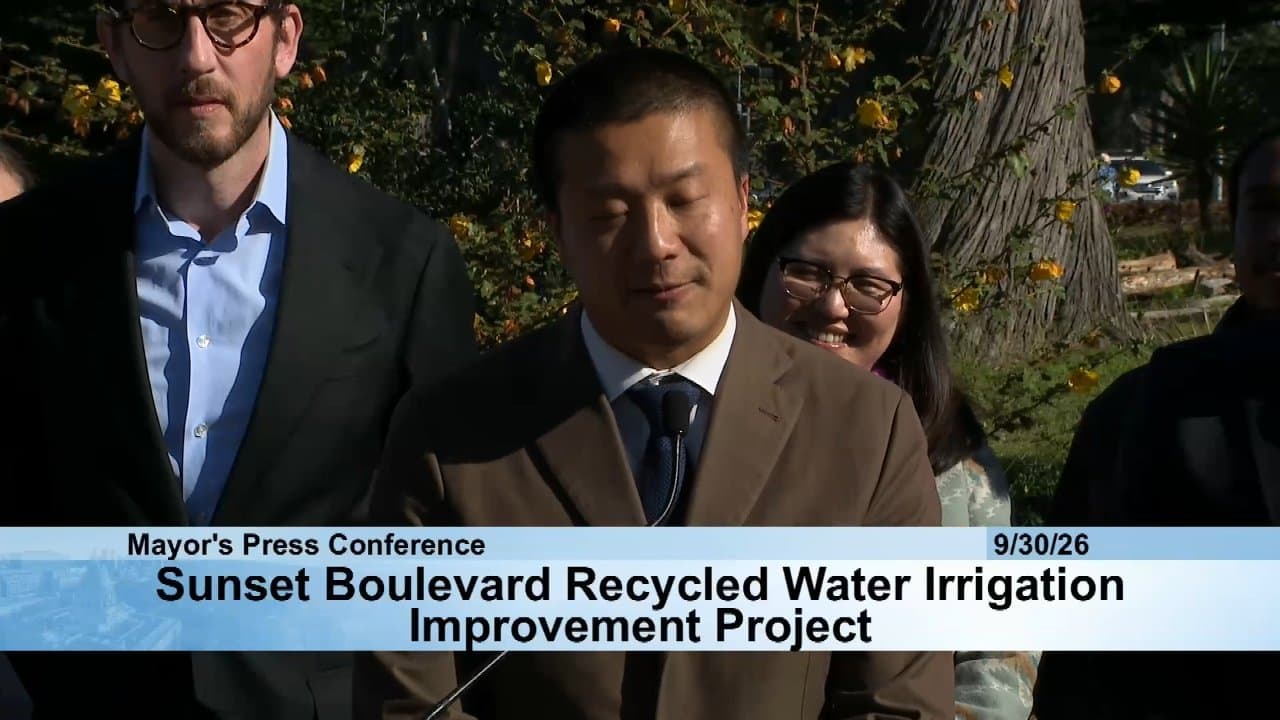
Mayor's Press Conference • San FranciscoSeptember 30, 2026
Locunity is an independent informational service and is not an official government page for this commission. All information is sourced from public footage and an analysis of official agendas with the aid of responsible, fact-checked AI. to report an error or omission.
San Francisco is moving to stop watering roughly 60 acres of Sunset Boulevard's medians and roadside green space with drinking water. At a Sept. 30, 2026, press conference, Mayor Daniel Lurie, Supervisor, District 4 Alan Wong, State Senator Scott Wiener and Public Works Director Carla Short celebrated a newly signed resolution that lets the city accept up to $1M in state funds to switch the greenbelt to recycled water. The money is approved, but the shovels aren't scheduled yet.
- $1M state grant will convert Sunset Boulevard irrigation from drinking water to recycled water
- Project expected to save about 40 million gallons of drinking water a year
- Resolution approved and signed, and it now heads to the State Water Resources Control Board
- No construction date yet, and Public Works says one is coming "shortly"
- Officials frame the westside project as drought prep and neighborhood-level climate action
1 Big Thing: Sunset Greenbelt Goes Recycled
The basics: The Sunset Boulevard greenbelt runs between Golden Gate Park and Lake Merced. It covers about 60 acres of landscaped medians and roadside green space, and it has long been irrigated with potable (drinking) water.
Why it matters: When water supplies tighten, drinking-water landscaping loses priority, and the greenbelt suffers. Moving to recycled water keeps the boulevard green in dry years and frees an estimated 40 million gallons of potable water annually.
"For years, keeping this greenbelt healthy has become harder during droughts. The irrigation system relies on drinking water, as the supervisor said," said Mayor Daniel Lurie.
Where things stand: Supervisor Wong carried the legislation authorizing San Francisco Public Works to accept and spend the grant. The Board of Supervisors approved the resolution the prior week, and Mayor Lurie signed it the preceding Friday. No action was taken at the press event itself.
"That is why I was proud to advance the legislation authorizing Public Works to accept and expend up to $1 million in state funding for the Sunset Boulevard Recycled Water Irrigation Improvement Project," said Wong.
The deal is straightforward. State Senator Scott Wiener secured the $1M in the state budget, and the California State Water Resources Control Board administers it. Wiener called the project "very important" and "long overdue."
Scope: Public Works Director Carla Short said the project reuses existing infrastructure rather than rebuilding it.
"The goal of this project is to connect that existing irrigation infrastructure to San Francisco's recycled water system, and eliminate the potable water irrigation connections serving the project area," said Short.
Decisions and stakeholder impacts: The main beneficiaries are Sunset and westside residents who use the boulevard daily. The city's drinking-water supply also gains, because it no longer has to cover landscaping. Speakers credited Friends of Sunset Boulevard and neighbors for years of advocacy that kept the project alive. Public Works takes on the implementation work, including grant compliance and eventual construction. No public comment was taken at the event.
What's next: The signed resolution goes to the State Water Resources Control Board. Public Works will coordinate on grant requirements and complete several administrative steps before construction begins.
"I don't wanna announce a date today, but we will be doing so shortly," said Short.
Drought Prep as Local Climate Policy
Why it matters: Officials used a $1M irrigation fix to stake out a broader principle: drinking water shouldn't go on landscaping. That stance could shape future city landscaping and water decisions well beyond Sunset Boulevard.
"And particularly when it comes to irrigation, we should never be using potable water. That should be recycled water," said State Senator Scott Wiener.
Where things stand: Mayor Lurie folded the project into his administration's push to keep streets paved, medians clean and neighborhoods visibly maintained. He argued the city should act before the next dry spell.
"We know that California will face droughts again. We should prepare for them now instead of waiting until the next one arrives," said Lurie.
Wiener took a more pointed national tone. He praised parks and open space as a quality-of-life asset in a dense city and cast neighborhood projects like trees, green space and habitat as frontline climate work.
"We know that climate change is real. It's not a hoax like the president says," said Wiener. He added, "But so much of climate action happens at the local level, at the neighborhood level."
The biodiversity angle: Short said Public Works is implementing a biodiversity master plan along Sunset Boulevard. She said the new infrastructure will let the department responsibly water new plants and trees there. She also credited Wiener for about a decade of work on San Francisco's trees.
Decisions and stakeholder impacts: Supervisor Wong framed the effort as a model of state money, City Hall action and department delivery working together. He said he wants to continue that kind of practical infrastructure investment across District 4. For westside advocates, the signal is clear: water-smart greening now has backing from City Hall, the Board and the state.
Looking Ahead
Watch for Public Works to announce a construction schedule once the State Water Resources Control Board processes the signed resolution. Residents and Friends of Sunset Boulevard supporters can ask District 4's office and Public Works how the biodiversity master plan plantings will be phased alongside the irrigation conversion.