
Martinez Council Leans Toward Restoring Alhambra Bike Lanes, Pauses $75K Study
City Council • MartinezNovember 4, 2026
Locunity is an independent informational service and is not an official government page for this commission. All information is sourced from public footage and an analysis of official agendas with the aid of responsible, fact-checked AI. to report an error or omission.
Families on bikes filled the Nov. 4, 2026, Martinez City Council meeting to protest a quiet swap of Alhambra Avenue's bike lane for painted sharrows. Council members signaled they would trade parking for safety, though they took no vote, and told staff to hold a proposed $75,000 study until the next meeting. The council also started the city's state-mandated immigration policy process, approved a 3.05% trash rate increase and pressed the county hospital to enforce its staff parking rules.
- Alhambra Avenue bike lane: Council favors safety over parking and freezes the $75,000 study until the next meeting.
- SB 580 model policies head to the Diversity and Cultural Commission on Nov. 17; council action is set for Dec. 16.
- Trash rates rise 3.05% on Jan. 1, 2027, after a 5-0 vote.
- Council tells the $173M hospital project that parking reminders are not enough.
- Downtown lighting upgrades will cost the city little but lack a PG&E date.
Alhambra Bike Lane Fight Puts Parking in Play
The basics: Repaving on Alhambra Avenue moved faster than the countywide smart signal project. The paving damaged loop detectors, the in-pavement sensors that time traffic signals. North of F Street, staff replaced a substandard 4-foot Class 2 bike lane with shared lane markings, or "sharrows," after the city's risk pool warned that keeping the narrow lane would create liability.
Where things stand: "The substandard bicycle lane was therefore replaced with shared lane markings, or sharrows," said Public Works Director and City Engineer Joe Enke. County Connection had asked for 11-foot travel lanes. Staff proposed a $75,000 traffic and bike study. The options include removing roughly 40 parking spaces for a buffered bike lane or a road diet that reduces travel lanes. Staff said sharrows comply with SB 1216 because the posted speed limit is 30 mph.
Why it matters: Alhambra connects neighborhoods and schools to downtown. Commenters framed the change as a direct safety risk to families. "This is a choice between protecting parking or protecting human life. Please choose human life," said public commenter Emily Warming.
Organized pushback: Bike East Bay Advocacy Manager Danny Canis opposed both the substandard lane and the sharrows. He cited a lawsuit against the city of Indian Wells: "The case went to trial and the jury decided against the city, which was forced to pay $5.8 million." Public commenter Gus Chakala, a civil engineer and parent, backed restoring Class 2 lanes in two short, constrained sections, at a cost of fewer than a dozen parking spaces. Public commenter Katie Masterman asked the council to make the road diet the first option and offered volunteer help to lower the study's cost. Advanced Mobility Group Active Transportation Program Manager Kara DeYoung said the group's Walk and Roll program reaches about 2,000 students at all five elementary schools. "We also know that 50% of parents identify safety concerns as their biggest barrier to letting their children walk or bike," she said.
The other side: Public commenter Greg Johnson said he supports safety but warned against losing parking and travel lanes. "Creating a one-lane road with all the infrastructure we have downtown is only going to slow it and actually make it more congested for everybody getting to town," he said.
Decisions and stakeholder impacts: Council members criticized the process more than the outcome. "There's a failure to anticipate, a failure to plan, and a failure to communicate," said Vice Mayor Satinder Malhi, who opposed an expensive study. "If I'm being given the choice of parking or bicycle safety, I'm going to come on the side of bicycle safety," he added. Councilmember Jay Howard said, "I think we have to rethink this, anchored in safety."
Mayor Brianne Zorn asked, "Why didn't you spend seventy-five thousand for public outreach and a traffic study to remove the bike lane in the first place?" Enke acknowledged, "I definitely should have been aware of it sooner." Zorn also asked whether existing Advanced Mobility Group work on vulnerable road users could take on the study. She insisted that every affected neighbor receive a letter or phone call before any parking is removed.
What's next: "I would like to respectfully ask that you do not start spending $75,000 until after the next meeting," Zorn said. The item returns at that meeting.
SB 580 Policy Heads to Commission
Why it matters: "Every city must adopt the policies or their equivalent by January 1st of next year," said the Chief of Police. SB 580 requires cities to adopt policies governing how their facilities and staff interact with immigration enforcement. Staff recommended adopting the state attorney general's model policies.
Where things stand: The proposed schedule runs as follows: Diversity and Cultural Commission review on Nov. 17, a council resolution and administrative policy on Dec. 16, department procedures by Feb. 28 and training by March 31. The policy builds on the city's 2017 Resolution 025-17 and police Policy 418. It covers non-public areas of city property, warrant requirements, limits on collecting and sharing personal information, and vendor protections. It does not apply to private residences. "It's not a magic bullet," the chief said.
Zorn asked whether the 2017 resolution needs updating. "There's no need to change it," the chief replied. She also raised whether the city should evaluate the "sanctuary" label. Councilmember Debbie McKillop said, "I would like to get moving on this and have it go to the Diversity and Cultural Commission." Malhi also voiced support.
The other side: Most commenters welcomed the move but wanted more. Public commenter Chappie Daviakin argued the attorney general's guidelines cover automated license plate reader vendors. The chief said the city operates no Flock cameras and that state law already bars sharing license plate data. Public commenter Linda Olvera asked, "How is all this going to be enforced?" The chief said violations would be enforceable under civil service rules. Public commenter Ishan called the presentation "more like a checkbox than rather a city who cares about their immigration population." Public commenter Rebecca Kenny asked that residents get more than three minutes to speak at the commission. Another commenter urged caution: "A nation is full of laws for a reason."
What's next: The chief said the commission chair would allow flexible dialogue on Nov. 17. Council action follows on Dec. 16.
Council to Hospital: Enforce Staff Parking
Where things stand: David Culberson, CEO of Contra Costa Regional Medical Center, outlined the seismic rebuild. "It's about $173 million, and we do have to have it completed by the end of December 2029 in accordance with state laws," he said. A new three-story building will replace food service and administration and add fire sprinklers, elevators, and backup power and water. Cafeteria demolition was set to begin the following week, with Ward E demolition in March. Construction hours run 7 a.m. to 5 p.m.
Why it matters: The hospital moved 60 staff to the off-site Marina and Summit lots, but council members said those lots sit underused while staff park in surrounding neighborhoods. "I think reminding is probably not strong enough," said Zorn. She suggested parking passes for residents, citations for everyone else and help from the police chief. Malhi said "reminders by themselves, I believe, are insufficient."
Decisions and stakeholder impacts: "I don't have any specifics tonight," Culberson said. He mentioned a possible summer agreement to use the school district's student lot. During general public comment, public commenter Richard Anderson urged residential permit parking around the hospital.
What's next: Culberson agreed to return to the council. Zorn suggested January.
Trash Rates Rise 3.05% in 2027
Where things stand: Senior Management Analyst Steve Devine explained the formula behind the Republic Services increase. The August-over-August Consumer Price Index rose 3.39%, and a 90% limiter in the contract trims that to 3.05%. The formula follows a 2024 base-year reset and a franchise extension through Dec. 31, 2027. Martinez rates remain below the average of 17 neighboring cities and the 69-city Bay Area average. Pleasant Hill expects a 4.77% increase.
Why it matters: Maximum rates rise for every residential and commercial customer on Jan. 1, 2027. Meanwhile, Zorn and Councilmember Greg Young sit on an ad hoc subcommittee negotiating the next franchise agreement.
Decisions and stakeholder impacts: McKillop called it "a modest rate increase and it's been a while." Council members asked staff and Republic to publicize included services, such as on-call pickups, in newsletters and rate notices. Republic representatives said they would look into it. No one spoke during the public hearing. The resolution passed (For: 5 — Zorn, Malhi, Howard, Young, McKillop; Against: 0; Absent: 0).
Downtown Lights Wait on PG&E
Where things stand: A Tanko Lighting consultant presented Phase 1 of the downtown lighting plan. PG&E would upgrade existing fixtures on Court, Ward and Green streets and other streets feeding Main Street to 39-watt and 49-watt LEDs. It would also add about four new lights on existing poles. PG&E pays for the work and recovers the cost through rates. The project sits in the five-year capital improvement plan with $200,000 from the parking fund, and spending so far is well below that amount.
The city first asked PG&E to finish by Halloween, then by Thanksgiving. "But we do not have a firm commitment yet from PG&E," city staff said.
The other side: Malhi pushed back on treating Main Street as adequately lit, citing merchant feedback gathered through Downtown Martinez. Zorn asked about Lot 4. Staff said lights in city-owned parking lots could be upgraded. Extending festoon lighting, the strung overhead lights, to cross streets would require new mid-block poles.
What's next: Staff will evaluate Phase 1. A workshop with the council, public and merchants will follow to shape Phase 2.
- Consent calendar passed (For: 5, Against: 0, Absent: 0). It includes Ordinance No. 1491 on Planning and Cemetery Commission rules, Ordinance No. 1492 on group homes and the LIUNA Local 324 side letter. Public commenter Craig praised Ordinance No. 1492 and urged the city to prioritize facilitating group homes.
- Free downtown meter parking runs Nov. 26 to Jan. 4 and covers all meters.
- First-quarter finances: The adopted budget projected a $2.2M general fund deficit. Overtime has reached $354,600, or 38.1% of budget, against a 25% quarterly benchmark. Malhi flagged the trend. No budget adjustments were proposed.
- 911 dispatch strain: The police chief said the city had to temporarily reroute 911 calls because no dispatchers were available. He plans to ask the council to make an overhire position permanent.
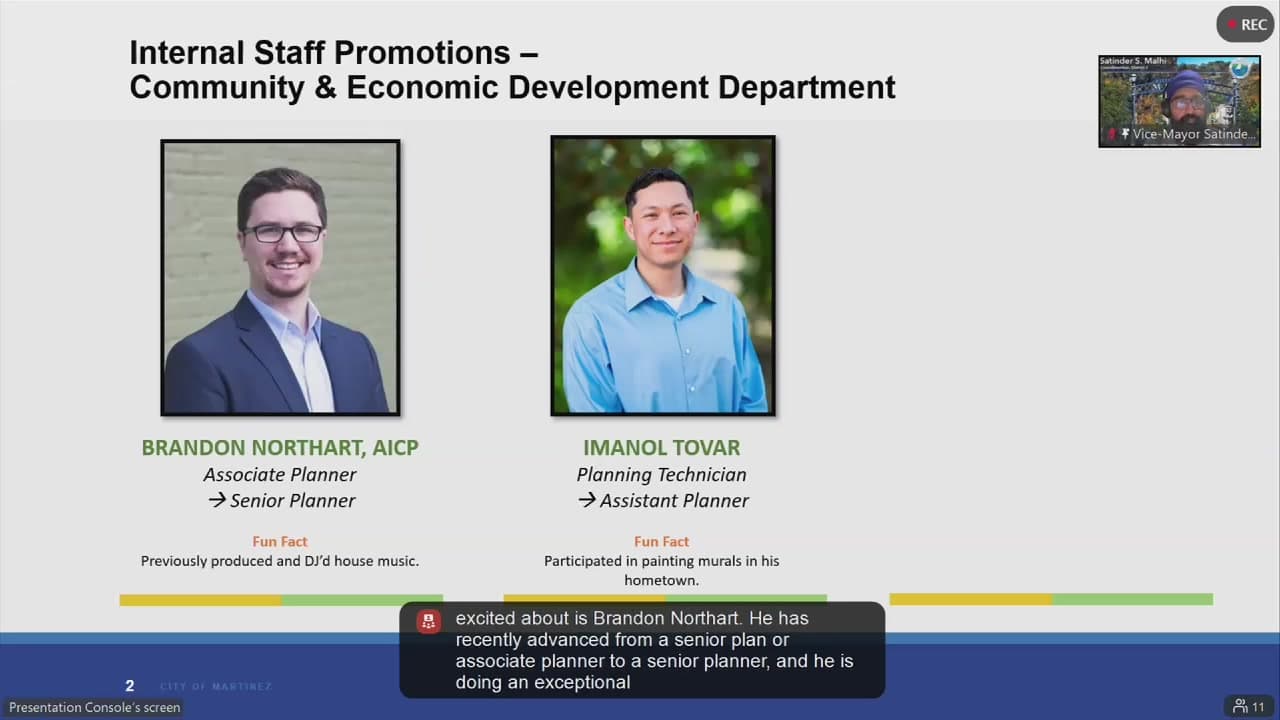
- Proclamation and new hires: Zorn proclaimed November 2026 Native American Heritage Month. Planning staff introduced two new hires and two promotions.
Looking ahead: The Alhambra Avenue item returns at the next council meeting. The Diversity and Cultural Commission reviews the SB 580 policy on Nov. 17, and the council takes it up on Dec. 16. The city's audit runs Nov. 9 to 25, the annual financial report arrives in January and the mid-year budget review is set for Feb. 3. The hospital is expected back in January. Veterans Day ceremonies are on Nov. 11.