
Housing Trust Requests Outstrip $18M as Marin Rethinks the Rules
Board of Supervisors • Marin CountyNovember 3, 2026
Locunity is an independent informational service and is not an official government page for this commission. All information is sourced from public footage and an analysis of official agendas with the aid of responsible, fact-checked AI. to report an error or omission.
Marin County's Housing Trust Fund holds more than $18 million, and the requests on the table already exceed it, led by the largest single ask in the fund's history. At a marathon workshop Tuesday, supervisors told staff how to rewrite the fund's rules before they expire in 2027. The same meeting brought a stark warning from the National Weather Service about winter flooding, a new equity grant pilot, approval of an accessible waterfall trail and pointed testimony about ICE activity at the county jail.
- Housing Trust Fund rewrite: supervisors favor speed, preservation and ownership as requests top $18M
- Coastal flooding is all but guaranteed this winter, forecasters say, after January's $5M-plus losses
- $342,000 Economic Opportunity Grant Pilot approved for low-income entrepreneurs and career changers
- Buck Gulch Falls trail and creek restoration approved 5-0 with strong disability-advocate support
- Immigrant-rights observers allege ICE force at county jail; urgency ordinance set for Nov. 10
Housing Trust Fund: Too Many Projects, Not Enough Money
The basics: The Housing Trust Fund is the county's local gap-financing pool for affordable housing. It often supplies the early dollars that make projects competitive for state funding and tax credits. Its 2023 guidelines split money 25% to preservation and 75% to new construction, generally at $50,000 to $100,000 per unit, and they expire in 2027.
Why it matters: Since 2015, the trust has committed about $64M across 956 units. Pending requests include $16M for 192 units at 1100 Los Gamos Drive in San Rafael, about $5.5M for Community Land Trust Association of West Marin (CLAM) scattered sites, $2.8M from Homeward Bound and $6M for Oak Hill. Those decisions will come before new guidelines or the county's strategic plan are in place.
Where things stand: "So there is no decision before the board today," said Community Development Director Sarah Jones. Housing Director Leili Thomas flagged a pipeline problem: "about $29 million has been committed to projects but not yet spent." On the preservation-versus-construction debate, she said, "I don't think it's an either/or. I think it's an and."
Supervisors each pressed a different lever:
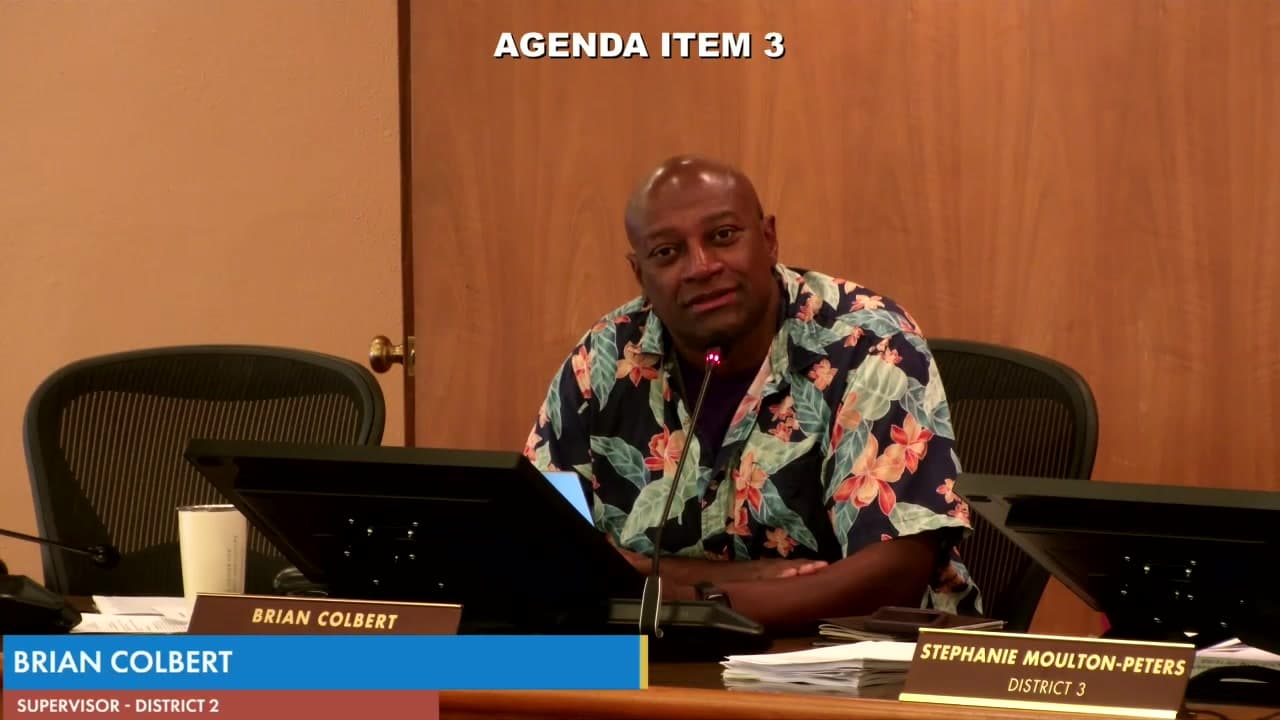
"Affordable housing is frankly a portfolio play," said Supervisor Brian Colbert, District 2, who wants a clearer view of unspent commitments and sharper signals to developers.
"I don't think that our housing trust fund dollars should get ahead of another jurisdiction's planning process," said Supervisor Mary Sackett, District 1, who wants community engagement before the county funds city projects.
"I do think that our allocation of $50,000 to $100,000 per unit probably needs to be looked at or revised just in light of what costs are," said Supervisor Stephanie Moulton-Peters, District 3. She also cited geographic parity and the state's Prop 1 housing bond.
Supervisor Dennis Rodoni, District 4, stressed data and preservation and said "prioritizing projects that are shovel-ready makes sense." He floated extending the county's $5M annual commitment to 2032. "Preservation is really key," said Board President Eric Lucan, who also backed conditional commitments, time limits and homeownership.
The other side: Most public commenters pushed back against rationing and against favoring unincorporated areas. "I really wanted to challenge the premise that we need to ration the Affordable Housing Trust Fund," said Jenny Silva, executive director of CalMarin Home. Urban Carmel, speaking for the City of Mill Valley, said the city's Hamilton Drive project is entitled and 70% funded but still lost on state scoring. "If you were to increase that to about $70,000 per unit, you would increase that total amount to $3 million," he said. Sausalito Mayor Stephen Woodside said voter-approved Measure K opens the door to 81 affordable units, and the city can offer land but has limited funds.
Decisions and stakeholder impacts: Cities, Homeward Bound, the Marin Organizing Committee, Habitat for Humanity, Canal Alliance, Legal Aid of Marin and CLAM all urged countywide eligibility and flexibility. Los Gamos developer Community Development Partners asked for an early commitment so it can chase entitlements and tax credits. County Executive Derek Johnson urged supervisors to "think about housing more holistically" and to weigh cost-effectiveness. The Board voted by voice to receive the report; no tally was announced.
What's next: Staff expect to return to the Board several times with draft guidelines.
Flood Season: 'El Niño Is Not a Storm'
Why it matters: January's King Tide pushed water to about 8.5 to 8.7 feet against a predicted 7 or so. Roughly 200 homes and 100 vehicles were hit. "We saw just over $5 million worth of loss," said Steven Torrence, director of the Marin County Office of Emergency Management.
Where things stand: Torrence outlined the fixes. They include faster alerts, an alerting agreement with 40 partners, a new emergency operations plan, a $3M winter preparedness investment and an activated Emergency Operations Center. A Nov. 18 tabletop exercise is planned with more than 240 participants. Two gaps remain open: Caltrans has not signed off on proactive highway closures, and AT&T gave a vague response about its San Rafael hub, which was linked to January's 911 outage.
"El Niño is not a storm," said Lamont Bain, a meteorologist with the National Weather Service. He said the odds favor above-normal rain and that coastal flooding is a guarantee. He named the riskiest windows: "the week of Thanksgiving, the week of Christmas, and then the week of MLK Jr. Day."
Decisions and stakeholder impacts: Supervisors asked about message specificity, Small Business Administration loans, neighborhood sandbagging and unhoused residents. Johnson said criteria for opening severe-weather shelters would be more generous this year. Felicia Gaston of Rise Marin asked the county to help supply outage kits, at about $103 each, to roughly 1,000 low-income households. The report was received 5-0 (For: 5, Against: 0).
What's next: Residents can expect clearer flood alerts and possible proactive highway closures, pending Caltrans agreement.
Equity Grants Target 'Last-Mile' Business Costs
The basics: The Office of Equity's new pilot offers "one-time flexible funding of up to $10,000 to start, formalize, or expand a microbusiness, and up to $1,000 to enter into a new career pathway," said Gary Besser, project manager. It is aimed at residents shut out of loans, student aid or workforce funds because of collateral, documentation status or income rules.
Where things stand: The money comes from two sources. "It's about $267,000 from the REAP funding," said Jamila Jordan, lead for the Office of Equity, referring to the Race Equity Action Plan. Another $75,000 in Parks fair funding is set aside for food businesses, for about $342,000 total. The pilot builds on the Microenterprise Support Program, which has trained more than 150 people, and on a home-kitchen pilot run with MECO. Many graduates still cannot cover licensing and equipment costs.
The other side: Colbert pressed for outcome measures tied to income, not paperwork. "Getting a license is not actually the same for a meaningful impact in somebody's life," he said. Moulton-Peters suggested "we could extend this to a 5-year program." Lucan floated Civic Center vending: "Maybe there's also an opportunity for them to vend to our workforce folks."
Decisions and stakeholder impacts: Colbert moved and Moulton-Peters seconded. The motion passed by voice with none opposed; no tally was announced. Rise Marin and Canal Alliance offered to serve as partners.
What's next: Applications open in December. Awards run from February to June 2027, with follow-ups at six, 12, 18 and 24 months and a report back in summer 2028.
Buck Gulch Falls Gets Bridges and Better Access
Why it matters: The waterfall's popularity in Novato's Ignacio Valley Preserve has caused trampling, erosion and unsafe creek crossings. Sitting as the Open Space District board, supervisors approved two pedestrian bridges, measuring 55 and 30 feet. The project also adds a 5-foot compacted trail surface, a viewing platform, native revegetation and streambank restoration. It applies the district's 2016 Inclusive Access Plan.
Where things stand: Staff received 68 comments on the environmental document and "opted for minor trail realignments," said John Campo, conservation science program manager. Disability advocates led the support, including Saskia Kramer-Wong of United Cerebral Palsy of the North Bay's Booth School, Dr. Colleen Arnold and county ADA coordinator Laney Davidson. Arnold called out ableism she said surfaced at an earlier Novato meeting. "MCL supports this project to protect and enhance riparian habitat," said Rebecca Schwartz-Lesberg, executive director of Marin Conservation League.
The other side: Bill Long, a neighbor of 55 years, backed the project, saying "the no-project alternative here is just not responsible." He asked for benches and a safe unloading area.
Decisions and stakeholder impacts: The Board adopted the Mitigated Negative Declaration, a finding that environmental impacts can be reduced below significance, on a motion by Sackett, seconded by Rodoni (For: 5, Against: 0). It then approved the project on a motion by Rodoni, seconded by Moulton-Peters (For: 5, Against: 0). Rodoni urged continued dialogue with neighbors.
Observers Allege ICE Escalation at County Jail
Where things stand: Volunteers with the Marin Rapid Response Network used general public comment to describe what they called aggressive ICE tactics. The accounts are allegations, not findings. "On October 20th, you unanimously passed a policy addressing federal immigration enforcement," said public commenter Patty Hoyt. She alleged ICE took people released from court and jail afterward and called the sheriff's reporting duty minimal. A jail observer volunteer alleged agents used gloves that may deliver electric shocks on a 20-year-old.
Amy Blevins, a legal observer with the network, asked the Board to review jail video from Oct. 23 and Oct. 25 and adopt an ICE-free Marin ordinance. "In October, we witnessed 18 more Marin residents taken by ICE with another re-detain," said Lisa Bennett, who runs the network. She said county resources are insufficient.
What's next: Johnson announced funding for service partners. "We will be calendaring an item for next Tuesday for an urgency ordinance as a temporary step for the potential impacts of detention facilities in California," he said. That item is set for Nov. 10.
- Coastal housing rules: Local Coastal Program amendments passed 5-0, remapping 36 Housing Overlay sites and capping coastal heights at 35 feet. They now go to the Coastal Commission.
- Consent calendars: Consent A, Consent B and the Open Space District calendar each passed 5-0, including Santa Venetia levee emergency work.
- Recognition: The county won a Premier award for financial reporting, and Measure B is funding a refresh of 10 library branches.
- Memorials: Supervisors requested memorials for Oak Dowling and Dolores Huerta.
- Dock dispute: A Belvedere Marin Keys resident disputed county enforcement over a recycled dock, and staff will follow up.
Looking ahead: The Board takes up the detention-facility urgency ordinance Nov. 10. The county holds a virtual El Niño town hall Nov. 19. Envision Marin, the first countywide strategic plan in more than 25 years, gets a preview Dec. 15.