
Marin Freezes Detention Facilities 5-0, but Residents Demand ICE-Free Ordinance
Board of Supervisors • Marin CountyNovember 10, 2026
Locunity is an independent informational service and is not an official government page for this commission. All information is sourced from public footage and an analysis of official agendas with the aid of responsible, fact-checked AI. to report an error or omission.
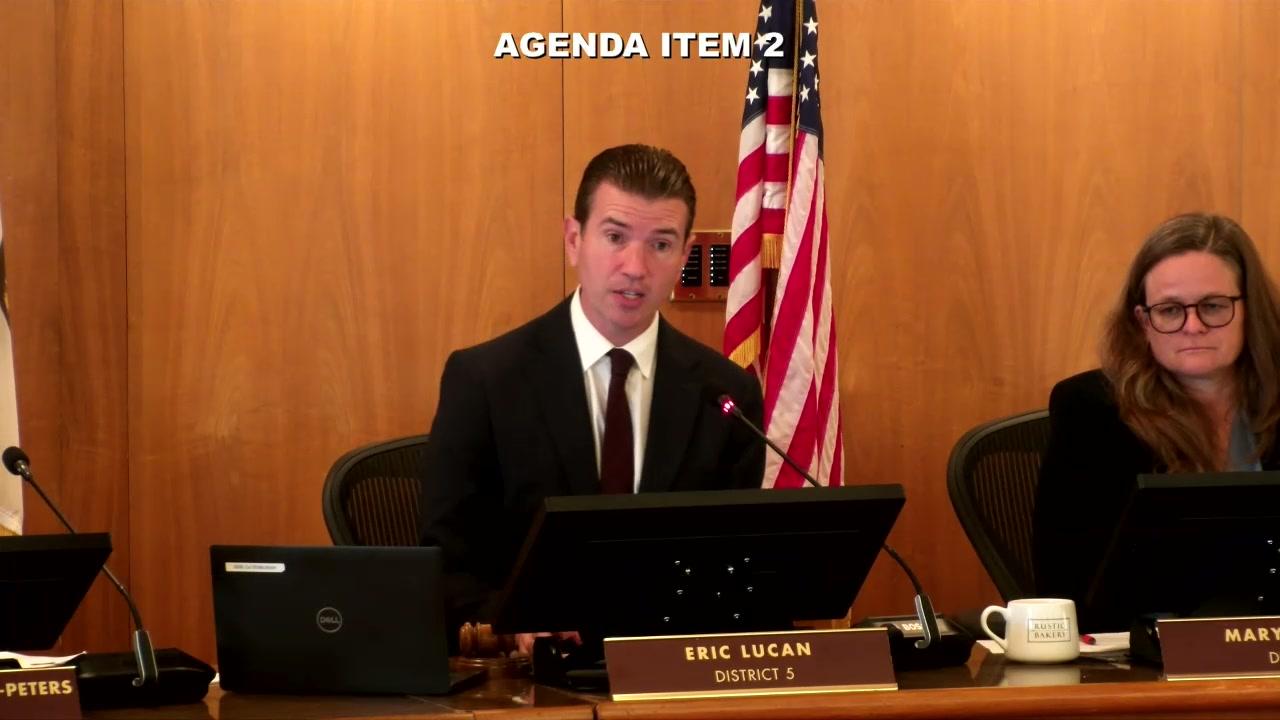
Marin County supervisors moved fast on Nov. 10, 2026, unanimously adopting an urgency moratorium on new detention facilities in unincorporated Marin, even as dozens of speakers said the real threat is ICE activity already happening at the Civic Center and jail. The board also committed $1.5M in one-time money to soften federal H.R. 1 cuts to Medi-Cal and CalFresh, previewed long-awaited septic reforms tied to housing, and approved $1.072 million in community grants.
- Detention-facility moratorium adopted 5-0 for an immediate 45 days; speakers called it no substitute for an enforceable ICE-free ordinance
- $1.5M H.R. 1 response plan approved 5-0; clinic leaders say it is "not enough"
- Septic overhaul previewed for about 6,000 parcels, with a draft due next year
- $1.072 million in community grants approved 5-0, against $6.75M in requests
- Development code updated 5-0 to match state ADU, SB 9 and density bonus laws
A Detention Moratorium, and a Louder Ask
The basics: Under Government Code 65858, counties can adopt an interim urgency ordinance that freezes certain land uses while they update zoning. It takes one reading and a four-fifths vote, and it takes effect immediately.
Why it matters: The ordinance blocks permits for new or expanded detention, correctional and support facilities in unincorporated Marin. Extending it beyond 45 days, for up to two years, requires a public hearing and a staff report.
Where things stand: Staff said existing zoning does not adequately address intensive detention uses. They cited a detention proposal near Gilroy and the strain El Niño preparations are putting on Marin staff. The rule applies only to unincorporated areas, where the board controls zoning. Staff confirmed no detention-center application is pending.
Community Development Director Sarah Jones drew a clear line around the item: "This item is not intended to be a substitute for the action that has been asked of the board regulating ICE activity."
"It is not specific against federal detention facilities, would apply to all detention facilities," said Chief Deputy County Counsel Kate Stanford. County Counsel said it would be enforced to the extent legally feasible.
County Executive Derek Johnson reported that the county had sent a cease-and-desist letter to ICE. He also noted that a new state law, AB 2760, bars law enforcement, including federal agencies, from using wearable electroshock devices starting Jan. 1, 2027.
The organized push: Most of the roughly 100 minutes on this item went to public comment. Speakers from MV Free and No ICE in Marin, Mill Valley Seniors for Peace, Marin DSA, Parent Voices and the Marin Rapid Response Network supported the moratorium. They said the urgency lies elsewhere and cited 18 people taken in 20 days, shock gloves and masked agents. Tammy Edmonson of MV Free and No ICE in Marin said a quarter of ICE detentions occurred on county property.
"There is no current proposal to place a detention center in Marin," said Nancy Miller of Mill Valley Seniors for Peace.
"A policy is open to interpretation. It is not law. An ordinance is," said Joe Powers of Marin DSA, taking aim at the board's Oct. 20 policy.
Speakers asked the board to bar ICE from county property, resources, data and personnel. They also asked it to close the jail booking log, offer free video jail visits and form a community safety task force. David Morgenthaler asked for an independent audit of the Sheriff's license-plate-reader data sharing. Kira Craft, a high school student, described fear and missed school.
The other side: "This proposal is completely performative and totally unneeded," said public commenter James Holmes. He warned that a moratorium could keep detainees farther from lawyers and families.
Decisions and stakeholder impacts: Supervisor, District 4, Dennis Rodoni cited a recommendation from a member of Congress. He said a Bay Area detention center would raise local enforcement numbers. "This is just another step in the process of trying to protect our residents," he said.
The board adopted the ordinance on Rodoni's motion, seconded by Supervisor, District 3, Stephanie Moulton-Peters (For: 5, Against: 0, Absent: 0). County Counsel and Johnson cautioned that the Supremacy Clause, which gives federal law priority over local rules, limits local authority. They noted that Bay Area counties are split between adopting ordinances and resolutions.
What's next: Advocates pledged to return Dec. 8 to press for an ICE-free ordinance.
Septic Reform Is Housing Reform in West Marin
The basics: The county's Local Agency Management Program (LAMP) sets the septic rules that the Regional Water Quality Control Board must approve.
Why it matters: "There are about 6,000 parcels that require septic systems, and we have records for only about 56% of them," said Community Development Agency Assistant Director Chris Chu. Today, a building permit can trigger septic inspections and upgrades costing from tens of thousands of dollars to more than $200,000. Staff said many owners simply work without permits.
Where things stand: In the informational study session, staff previewed several changes:
- Pathways to legalize unpermitted systems
- Incremental repairs
- Fewer inspections for newer systems
- Sizing credits for ADUs and bedrooms
- Standard waivers with an appeal path
- Composting and incinerating toilets where a functioning septic system exists
Financing ideas include a revolving loan concept, judicial validation (a court ruling confirming a funding mechanism is legal) or new state legislation. Federal grants are limited to very low-income owners.
Minimum lot size remains unresolved. "We are still working through with the Water Board how to achieve what they're hoping to achieve in a way that is going to be workable," Jones said.
Public input: Hal Rusick of Two Valleys Community Land Trust argued that in West Marin, septic policy is housing policy. Another speaker urged county tools for community wastewater systems. Others sought composting-toilet options without a septic requirement and help for low-income heirs. Public commenter Kirk Markwell asked the board to "direct the staff to prepare the actual proposed language and conduct at least one public workshop before returning to the Board for approval."
The board's direction: "I do have reservations about point-of-sale inspections," said Supervisor, District 1, Mary Sackett. Board President Eric Lucan called resale triggers "a slippery slope." He also asked staff to study a pilot allowing waterless toilets without septic. Supervisor, District 2, Brian Colbert set the test: "Our objective should be safe, functioning septic systems without creating unnecessary barriers for homeowners, housing, agriculture, or small business."
What's next: No vote was taken. A draft is due next year. Chu stressed that nothing takes effect until the board adopts the rules and the Regional Board approves them.
$1.5M to Blunt Federal Safety-Net Cuts
Why it matters: The county estimates up to 5,200 Marin residents could lose Medi-Cal and about 2,500 could lose CalFresh under H.R. 1. "The county simply cannot backfill the millions of dollars being lost or shifted by the federal government," said Assistant County Executive Dr. Lisa Varhus, who oversees Health and Human Services.
Where things stand: The federal changes are phased. CalFresh work requirements apply now. Medi-Cal work requirements and six-month renewals begin in January. More than 11,000 Medi-Cal members will shift to fee-for-service.
The one-time plan splits $1.5M among three areas: employment and training, support for federally qualified health centers (FQHCs, the community clinics serving low-income patients) and communications. Ahmed Ismail, HHS Chief Assistant Director over Finance, outlined $100,000 to expand employment and training capacity and $500,000 for a broader hub-and-spoke model. The plan adds a CalFresh Workfare option that cuts required hours to about 15 per month, plus a community information exchange.
So far, staff reported 50 CalFresh disenrollments a month, versus 170 projected.
The other side: Clinic leaders backed the plan but called it too small. Pedro Toledo, CEO of Petaluma Health Center, put the risk in numbers: "every 3% drop in Medi-Cal, $5 million less in revenue." Mark Shotwell, CEO of Ritter Center, was blunter: "It ain't enough, right?" Harold Wallace, CEO of Marin City Health and Wellness, asked for help with IT systems and recruitment. Maya Marjanovic of the San Francisco Marin Food Bank offered to partner on Workfare.
Decisions and stakeholder impacts: The board approved the plan on Colbert's motion (For: 5, Against: 0, Absent: 0). Clinics, job seekers facing work rules and immigrant patients stand to benefit most, but the money is one-time.
Grants: $1.072 Million Against $6.75M in Asks
Supervisors approved $900,000 in Community Grants and Investment Program awards and $172,000 for adult and disability services, covering 79 organizations. Each supervisor directs $50,000 in supplemental awards, up to $250,000 total. Strategic Project Manager Amy Gladstone said the county "received, as I said, 200 applications totaling $6.75 million of requests."
Lucan added $16,000 for the Dolly Parton Imagination Library. Jennifer Carter, executive director of Mental Health Advocates of Marin, said last year's grant now supports "at least 7 support groups per week in the county jail." Marin Symphony and Resilient Neighborhoods also sought funding.
The package passed on Sackett's motion, seconded by Rodoni (For: 5, Against: 0, Absent: 0). Staff will clarify the spending-period dates.
Code Catches Up to State Housing Law
The board adopted Title 22 amendments that align the county code with state ADU, JADU, SB 9, SB 35, AB 2011 and density bonus laws. The update replaces the local density bonus ordinance with the state Department of Housing and Community Development's model and adds development agreements.
"We are recommending that we remove a planning permit for ADU permits in order to streamline the ADU review process," said Principal Planner Immanuel Bereket.
Sackett asked what would draw developers to development agreements. Staff answered that they offer certainty and longer-term vesting of entitlements in exchange for negotiated public benefits. Coastal zone rules and CEQA are unaffected.
The Planning Commission had recommended approval unanimously, and no one spoke during public comment. The ordinance passed on Sackett's motion, seconded by Rodoni (For: 5, Against: 0, Absent: 0).
Minor Items
- In memoriam: The board adjourned in memory of Richard Scaff, founder of Designing Accessible Communities and a former Corte Madera mayor.
- Appointments: Adriana Rapkin joins the Disaster and Citizens Corps Council (5-0); Health Council picks are paused pending sunset review (5-0).
- Consent Agenda A (5-0): Routine items included setting Dec. 8 hearings on Recology and Marin Sanitary rate increases.
- Consent Agenda B: Approved without opposition, with CB-1a removed. Sleepy Hollow residents praised the Butterfield Road crosswalk, sought since 2019.
- Water heaters: Colbert said the Air District moved its zero-NOx compliance date to January 2028 and added low-income exemptions.
Looking Ahead
Dec. 8 brings the garbage rate hearings and promised ICE-free ordinance advocacy. Health Council sunset review recommendations are tentatively due in February 2027, and the draft septic rules are expected next year.