
Maplewood Rent Leveling Overhaul With 4% Cap Heads to Introduction
Township Committee • MaplewoodNovember 17, 2026
Locunity is an independent informational service and is not an official government page for this commission. All information is sourced from public footage and an analysis of official agendas with the aid of responsible, fact-checked AI. to report an error or omission.
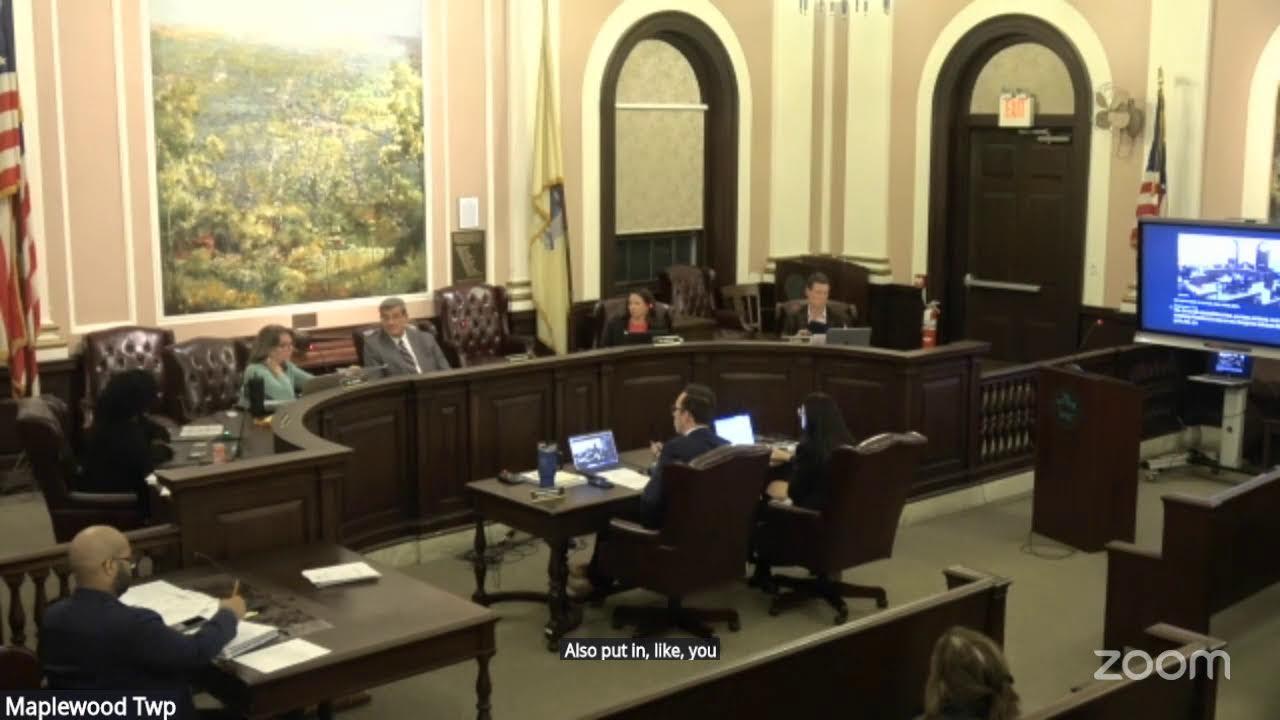
Maplewood's Township Committee spent the longest stretch of its Nov. 16, 2026, meeting on a rewrite of the township's rent leveling law. The proposal would replace today's CPI-based increases with a flat 4% annual cap. No vote was taken, but members agreed to introduce the ordinance at the next meeting, despite pointed questions about a provision that resets rent when a unit turns over.
The committee also adopted Maplewood's first standalone scooter parking permit at $250 a year after a lower-fee amendment failed without a second.
- Rent leveling draft 6 heads to introduction: a 4% annual cap, 2.5% for seniors, and a once-per-five-years vacancy reset
- $250 scooter parking permit adopted 5-0 after a $200 amendment failed for lack of a second
- Health and camp fee increases, some untouched since 2004, are slated for Dec. 1 introduction
A 4% Cap Replaces the CPI Formula
The basics: Rent leveling is Maplewood's form of rent regulation. It limits how much landlords can raise rents on covered units each year.
Why it matters: About a quarter of Maplewood households rent. The draft changes how much their rents can rise and how they get relief when problems arise.
Where things stand: Committee Member Dean Dafis, liaison to the Rent Leveling Board, presented draft number 6 after a year of work. He said the current ordinance has three weaknesses: it ties increases to the CPI, it has no enforcement procedures, and it has drawn two landlord exemption applications.
"It is, however, an important tool municipalities can use to moderate rent increases," said Dafis, framing the ordinance as a moderating tool rather than a cure for unaffordability.
The draft would:
- Cap annual increases at 4%, or 2.5% where a senior is the primary leaseholder
- Cover some single-family and condo rentals owned by corporations or funds
- Allow a vacancy adjustment to fair market rent no more than once every five years
- Expand the Rent Leveling Board from four members to seven
- Place a rent leveling officer within existing clerk's office staff
- Add housing-quality, anti-harassment and cost-shifting protections
- Charge landlords $75 per unit in annual registration
On why the cap is 4%, Dafis pointed to comparable Essex County ordinances and a CPI of around 3.75.
The other side: The vacancy reset drew the sharpest scrutiny. Committee Member Nancy Adams asked whether it could let a vacant apartment's rent jump from $2,200 to about $4,500 a month. Deputy Mayor Malia Herman also questioned the reset and how it would be enforced.
Dafis answered that a reset is conditioned on registration and code compliance. He added that most Essex County towns allow resets every two to three years, more often than Maplewood's proposed five. Mayor Victor De Luca framed the provision around who it protects. "It's a tenant protection, it's not an apartment protection," said De Luca.
Decisions and stakeholder impacts: There was no vote, only consensus to introduce the ordinance. The Mayor acknowledged that differences of opinion remain.
- Tenants would gain a predictable cap and new enforcement tools.
- Seniors would get a lower 2.5% ceiling.
- Corporate and fund owners of single-family homes and condos would come under regulation for the first time.
- Landlords would face registration fees but could reset rent to market rate once every five years.
What's next: The ordinance is expected to be introduced at the Dec. 1 meeting. Dafis will nominate three board members at that meeting to fill the expanded board. The draft's definition of "senior" also needs fixing, because it currently uses both 62 and 65.
Scooter Permit Lands at $250 Despite Pushback
Why it matters: Ordinance 4021-26 creates Maplewood's first standalone scooter parking permit at $250 a year. It also creates a $260 jitney-and-scooter combination pass. The debate pitted climate incentives against cost recovery.
Where things stand: Resident Rob Ballesta opened the hearing with the case for a lower price. He said four scooters fit in one car space, South Orange charges $20, and the township already discounts hybrids and EVs.
"I did want to ask the group to consider a more balanced fee of $100 to $125 rather than $250," said Ballesta, a public commenter.
Adams, who moved adoption, defended the price. She noted that Maplewood's commuter rates are already lower than neighboring towns' and that undercharging shifts costs onto taxpayers. "I still think $250 a year is a pretty nominal amount for all the days that people commute into the city," said Adams.
The other side: Herman preferred $150 to $200 to encourage scooter use. "I think that there is a rate that is lower than what we have introduced, which is $250," said Herman.
Dafis asked how the $250 figure was set. Herman said a resident had proposed it at Engineering. The Mayor compared the fee to the $400 commuter pass, a $150 discount for scooter riders.
Decisions and stakeholder impacts: Herman moved to amend the fee to $200. The amendment failed for lack of a second.
The ordinance then passed on a roll call:
- For: 5 (De Luca, Herman, Dafis, Adams, Collins-Colding)
- Against: 0
- Absent: 0
Herman voted yes despite her objection. Scooter commuters now have a dedicated permit priced well below a car pass, though far above South Orange's.
Health and Camp Fees Get First Update in Years
Why it matters: Some township fees have not changed since 2004. Updating them in 2026 is meant to build revenue into the 2027 budget.
Where things stand: Committee Member Jane Collins-Colding outlined the health department changes:
- Retail food licenses would range from $110 to $360, based on square footage
- Vending machines would be $75
- Childcare licensing would rise from $150 to $200
- Dog and cat fees would also be updated
Repeat reinspections would get more expensive. "The second offense and up will be the full licensing fee," said Collins-Colding.
Recreation fees would rise too. Kids camp, for example, would go from $325 to $375.
The other side: Adams wanted to avoid future multi-decade gaps between updates. "Is there a way we could incorporate, in the ordinance, a 4% annual increase or something from a base?" asked Adams. The township administrator said he can explore the idea. The Mayor cautioned against binding future committees.
What's next: Both fee ordinances are slated for introduction Dec. 1. Food businesses, childcare providers and camp families should expect higher costs.
Minor Items
- Ordinances adopted 5-0: The committee adopted three ordinances with no public comment. They add parking bans on Euclid Avenue and Durant Road, bar parking within 5 feet of driveways on Colgate Road and part of Harvard Avenue, and raise penalties for frequent false alarms.
- Affordable housing ordinance introduced 5-0: Ordinance 4023-26 would expand the Affordable Housing Board and implement the Section 150-23 development fee rules.
- Comcast franchise hearing: Matt Rose, senior manager of government affairs, Comcast, said the franchise expired Sept. 4, 2025, and that Comcast has met its obligations. No residents spoke. The Mayor pressed the company on wires left hanging after service is cut off. The renewal ordinance will come later.
- Proclamations and appointment: The committee proclaimed Transgender Awareness Week and National Family Caregivers Month. It also appointed Christopher Storms to the Recreation Advisory Committee on a 5-0 vote.
- Best practices score: Maplewood scored over 40 of 48 points on the state Department of Community Affairs inventory, above the 34 needed for full state aid.
Looking Ahead
The committee meets next on Tuesday, Dec. 1, 2026. Members agreed to place two resolutions on that agenda:
- Wyoming Avenue speed limit: Herman's resolution urges Essex County to lower the limit from 35 mph. Millburn has asked the county for 25 mph.
- Green Amendment: Adams brought this forward at the Environmental Advisory Committee's request. It supports making a clean and healthy environment a right under New Jersey's constitution.
The Finance Committee also recommended a December ordinance to disband the pool utility, followed by a Saturday budget meeting in February.
Residents can weigh in on the SOMA shuttle survey through Nov. 20.